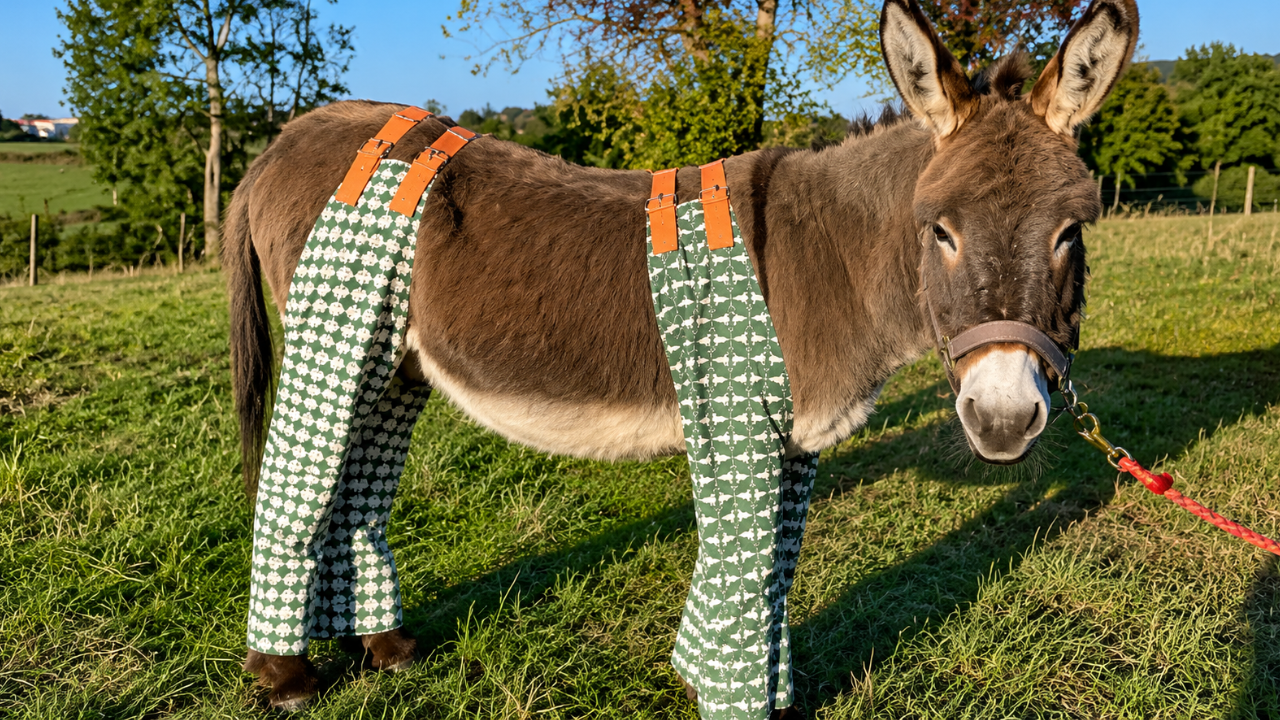
Summers in the UK are getting warmer, and with the heat comes a relentless swarm of biting insects. While humans can slather on repellent or step indoors, farm animals don't have that luxury. Donkeys suffer tremendously from horseflies, midges, and mosquitoes during peak summer months. Flies target their legs, causing painful bites, bleeding, and severe skin irritation.
Sanctuaries and owners across the UK found an unexpectedly simple solution. They put donkeys in custom-fitted pyjamas and patterned dungarees—often dubbed "don-gerees."
It looks like a quirky internet photo op. It isn't. The zebra-striped and lightweight fabric suits serve a crucial biological purpose that protects these animals from intense pain and infections.
Flies Hate Stripes and That Changes Everything
You've probably seen photos of donkeys wearing black-and-white patterned suits and assumed it was just for fun. The design choice is backed by solid scientific research.
Flies navigate using polarized light. Smooth, dark surfaces reflect light in a way that attracts insects, making a donkey's dark coat an easy target. Zebra stripes mess with that visual system. The contrasting pattern confuses the flies' motion detection as they approach. Instead of landing smoothly to bite, they get disoriented, overshoot their target, or fly away entirely.
Researchers from the University of Bristol tested this phenomenon by fitting horses with plain black, plain white, and zebra-patterned coats. The results were clear. Tabanids—commonly known as horseflies—approached all the animals equally, but far fewer managed to land on those wearing stripes. The pattern acts as an optical illusion that disrupts their landing mechanism.
Putting a donkey in zebra-striped pyjamas cuts down fly landings significantly. That means fewer bites, less distress, and zero need for harsh chemical sprays.
Severe Health Risks of Fly Bites on Donkeys
A fly bite on a donkey isn't just a mild itch. It's a real health hazard.
Horseflies have mouthparts designed to slice open skin to feed on blood. These wounds are painful and take time to heal. When flies target a donkey's legs repeatedly, several problems follow:
- Stomping damage. Donkeys stomp their hooves hard to shake off flies. Constant stomping on dry, hard summer ground leads to bruised soles, joint strain, and cracked hooves.
- Open sores and secondary infections. Flies land on existing bites, introducing bacteria that cause stubborn skin infections and tissue damage.
- Sweet itch and allergic reactions. Many donkeys develop hypersensitivity to midge bites, leading to intense itching, hair loss, and raw, bleeding patches along their legs and belly.
- Parasite transmission. Flies carry habronema larvae, which cause unsightly skin lesions known as summer sores.
Standard fly sprays sweat off quickly in high heat. Equine fly rugs work well for horses, but donkeys have different body proportions. They have larger ears, broader necks, and shorter legs. Standard gear doesn't fit them right. Custom dungarees and lightweight pyjamas cover vulnerable areas like legs and underbellies without slipping or rubbing the skin raw.
Why Donkeys Suffer More Than Horses
Donkeys and horses might seem similar on the surface, but their coats and evolutionary backgrounds are very different.
Horses evolved in temperate climates. Their coats produce natural oils that provide a water-resistant barrier against rain and moisture. Donkeys originated from arid, desert environments in North Africa and the Middle East. Their fur lacks those heavy protective oils.
Because donkey hair absorbs water instead of repelling it, their skin is far more vulnerable to dampness, mud, and insect penetration. When insects bite a donkey, the lack of thick oily protection makes the skin react more severely.
Donkeys also handle pain differently than horses. A horse will run, kick, or bolt when bothered by insects. Donkeys are stoic. They freeze, tense up, and internalize stress. A donkey suffering from hundreds of painful fly bites might stand quietly, masking its distress until skin infections or hoof damage become severe.
Owners and rescue organizations have to step in proactively. Waiting for a donkey to show obvious signs of distress means you're already too late.
Fabric Choice Matters More Than You Think
You can't just toss human clothing on an animal and call it a day. Fabric selection requires careful thought.
The material must be ultra-breathable to prevent overheating in direct sunlight. Heavy cottons or synthetic polyesters trap heat, causing heat stress or fungal infections underneath the garment. Most tailored donkey pyjamas use light, UV-protective mesh fabric. It blocks insects and harmful sun rays while allowing breezes to cool the skin.
Fit is equally critical. Loose fabric snags on fences, bushes, or stable doors, posing a strangulation or panic risk. Overly tight fabric causes friction burns along the shoulders, chest, and legs. Tailored dungarees feature soft fleece linings around the straps and elasticated bands around the legs to prevent gaps where flies can crawl in.
Sanctuaries often use velcro fastenings instead of metal buckles. Buckles get hot in summer heat and burn the animal's skin, while velcro yields safely if the garment gets caught on an obstruction.
Simple Steps to Protect Your Own Animals
If you care for donkeys, horses, or livestock facing severe summer fly problems, jump straight to practical solutions rather than relying solely on chemical sprays.
- Measure for custom fitting. Don't rely on standard horse sizes. Measure the chest, spine length, and leg circumference accurately before buying insect suits.
- Choose zebra or high-contrast patterns. Plain dark fabrics draw flies in. Opt for high-contrast black-and-white stripes to maximize the visual disruption effect.
- Switch to breathable UV mesh. Ensure any full-body suit or leg wraps use lightweight, breathable mesh to prevent heat retention.
- Clean and inspect daily. Remove the garments daily to check for chafing, sweat buildup, or trapped insects beneath the fabric. Wash suits regularly to prevent dirt accumulation.
- Combine physical barriers with environmental control. Keep pastures clear of standing water, clear manure twice daily, and provide shaded, well-ventilated field shelters equipped with fans to keep flies at bay naturally.