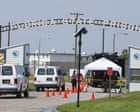
Time moves differently behind triple-perimeter razor wire. In the limestone-and-concrete footprint of the Florida State Prison near Starke, hours are usually measured by the shuffle of rubber sandals on painted concrete, the metallic clatter of heavy meal trays, and the distant, mechanical drone of industrial air handlers. But a clock can be forced to run fast. A schedule can be compressed.
On a quiet Tuesday, that internal institutional rhythm shattered. The state executed two men within a span of six hours. If you found value in this article, you might want to look at: this related article.
To find a precedent for a dual execution day in Florida, one must flip backward through yellowed calendar pages to 1964. Back then, analog television was still a novelty, the modern interstate highway system was half-finished, and lethal injection was decades away from being conceptualized. Nationally, the practice of scheduling back-to-back state killings had retreated into the footnotes of legal history, remaining dormant across the country since Arkansas carried out a rushed pair in 2017.
Until now. For another angle on this development, refer to the recent coverage from NPR.
Consider what happens next when policy shifts from a trickle to a surge. Under the administration of Governor Ron DeSantis, Florida transformed its death chamber into the most active execution site in America. While the broader national trend spent two decades slowly winding down the scale of capital punishment, Florida went the other way. The state accelerated the cadence, pushing past historical norms and eclipsing neighboring jurisdictions.
The logistics of a single execution demand an extraordinary alignment of machinery, medical supplies, legal clearances, and armed personnel. Doubling that burden on the same calendar date turns the institution into an assembly line of finality.
At noon, the first protocol began. James Aren Duckett, sixty-eight years old, was strapped to a gurney. Decades earlier, Duckett had worn a badge as a police officer in a small central Florida town. In 1987, he was arrested, tried, and convicted for the abduction, sexual battery, and drowning of an eleven-year-old girl named Teresa McAbee. For nearly forty years, his life hung in the balance of endless appellate briefs.
Even in the final stretch, the friction of the legal system fought for space against the clock. Earlier in the year, the Florida Supreme Court temporarily halted Duckett's scheduled execution to allow for independent DNA testing on physical evidence. His defense team argued that modern genetic science might rewrite the narrative of a conviction secured decades prior. When the laboratory results ultimately returned inconclusive—neither definitively proving absolute guilt nor unlocking a clean exoneration—the stay dissolved.
The state machinery restarted. Duckett was pronounced dead at 1:19 p.m.
The medical team did not unpack their equipment and leave. They waited. Six hours later, the second cycle began.
Dominick Occhicone was eighty years old. He entered the modern history books not just for the timing of his death, but for his age, becoming the second-oldest inmate executed in the United States since the reinstatement of capital punishment in 1976. Occhicone had spent decades behind bars for the 1986 murders of his ex-girlfriend's parents in Pasco County.
As his date approached, Occhicone’s attorneys raised a straightforward constitutional question: Does executing an octogenarian violate the Eighth Amendment prohibition against cruel and unusual punishment? They argued that the physical realities of advanced age—frailty, failing health, and the sheer passage of forty years—rendered the retributive purpose of the sentence obsolete. The courts disagreed, clearing the path for the evening appointment.
When the chemicals took effect, Occhicone became the twelfth person put to death by Florida within a single calendar year.
Human rights advocates and legal scholars watched from the outside with deep alarm, pointing not only to the velocity of the process but to the shadows cast around it. Critics argue that the administrative rush introduces systemic risks, compresses critical judicial review, and shrouds the mechanics of state-sanctioned death in an impenetrable veil of bureaucracy.
Yet, for the families of victims who have navigated decades of appeals, court filings, and institutional silence, the pace represents an entirely different kind of reckoning. To them, every postponed hearing and delayed mandate feels like an extension of an unhealable wound. Proponents of the state's approach argue that justice delayed for forty years loses its moral anchoring, turning punishment into a bureaucratic purgatory.
Two views of time stand opposed here. One sees time as a safeguard, a necessary cushion to prevent irreversible errors in a deeply flawed human system. The other sees time as an eroding agent that dilutes accountability and denies closure to those left behind.
The double gurney in Starke has been cleared. The medical staff have packed their trays. The witnesses have filed out past the double gates, returning to the humid Florida evening. But the questions raised by a state pressing its foot hard against the accelerator of capital punishment remain suspended in the air, echoing long after the last monitor flatlined.