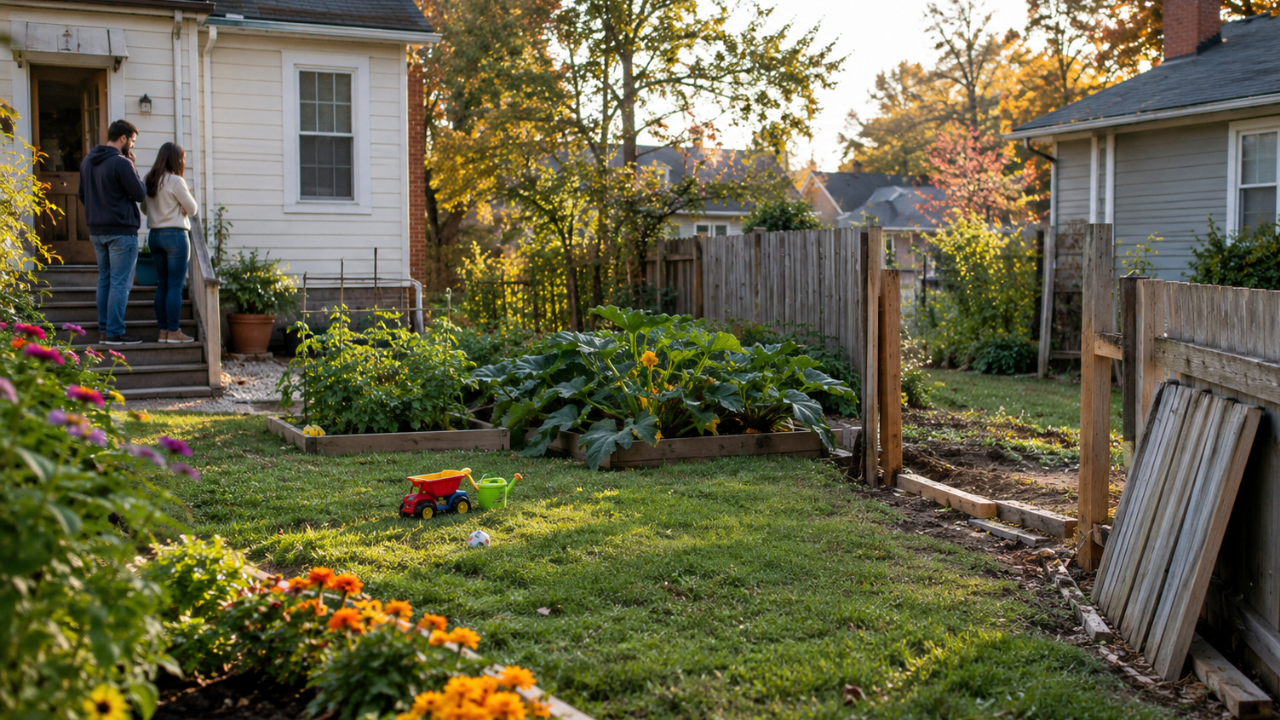
Residential property disputes rarely start with malice. They start with a shovel, a bag of mulch, and a homeowner assuming an overgrown strip of grass belongs to them. When a Virginia couple invested thousands of dollars into transforming an unused patch of backyard dirt into a thriving garden, they triggered a legal and neighborhood battle that highlights a massive blind spot in American homeownership. Without a recent boundary survey, planting a single tomato bush on disputed ground can legally hand your neighbor ownership of your hard work—or force you to rip it out at your own expense.
Most people buy a house assuming the fence line equals the property line. It does not. Fences rot, get rebuilt two feet to the left by a careless contractor, or get installed purely for convenience decades before the current owners ever signed a mortgage. Over time, visual cues replace legal reality. A mowed edge becomes an accepted border. A row of hedges becomes an unofficial wall. Then someone decides to build raised beds, pour concrete pavers, or install a greenhouse, and suddenly everyone pulls out their closing paperwork.
The Mechanics of Backyard Encroachment
To understand how a backyard garden turns into a civil lawsuit, you have to look at how residential land is actually measured and transferred. When you purchase a home in Virginia—or almost anywhere in the United States—your deed contains a legal description of the property. This document relies on metes and bounds, lot numbers, or subdivision plats filed at the county courthouse. It does not rely on where the previous owner decided to stop pushing their lawnmower.
If you plant a garden across that invisible legal line, you have committed encroachment. Even if the strip of land was completely neglected, covered in weeds, and ignored by your neighbor for ten years, title to that soil remains with the deed holder. In the eyes of property law, improving someone else’s land without permission does not grant you equity in it. Quite the opposite. The legal owner of the dirt generally has the right to demand the removal of any structures, plants, or hardscaping placed on their parcel.
Consider a hypothetical scenario that plays out in suburban counties every spring. Imagine a homeowner buys a corner lot with a deep, irregular backyard. Behind the existing chain-link fence sits a fifteen-foot buffer of brambles and scrub trees before the neighbor's manicured lawn begins. The new owner clears the brush, grades the soil, installs cedar raised beds, and runs a drip irrigation line. Two years later, the neighbor decides to sell their house. The buyer’s lender requires a fresh survey, which reveals that the cedar beds sit squarely inside the seller's legal boundary. The seller now has a clouded title they cannot close on until those garden beds are gone. What started as a weekend beautification project instantly becomes an emergency legal demand.
Why Homeowners Associations and Local Codes Complicate the Fight
The friction rarely stays strictly between two neighbors. Once a dispute over backyard land erupts, both parties almost always look for institutional backup. They call county code enforcement. They email the Homeowners Association (HOA) architectural review board. They dig through municipal zoning ordinances looking for leverage.
In planned communities across Northern Virginia, Richmond, and the Tidewater region, HOAs wield tremendous power over exterior modifications. Even if a garden sits entirely on your own property, building a trellis over a certain height, installing a shed for tools, or altering the drainage grade of your yard can violate restrictive covenants. When a neighbor complains about a border dispute, the HOA often steps in not to adjudicate the property line—which they generally lack the legal authority to do—but to enforce secondary rules.
- Impervious surface limits: Municipal codes often restrict how much of a residential lot can be covered by patios, pathways, and permanent structures to prevent stormwater runoff.
- Setback requirements: Local zoning laws typically prohibit building structures, including certain fences, retaining walls, and greenhouses, within five to fifteen feet of a property line.
- Nuisance and drainage ordinances: Redirecting water runoff onto an adjacent lot through raised beds or regraded soil is a fast track to a municipal citation.
- Vegetation height and noxious weed rules: Letting a naturalistic garden grow wild near a shared border frequently triggers complaints from neighbors accustomed to turfgrass.
Once code enforcement officers or HOA boards open a file, the dispute loses all flexibility. Informal compromises—like agreeing to split the harvest or letting the garden stay until the end of the growing season—evaporate. Written violation notices carry daily fines, forcing homeowners into defensive legal postures where backing down feels like admitting defeat.
The Myth of Easy Adverse Possession
Whenever a story surfaces about a homeowner fighting over a strip of backyard land, armchair lawyers immediately bring up adverse possession. The concept sounds straightforward. If you openly use and maintain a piece of land for long enough, it becomes yours.
In reality, claiming title through adverse possession is extraordinarily difficult, expensive, and rarely successful in modern suburban disputes. In Virginia, a claimant must prove continuous, uninterrupted, open, notorious, exclusive, and hostile possession of the land for a statutory period of fifteen years. Every single one of those legal terms carries a heavy evidentiary burden.
If the previous owner of your house planted a garden there for twelve years, and you have only lived there for four, you might try to use a legal doctrine called tacking to combine your time with theirs. However, if the neighbor ever gave casual permission—even a verbal "sure, go ahead and plant some flowers back there"—the possession is no longer hostile. Permission destroys an adverse possession claim instantly.
Furthermore, winning an adverse possession claim requires filing a quiet title action in circuit court. You cannot just tell the county tax assessor to redraw the map. You have to hire a real estate litigator, pay for expert testimony, and endure months or years of discovery. Legal fees for a contested quiet title lawsuit easily climb into the tens of thousands of dollars, frequently exceeding the actual market value of the disputed strip of dirt.
What Actually Happens When You Skip the Survey
Most homebuyers waive a full boundary survey at closing to save between $500 and $1,200. Instead, they rely on an older survey provided by the seller, accompanied by a "survey affidavit" stating no changes have been made, or they accept a basic lender's location drawing. Title insurance policies issued without a current survey almost always include a standard survey exception. This clause explicitly refuses to cover any losses, legal fees, or boundary disputes that an accurate, up-to-date survey would have revealed.
When a dispute erupts over a dream garden, the homeowner who skipped the survey discovers they are completely uninsured for the fight. Title companies will not step in to defend your right to keep your tomato beds if you never paid to verify where your land ended.
Hiring a licensed land surveyor after a conflict has already started changes the dynamic entirely. Surveyors do not take sides; they find iron pins buried at the corners of lots, measure angles using GPS and total stations, and compare physical improvements against recorded subdivision plats. Sometimes the results shock the person who ordered the work. A homeowner convinced their neighbor is encroaching may learn their own driveway or deck is actually two feet over the line.
The Psychological Trap of Sweat Equity
Why do people fight so fiercely over four feet of grass? Financial value rarely explains it. A ten-by-twenty-foot strip of suburban backyard might be worth a few thousand dollars on paper, yet neighbors routinely spend thirty thousand dollars on attorneys fighting over it.
The answer lies in sweat equity and perceived territoriality. Building a garden requires physical labor. You haul wheelbarrows of compost, pull roots out of dense clay, build wooden frames, and tend to plants through summer heat. That physical investment creates an intense psychological sense of ownership. When a neighbor demands you tear it down, it does not feel like a technical real estate correction. It feels like a personal attack and an erasure of your hard work.
On the other side of the line, the legal owner experiences a different but equally powerful trigger. Allowing a neighbor to permanently occupy your land feels like losing control of your single largest financial asset. Real estate attorneys routinely see sellers panic when a buyer threatens to walk away over an unpermitted encroachment. Protecting the marketability of the home becomes an absolute priority, leaving zero room for neighborly sentiment.
Practical Ways to De-Escalate Before Calling a Litigator
When a boundary line comes into question, the worst move is doubling down with construction. Do not build a fence to block the neighbor out. Do not pour concrete to make the garden permanent. Escalating physical changes on disputed land only increases your financial exposure if a judge eventually orders you to restore the property to its original condition.
Smart homeowners treat a boundary question as a technical problem rather than a personal feud.
Commission a Joint Survey
If the property line is genuinely unclear, propose splitting the cost of a licensed land surveyor with the neighbor. Agreeing in advance to abide by the surveyor's physical stakes removes emotion from the equation. When both parties see the wooden stakes and pink flagging tape driven into the ground by an independent professional, arguments about where the old fence used to stand become irrelevant.
Negotiate a Written License Agreement
If the survey confirms your garden sits on your neighbor's land, ask for a revocable license agreement rather than demanding ownership. This simple legal document states that the neighbor owns the land, grants you temporary permission to maintain the garden, and explicitly blocks you from claiming adverse possession in the future. For the neighbor, it protects their title and keeps their property marketable. For you, it saves your plants and avoids immediate demolition costs.
Execute a Lot Line Adjustment
In cases where a permanent structure—like a stone retaining wall, an expensive greenhouse, or an established orchard—crosses the border, you can offer to buy the narrow strip of land. A lot line adjustment requires a surveyor to draw a new plat, approval from local municipal planners to ensure neither lot violates minimum size or setback rules, and a newly recorded deed. It takes time and administrative fees, but it permanently solves the defect without destroying the improvements.
Use Movable Infrastructure Near Borders
Whenever you plan a major landscaping project within ten feet of an unverified boundary, avoid permanent foundations. Use modular galvanized metal beds, stock tanks, or heavy-duty fabric grow bags instead of mortared stone or deep-set timber posts. If a survey five years down the road reveals a boundary issue, a portable garden can be relocated over a single weekend without a legal battle.
Property lines do not care how much compost you bought or how well your hydrangeas bloomed last summer. The county land records exist in black and white, immune to good intentions and neighborhood assumptions. Before you sink a shovel into the edge of your yard, find the metal pins buried in the dirt, pull out your plat map, and make sure the ground you are building on is actually yours to keep.