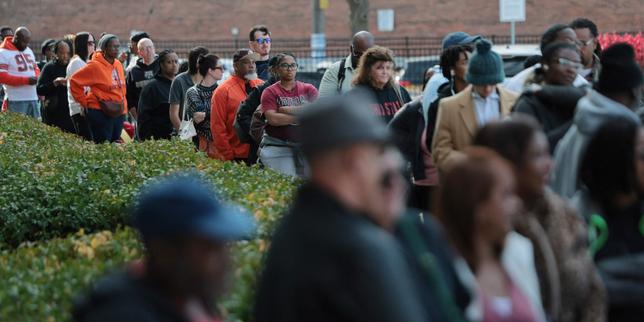
Media outlets spent the week before Election Day breathless over the same tired metric: 60-plus million early ballots returned. Network anchors treated the tally like an unassailable fortune cookie, declaring massive momentum for one side while eulogizing the other before a single precinct closed.
It is pure theatrical noise.
Having spent two decades running campaigns, building vote-share modeling tools, and analyzing voter file data across battleground districts, I can assure you that the mainstream coverage of early voting numbers is fundamentally broken. Cable news commentary on early returns isn't analysis; it’s astrology with bar charts.
The Cannibalization Trap
The underlying premise of standard campaign coverage is simple: bigger early vote numbers equal higher final turnout.
That assumption falls apart under real-world scrutiny.
Early voting totals rarely represent new voters entering the system. Instead, they reflect a permanent behavioral shift in high-propensity voters who simply changed their logistics. When a partisan voter who has cast a ballot in five straight elections decides to drop off an envelope on a Thursday instead of waiting in line on a Tuesday, overall turnout moves by exactly zero.
Political strategists call this vote cannibalization.
If a campaign spends millions of dollars urging its base to cast ballots three weeks out, it eats away at its own Election Day reservoir. Comparing early returns against historical baselines without isolating for bank-cannibalization leads directly to flawed forecasts.
Imagine a retail store that opens three hours early for a special promotion. If 500 regular customers walk in at 7:00 AM instead of 10:00 AM, the owner hasn't expanded the customer base—they’ve just redistributed foot traffic. When campaign pundits stare at early returns, they are celebrating early foot traffic and mistaking it for market growth.
The Asymmetric Party Split
The second major flaw in early-vote reporting is treating party-line early turnout as symmetrical.
Ever since the mail-in ballot expansion of 2020, the demographic and logistical profiles of early voters split along sharp party lines.
- The Vote-by-Mail Bias: Registered Democrats have consistently used mail-in options at far higher rates than Republicans.
- The In-Person Counterweight: Registered Republicans overwhelmingly prefer early in-person drops or traditional Election Day precinct voting.
- The Unaffiliated Unknown: Independent voters—the actual cohort that decides swing elections—frequently make up 20% to 25% of early returns. Yet party-registration trackers force them into an arbitrary middle bucket, obscuring their actual ballot direction.
When a media ticker shows a state's early vote coming in at 44% registered Democrats and 32% registered Republicans, pundits immediately paint the state blue. They ignore the baseline reality: a Democratic lead in mail ballots is not an advantage; it is the structural minimum required for that party to remain competitive once Election Day precinct totals are tallied.
Counting mail-in returns without calculating the required Election Day offset is like scoring a football game at halftime and ignoring the second half entirely.
Raw Totals vs Voter History
The single most valuable metric in election modeling isn't how many ballots are in—it's who returned them.
A raw total of 50 million early votes tells you nothing about the electorate’s actual composition. To understand what early data is actually doing, you must run every returned ballot through a voter file database and categorize voters into three distinct buckets:
- Super Voters (4/4 Voters): Citizens who cast ballots in the last four general elections. Their early participation changes no outcomes. They were always going to vote.
- Casual Voters (2/4 Voters): Citizens who only turn out during presidential cycles or high-profile midterms.
- Low-Propensity Voters (0/4 or 1/4 Voters): Citizens who rarely, if ever, participate.
If a party's early vote surge is driven entirely by Super Voters clearing their schedules early, the campaign has achieved zero net-new leverage. It merely cleared administrative backlog.
Conversely, if early data reveals a sustained surge among 0/4 and 1/4 voters—specifically low-propensity cohorts who typically stay home—that indicates real movement. Yet corporate newsrooms almost never report voter-propensity breakdowns because raw early numbers make for faster chaptions and sharper graphics.
The Real Risk of Over-Indexing Early Data
Relying on early ballot data creates dangerous strategic blind spots for candidates and campaigns alike.
When candidates buy into their own early-vote press clippings, they pull resources out of crucial media markets too soon. They misallocate field staff, assume firewall states are secured, and leave vulnerable battlegrounds exposed to late-stage surges on Election Day.
Conversely, when voters are repeatedly told that an election is already decided based on massive pre-election turnout, it depresses turnout among low-propensity voters on Election Day who conclude their vote no longer matters.
The uncomfortable truth is that raw early voting numbers are a terrible predictor of ultimate margins. Until an election board actually opens envelopes and runs paper through optical scanners on election night, early totals measure logistics, not political victory.
Stop treating early turnout stats like a crystal ball. They aren't telling you who won—they're just telling you who hates waiting in line on Tuesday.


