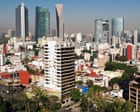
The implementation of a $300 USD cover charge specifically targeting U.S. citizens at a Mexico City nightclub is not a localized instance of xenophobia, but a calculated application of Price Discrimination as a Social Signal. This pricing strategy serves two distinct functions: it creates an artificial barrier to entry for a demographic perceived as high-demand/low-cultural-affinity, and it builds brand equity among a local "protectorate" class by monetizing the friction of gentrification. The incident highlights a shifting equilibrium where the economic benefits of digital nomadism are being weighed against the degradation of local social capital.
The Tri-Factor Model of Urban Friction
The tension between Mexico City residents and foreign arrivals—primarily from the United States—is driven by three measurable variables. When these variables reach a specific threshold, businesses begin to pivot toward exclusionary pricing as a marketing tactic.
- Purchasing Power Disparity (PPD): The median income of a remote-working U.S. professional often exceeds the local median by a factor of 10 or more. This creates an inelastic demand for housing and entertainment that pushes local consumers out of the "primary market" (neighborhoods like Roma and Condesa).
- Cultural Homogenization: The proliferation of "Global Minimalism"—coffee shops, coworking spaces, and aesthetic choices designed to appeal to Western sensibilities—reduces the unique value proposition of the local geography.
- The Displacement Velocity: The rate at which rental prices increase relative to local wage growth. In Mexico City, this velocity has accelerated to a point where social resentment becomes a marketable asset.
The Mechanics of Exclusionary Pricing
The $300 USD cover charge functions as a Punitive Entry Barrier. In standard economic theory, price discrimination is usually used to maximize revenue from high-spending segments (e.g., business class flights). However, in this specific nightclub model, the price is set intentionally above the "willingness to pay" threshold for the average tourist to achieve a specific demographic mix.
The Cost-Benefit Logic of Localist Branding
A business choosing to alienate a wealthy demographic follows a specific risk-reward calculus:
- Risk: Immediate loss of high-margin revenue from U.S. tourists who spend more per capita on alcohol and table service.
- Reward: Long-term "Authenticity Premium." By positioning the venue as a "No-Gringo Zone," the establishment secures a loyal base of local influencers and high-net-worth residents who are seeking refuge from the perceived "Disneyfication" of their city.
- The Conversion: The $300 fee is not intended to be paid. It is a communication device. It signals to the local population that the venue values "Social Cohesion" over "Maximum Profitability."
Digital Nomadism and the Erosion of the "Third Space"
The influx of remote workers has transformed "Third Spaces"—social environments like cafes and bars—into de facto offices. This transition creates a logistical bottleneck for business owners. A digital nomad may occupy a table for six hours while purchasing a single espresso, whereas a local social group might cycle through that same space in 90 minutes with a higher cumulative spend.
The $300 fee acts as a crude filter for the Value-to-Space Ratio. It targets the specific demographic most associated with the "laptop culture" that stifles the traditional high-velocity turnover of Mexican social venues.
Strategic Limitations of "Anti-Tourist" Business Models
While the "US-only" surcharge generates significant earned media and local goodwill, it faces three structural vulnerabilities that prevent it from being a sustainable long-term strategy for the broader service industry.
The Arbitrage Problem
If a venue becomes too successful at excluding foreigners, it risks losing the very "vibe" that makes it attractive. Often, the local elite who frequent these "authentic" spots are themselves highly globalized and mobile. If the venue becomes a closed loop, it can lose the dynamic energy that high-end hospitality requires to remain relevant.
Regulatory and Legal Blowback
Article 1 of the Mexican Constitution and the Federal Law to Prevent and Eliminate Discrimination prohibit pricing based on nationality. While enforcement is historically inconsistent in the nightlife sector, a high-profile $300 fee invites intervention from PROFECO (the Federal Consumer Attorney's Office). This creates a legal liability that far outweighs the marketing gains.
The Replacement Cycle
When a venue uses "localism" as its primary brand pillar, it is susceptible to the next, even more "authentic" competitor. Authenticity is a depreciating asset; once it is successfully marketed, it begins to feel manufactured, leading the core local audience to migrate elsewhere.
The Shift from Open Access to Tiered Urbanism
We are witnessing the emergence of Tiered Urbanism, where access to city infrastructure is no longer dictated solely by the ability to pay, but by "Social Fit." This is a defensive mechanism against the borderless nature of the modern economy.
For the strategist, the Mexico City nightclub incident is a leading indicator of a "localization" trend that will likely expand to other global hubs like Lisbon, Medellín, and Bali. Businesses will increasingly be forced to choose between the Global Dollar (high liquidity, low loyalty) and the Local Peso (lower liquidity, high social stability).
The $300 cover charge is a prototype of a new friction-based economy. To navigate this, hospitality and real estate stakeholders must move beyond simple capacity management and into Sentiment Management. This requires a transition from "inclusive" models that inadvertently lead to displacement, to "integrated" models where pricing and access are calibrated to preserve the underlying social fabric that made the destination desirable in the first place.
The most resilient businesses in the next decade will not be those that simply hike prices for foreigners, but those that create "Dual-Stream Value"—where the revenue from the global market is visibly and structurally reinvested into maintaining the accessibility of the venue for the local population. Failure to solve this "Gentrification Paradox" will result in more aggressive, public-facing price wars that ultimately damage the city's brand as a global destination.