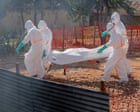
The containment of highly infectious diseases often creates a secondary crisis that remains largely invisible to global health agencies. In the Democratic Republic of Congo’s Ituri province, the city of Bunia has repeatedly found itself on the front lines of Ebola outbreaks. While international intervention focuses heavily on clinical isolation and vaccination rings, the immediate economic fallout paralyzes the informal workforce that keeps the city alive. Public-facing workers—motorcycle taxi drivers, market vendors, and small-scale traders—face a brutal choice between risking exposure to a deadly virus or watching their households slide into extreme poverty. The traditional public health playbook saves lives in the short term, but it systematically destroys local economies by cutting off the daily cash flow that sustains the population.
Public health metrics track infections, recoveries, and fatalities. They rarely measure the collapsed daily revenue of a marketplace or the empty tank of a transport worker who can no longer afford fuel. To understand the true impact of an Ebola outbreak in a hub like Bunia, one must look past the treatment centers and examine the micro-economies of the streets.
The Collateral Damage of Biological Isolation
When Ebola enters an urban center, the immediate institutional response is to limit human contact. For the thousands of informal workers in Bunia, human contact is their only source of income.
Consider the city's transport network, dominated by boda-boda (motorcycle taxi) operators. These drivers rely on constant, close physical proximity to their passengers. As soon as health authorities announce a confirmed case, ridership plummets. Fear drives people indoors, and those who must travel avoid motorcycles out of dread of touching a driver or a helmet that might be contaminated.
The economic contraction moves rapidly through the community.
- Transport operators lose up to eighty percent of their daily earnings within the first week of an alert.
- Market women, who sell perishable goods like fish and vegetables, see their customer base vanish overnight as residents avoid crowded trading hubs.
- Small shopkeepers face a double squeeze: wholesale supply chains from neighboring regions freeze due to health checkpoints, while local demand dries up completely.
This is not a temporary inconvenience. It is an immediate threat to survival. In an economy where savings accounts are nonexistent and families eat based on what was earned that morning, a three-week dip in revenue triggers acute food insecurity.
Why Top-Down Health Interventions Misread the Ground Reality
Global health organizations and national ministries usually approach outbreaks as purely medical emergencies. They deploy epidemiologists, establish isolation wards, and set up handwashing stations across the city. This infrastructure is necessary, but the execution often ignores the survival strategies of the urban poor.
When authorities set up health checkpoints on major roads, the intention is to screen for fever and track movement. The unintended consequence is the creation of economic bottlenecks. A vendor trying to bring produce from rural Ituri into Bunia faces hours of delay at these checkpoints. For a cargo of tomatoes or bananas, a four-hour delay in the tropical heat means the difference between a profitable sale and rotten waste.
Furthermore, the enforcement of sanitary mandates often lacks financial support. Telling a market trader she must wash her hands between every transaction sounds reasonable in a Geneva briefing room. In a bustling market with no running water, forcing that trader to purchase her own jerrycans of clean water and chlorine solution eats directly into a profit margin that is already measured in pennies. When compliance becomes an unaffordable expense, workers either evade the regulations or shut down their businesses entirely.
The Friction Between Security Forces and the Informal Sector
In Bunia, health emergencies frequently overlap with existing security operations. The enforcement of health protocols often falls to local police or military units, leading to a volatile dynamic on the streets.
Workers report that health checkpoints can become sites of financial extortion. Drivers who cannot show immediate compliance with every shifting regulation face fines or vehicle impoundment. This creates deep resentment. Instead of viewing public health workers as allies against a deadly virus, the local population begins to see the entire outbreak response as an aggressive state apparatus designed to drain their resources.
This trust deficit has material consequences for disease control. When people view health regulations as punitive, they hide symptoms. They avoid formal medical centers, opting instead for informal, unregulated neighborhood clinics where they can stay under the radar. By failing to cushion the economic shock of containment, health authorities inadvertently drive the epidemic underground, making it far more difficult to track and eliminate.
The Flawed Logic of Post-Outbreak Aid
When international aid does arrive to address the economic fallout, it usually comes late and targets the wrong groups. Large non-governmental organizations favor structured, registered businesses for credit programs or grants. The reality of Bunia is that the vast majority of public-facing workers operate entirely within the informal sector. They do not have tax registration numbers, formal business licenses, or bank accounts.
Cash transfer programs, when implemented, are frequently plagued by bureaucratic delays. A cash injection that arrives six months after an outbreak has subsided does nothing to prevent a family from defaulting on rent or pulling their children out of school during the crisis. The lack of an immediate, agile financial safety net explicitly tailored for informal workers remains the glaring hole in modern epidemic response.
Redesigning the Epidemic Response Playbook
Stabilizing a city during a health crisis requires a dual strategy that treats economic collapse with the same urgency as viral transmission.
First, public health infrastructure must integrate direct, immediate cash compensation for workers whose livelihoods are legally restricted. If a government mandates that motorcycle taxis carry fewer passengers or that markets operate at half capacity, that mandate must be accompanied by daily stipends distributed via mobile money platforms. This is not welfare; it is a fundamental public health tool that buys compliance and allows people to isolate without starving.
Second, local workers must be hired to run the response. Instead of importing external teams to manage sanitization stations or conduct contact tracing, authorities should employ displaced transport workers and market leaders. A boda-boda driver who knows every alleyway in Bunia makes a far more effective contact tracer than an outside technician. Transforming affected workers from victims of regulation into paid participants of the response injects liquidity back into the local economy while leveraging hyper-local expertise.
The current model relies on the endurance of people who have already reached their breaking point. Expecting the informal workforce of Bunia to bear the financial burden of global health security is both ethically indefensible and epidemiologically self-defeating. Until economic preservation is baked directly into the outbreak response, the containment of viruses will continue to leave a trail of financial devastation that outlasts the disease itself.