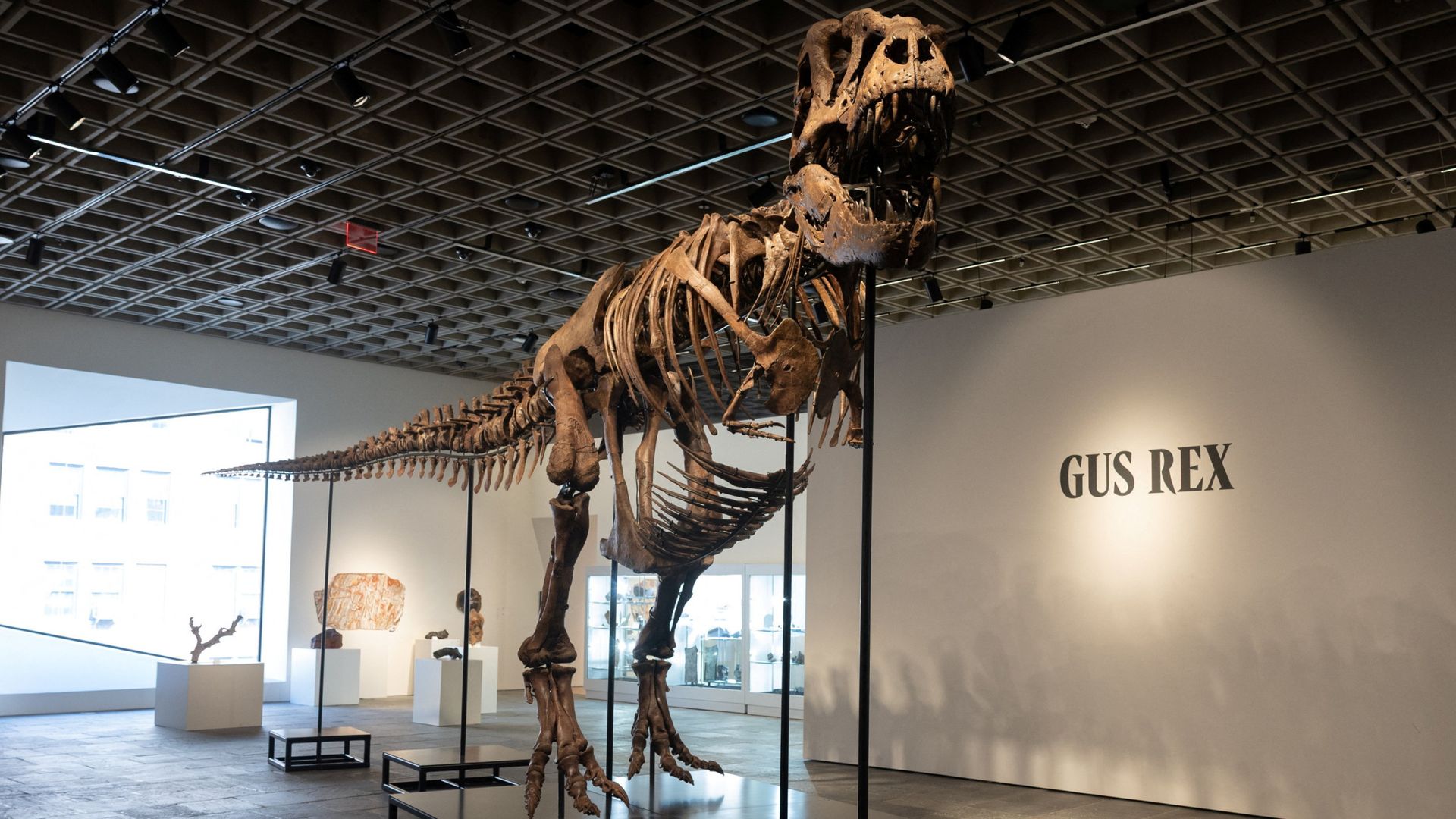
The $50.1 million sale of "Gus," a 67-million-year-old Tyrannosaurus rex skeleton, at Sotheby’s in New York represents a structural shift in the capitalization of natural history. This transaction did not merely break the previous $44.6 million auction record set by "Apex" the stegosaurus in 2024; it redefined the asset class. For institutional observers, sovereign wealth funds, and ultra-high-net-worth individuals, the valuation of fossilized specimens is no longer governed by academic consensus, but by a complex interplay of legal geography, scarcity dynamics, and intellectual property rights.
To analyze the mechanics of this market, one must dismantle the variables that transformed 183 fossilized bones into a $50 million commodity.
The Geography of Ownership: The US Legal Anomaly
The global market for high-value paleontological assets is severely supply-constrained by sovereign legal frameworks. In jurisdictions such as Mongolia, Brazil, and China, all fossil specimens discovered within national borders are state property. Exporting them is illegal, effectively neutralizing their commercial liquidity.
The United States represents the sole systemic exception to this rule. Under US common law, subsurface mineral and paleontological resources found on private land belong entirely to the landowner.
[Private US Land Discovery] ---> [Unrestricted Private Ownership] ---> [Global Liquidity / Auction Entry]
Gus was discovered in 2021 on a cattle ranch in Harding County, South Dakota—a parcel of private land owned by the late Gary Licking. Because of this geographic origin, the specimen entered the market free of state ownership claims, enabling clean title transfer to an anonymous international buyer. Without this specific legal framework, the commercial transaction would have been legally impossible.
The Valuation Matrix: Completeness vs. Mass vs. IP
Dinosaur fossil valuations are frequently misunderstood as simple functions of scale. In reality, the market utilizes a multi-variable matrix to assess value. Gus's final pricing can be deconstructed into three distinct vectors: completeness metrics, anatomical rarity, and commercial licensing potential.
1. The Discrepancy Between Bone Count and Mass
Sotheby’s marketed Gus as approximately 61% complete by bone count (183 of roughly 300 bones in a standard T. rex skeleton). However, from an asset-density perspective, the specimen represents 75% to 80% of the animal's total skeletal mass.
This divergence is critical. Small, fragile bones (such as those in the digits or tail ends) degrade quickly and are often lost to erosion. Larger, denser bones—such as the femur (measuring 50.39 inches on Gus) and the pelvis—survive. Buyers prioritize skeletal mass and structural presence over raw bone count because mass dictates the visual footprint and physical gravity of the mounted display.
2. Anatomical Rarity and Preservation Quality
Gus possesses several rare anatomical features that drive an exponential premium:
- The Skull: The specimen’s skull is 82% complete and exceptionally preserved. In theropod fossils, skulls are typically crushed by geological pressure.
- The Gastralia (Belly Ribs): Gus includes 30 of 32 gastralia. These delicate bones rarely fossilize and are exceptionally difficult to excavate without damage.
- Intact Feet: Only one other known T. rex specimen features two well-represented fossilized feet.
3. The "Clean Title" IP Arbitrage
When a commercial fossil preparation firm mounts a dinosaur, missing bones are typically cast from other known specimens—most frequently from "Stan," a T. rex sold in 2020 whose casts are widely licensed.
Gus, however, was sold with "full rights," meaning the physical assembly is free of copyrighted casts from third-party specimens. The buyer of Gus does not just own a physical asset; they own an IP platform. They can legally produce, license, and sell high-fidelity 3D scans and physical casts of Gus to global museums and private collectors, competing directly with the licensing revenue models established by Stan's owners.
The Supply-Chain Bottleneck: The Cost of Extraction
The five-year journey of Gus from discovery to auction block highlights the immense operational costs and risks associated with commercial paleontology.
Phase 1: Discovery (2021)
   │ (Initial metatarsal find on Licking Ranch)
   ▼
Phase 2: Extraction (2021–2023)
   │ (Three seasons of field excavation by Theropoda Expeditions)
   ▼
Phase 3: Lab Preparation (2023–2026)
   │ (Cleaning, stabilizing, and reassembling ~1,000 bone fragments)
   ▼
Phase 4: Mount & Monetization (2026)
   │ (Custom steel framing, exhibition, and Sotheby's auction)
This timeline introduces significant capital risk. Commercial outfits must fund field crews, heavy machinery, conservation labs, and specialized preparators for years before realizing any revenue. In the case of Gus, the excavation was managed by Theropoda Expeditions. The process required stabilizing and piecing together nearly 1,000 fragmented bone pieces.
Furthermore, the physical logistics of presenting these specimens are highly restrictive. The skull of Gus is too heavy to be mounted on the actual armature; a lightweight replica is used on the standing display, while the genuine 54-inch fossilized skull must be exhibited separately on reinforced pedestals.
The Public-Private Paradox
The escalation of fossil prices to the $50 million threshold has widened the divide between commercial dealers and the academic community.
The Society of Vertebrate Paleontology (SVP) routinely opposes these auctions, arguing that private sales remove vital specimens from the scientific record. Academic institutions operate on research grants and public donations that cannot compete with the purchasing power of private individuals or sovereign entities. When a specimen enters a private collection without a mandate for academic access, it cannot be peer-reviewed, effectively halting its scientific utility.
However, the market is beginning to construct hybrid models to mitigate this friction. The sale of "Apex" the stegosaurus in 2024 to billionaire Ken Griffin resulted in a long-term loan to the American Museum of Natural History. This strategy allows private buyers to retain equity in a highly prestigious, appreciating asset while granting scientists physical access to the specimen.
Whether the anonymous buyer of Gus will pursue a similar institutional loan or withdraw the specimen into a private estate remains the critical variable for the scientific community. If the buyer intends to monetize the acquisition through casting and exhibition licensing, a partnership with a major public museum is the most logical path to validate the specimen's scientific authenticity and maximize its global brand equity.