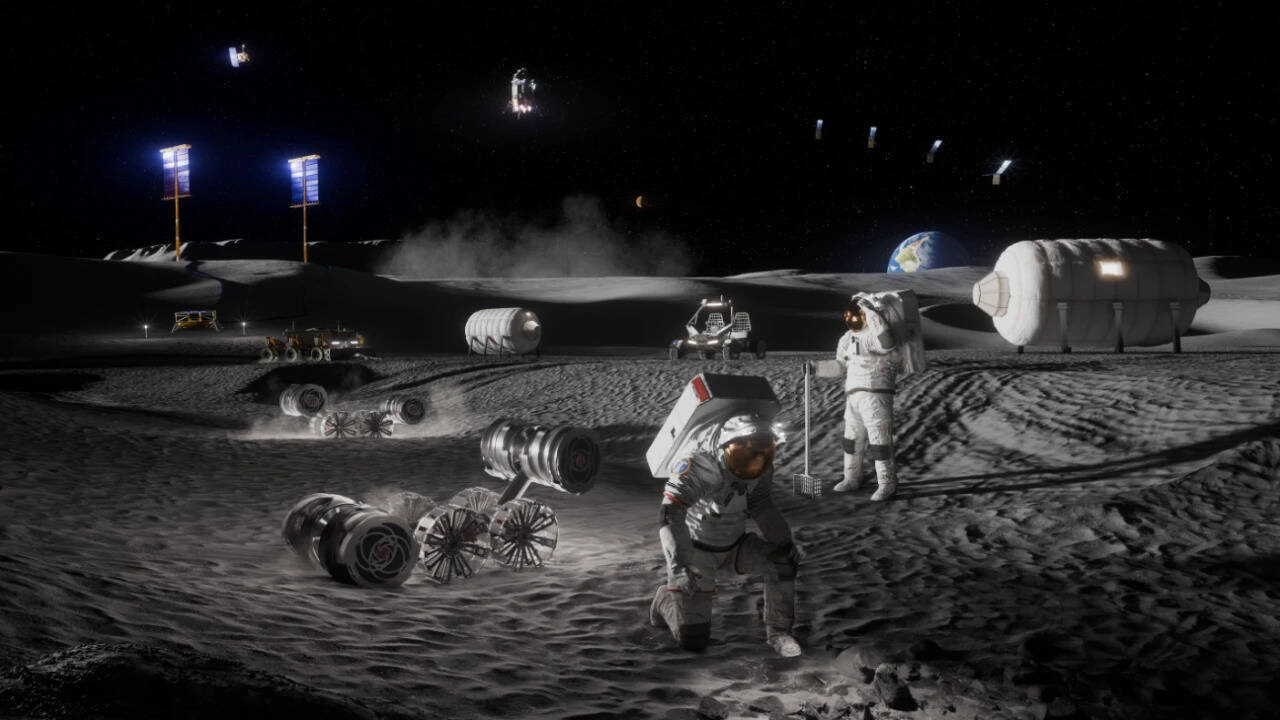
The primary obstacle to establishing a permanent human settlement on the Moon is not propulsion or life support, but the prohibitive mass-to-orbit cost of raw construction materials. NASA's $1 million prize competition—specifically targeting lunar excavation, construction, and resource utilization—functions as a capital-efficient procurement mechanism designed to offload early-stage research and development risk onto the private sector. By framing a complex civil engineering problem as an open incentive prize, the agency attempts to solve the fundamental equation of off-world logistics: every kilogram of structural shielding launched from Earth multiplies mission costs by orders of magnitude, making terrestrial supply chains mathematically unsustainable for permanent habitation.
To understand why a seven-figure prize sits at the center of multi-billion-dollar space architecture, one must examine the underlying physics and economics of lunar surface operations.
The Mass-to-Orbit Penalty and the Case for ISRU
In orbital mechanics, the Tsiolkovsky rocket equation dictates an exponential relationship between payload mass and required propellant. Transporting a single metric ton of concrete, steel, or radiation shielding from Earth's gravity well to the lunar surface requires tens of tons of propellant and multi-stage launch vehicles. Even with declining commercial launch costs, importing bulk construction materials for landing pads, habitats, and blast shields creates an insurmountable capital expenditure bottleneck.
The operational solution is In-Situ Resource Utilization (ISRU)—the practice of harvesting and processing local planetary materials rather than bringing them from Earth. On the Moon, the primary feedstock is lunar regolith: a layer of unconsolidated, fragmented rock and mineral dust covering the bedrock.
NASA’s incentive structure targets the exact technological gap between theoretical ISRU and functional civil engineering. While laboratory experiments have demonstrated that regolith can be sintered with microwaves, melted with concentrated solar energy, or bound with polymers to create bricks, scaling these processes to autonomous, continuous construction in a vacuum remains unsolved. The $1 million prize purse is not intended to fund the entire development lifecycle of a lunar construction company; rather, it acts as a market signal and a validation filter to identify viable mechanical and chemical methodologies before committing to flight hardware contracts.
The Four Engineering Bottlenecks of Lunar Construction
Popular coverage of NASA's lunar challenges often frames the problem simply as "building houses on the Moon." From an operational systems perspective, the challenge breaks down into four distinct, interdependent failure modes.
1. Abrasive Electrostatic Dust Mitigation
Lunar regolith is fundamentally different from terrestrial sand or soil. Because the Moon lacks wind and water erosion, regolith particles are microscopic, razor-sharp shards of glass and basalt formed by billions of years of micrometeorite impacts. Furthermore, ultraviolet radiation from the Sun strips electrons from the surface, giving the dust a persistent electrostatic charge.
This dust adheres aggressively to optical sensors, solar panels, thermal radiators, and spacesuits. When ingested into mechanical joints, gears, or pneumatic seals, it acts like industrial grinding paste. Any excavation or 3D-printing system competing for NASA's prize must demonstrate mechanical longevity without terrestrial lubricants, which evaporate or freeze in the lunar vacuum.
2. Thermal Cycling Extremes
A lunar day lasts approximately 29.5 Earth days, resulting in roughly two weeks of continuous sunlight followed by two weeks of total darkness. Without an atmosphere to buffer heat transfer, equatorial and mid-latitude surface temperatures swing from +120°C (+250°F) during the lunar day to -130°C (-208°F) at night, and drop below -240°C (-400°F) in permanently shadowed craters at the poles.
Construction materials and the robotics assembling them must survive severe thermal expansion and contraction cycles. A binder or sintering process that produces high compressive strength at room temperature may fracture due to thermal shock across a single lunar night.
3. Low-Gravity Soil Mechanics
The Moon's gravity is roughly one-sixth that of Earth ($1.62\text{ m/s}^2$). On Earth, heavy excavation equipment relies on its own mass to generate downward traction and digging force. On the Moon, a rover with one-sixth its terrestrial weight will simply push itself backward or spin its wheels when attempting to scoop compacted regolith.
Solving this requires counter-intuitive mechanical designs: counter-rotating bucket drums, percussive digging tools, or anchoring systems that brace against the terrain rather than relying on gravitational weight.
4. Zero-Atmosphere Thermodynamics
Convective cooling does not exist in a vacuum. Industrial machinery operating on Earth sheds waste heat into the surrounding air. On the Moon, motors, power electronics, and laser or microwave sintering heads can only reject heat through thermal radiation or direct conduction into the ground. Continuous high-power construction operations risk rapid thermal runaway and component burnout unless systems are engineered with massive radiator arrays or duty-cycle throttling.
Incentive Prizes as Venture Subsidies
Why does a federal agency with an annual budget exceeding $25 billion offer a $1 million prize rather than issuing a traditional cost-plus contract? The answer lies in procurement economics and risk allocation.
Under a traditional Federal Acquisition Regulation (FAR) cost-plus contract, the government pays a contractor for all allowable expenses plus a guaranteed fee, regardless of whether the technology works. This shields the vendor from financial ruin during high-risk R&D, but it removes incentives for speed and capital efficiency, often resulting in multi-year delays and cost overruns.
Incentive prizes invert this model. NASA defines the performance metrics—such as autonomous excavation volume, structural load capacity of a sintered beam, or continuous operating duration in a simulated lunar environment—and pays zero dollars until a team demonstrates verified hardware performance.
For participating startups and university engineering teams, the $1 million payout rarely covers the actual cost of building and testing prototypes. Instead, the prize provides three non-dilutive assets:
- Technical Validation: Passing NASA's testing gates provides third-party engineering verification that private venture capital firms lack the domain expertise to conduct themselves.
- Intellectual Property Retention: Unlike many traditional government development contracts, prize competitors typically retain ownership of their underlying patents, allowing them to commercialize dual-use technologies for terrestrial mining, autonomous robotics, or extreme-environment construction.
- Pipeline Positioning: Prize winners establish operational track records that qualify them for subsequent, vastly larger NASA Commercial Lunar Payload Services (CLPS) or Space Technology Mission Directorate contracts.
The Structural Sequence of Lunar Settlement
A common misconception is that the first lunar construction projects will be pressurized human habitats. In reality, pressurized structures require fail-safe life support, airlocks, and micrometeorite shielding that cannot be reliably 3D-printed in the near term. The actual deployment sequence follows a strict hierarchy of operational necessity.
Phase 1: Landing and Launch Pads
When a lunar lander fires its descent engine near the surface, the rocket plume blasts high-velocity regolith ejecta outward at speeds exceeding 1,000 meters per second. During the Apollo 12 mission, dust kicked up by the Lunar Module sandblasted the Surveyor 3 probe parked 160 meters away. For larger Artemis-class landers, unimproved landing zones pose a catastrophic risk to nearby orbital assets and surface infrastructure. The immediate application of regolith sintering is paving flat, consolidated landing pads to contain plume ejecta.
Phase 2: Berms and Radiation Shielding
Beyond the Earth's magnetosphere, astronauts are exposed to Galactic Cosmic Rays (GCRs) and Solar Particle Events (SPEs). Rather than printing pressurized walls, early construction robotics will pile raw regolith over inflatable or rigid metallic modules brought from Earth. A two-to-three-meter layer of compacted lunar soil reduces radiation exposure to safe operational limits and provides passive thermal insulation against the two-week lunar night.
Phase 3: Unpressurized Civil Infrastructure
Once landing zones and radiation shields are established, ISRU construction shifts to roads, solar array foundations, and thermal storage beds. Compacted roadways reduce dust generation from rover traffic, while regolith-filled thermal batteries can store solar heat during the lunar day to keep equipment warm through the night.
Limitations of the Current Prize Architecture
While incentive prizes accelerate early prototyping, they possess structural blind spots that prevent them from solving the entire deployment problem.
First, terrestrial testbeds cannot replicate the coupled physics of the lunar environment. Engineers can simulate one-sixth gravity using parabolic flights or offload rigs, simulate vacuum in thermal-vacuum chambers, and simulate lunar dust using terrestrial basalt simulants like JSC-1A or LHS-1. However, no facility on Earth can simultaneously replicate low gravity, high vacuum, electrostatically charged sharp dust, and extreme solar radiation across a full-scale construction site. Solutions optimized for terrestrial testbeds frequently fail when exposed to the combined stresses of the actual lunar surface.
Second, power infrastructure remains decoupled from construction prizes. Sintering regolith into solid basalt bricks requires substantial continuous electrical power—often tens of kilowatts. Until nuclear fission surface power systems or massive polar solar arrays with high-density energy storage are deployed on the Moon, energy-intensive construction methods remain bottlenecked by power availability, regardless of how well the robotics perform.
The Strategic Play for Space Infrastructure Operators
Organizations aiming to capture value in the emerging cislunar economy should not treat NASA's $1 million prize as a standalone revenue event. The winning strategy requires viewing the competition as a customer-acquisition cost for long-term infrastructure monopolies.
- Optimize for Low-Energy Binders Over High-Energy Melting: Because continuous electrical power will be the scarcest commodity on the lunar surface for the next decade, mechanical compaction, interlocking dry-stack geometries, and low-mass chemical binders will outperform high-wattage laser or microwave sintering in near-term deployment schedules.
- Design Modular End-Effectors: Rather than building bespoke, single-purpose construction rovers, engineering teams should develop standardized excavation and additive manufacturing attachments compatible with existing commercial lunar landers and mobility platforms.
- Monetize Terrestrial Dual-Use Immediately: Companies cannot survive on multi-year aerospace procurement cycles alone. The autonomous navigation, dust-sealed actuators, and remote-teleoperation software developed for lunar regolith challenges must be deployed simultaneously in terrestrial mining, hazardous waste remediation, and automated agriculture to generate operating cash flow while awaiting lunar flight manifests.