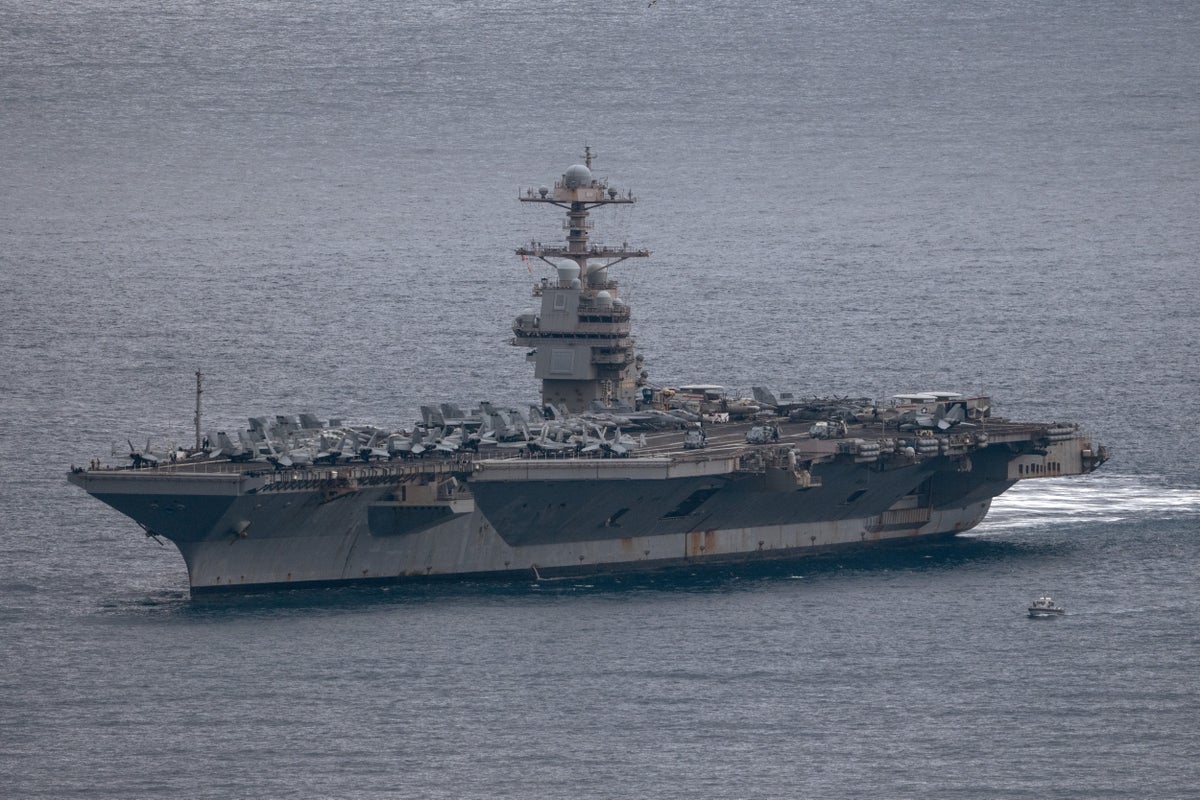
Naval architecture is a zero-sum exercise in balancing mass, volume, and hydrodynamic efficiency against strict operational constraints. When executive oversight bypasses empirical engineering metrics in favor of personal preference, the resulting friction disrupts the procurement lifecycle, multiplies integration risk, and destabilizes cost baselines. Recent initiatives demanding that the United States Navy evaluate structural redesigns for the Ford-class aircraft carrier fleet—specifically shifting the command island forward to mimic World War II vessels and replacing advanced electromagnetic launch systems with legacy steam technology—expose a fundamental misalignment between aesthetic vision and functional engineering economics.
Evaluating these mandated modifications requires examining three core mechanical and financial variables: spatial utility, weight distribution physics, and industrial base capacity.
The Cost Function of Structural Relocation
The primary structural intervention under consideration involves shifting the multi-story command tower, known as the island, from its current position near the stern toward the center of the hull. On a modern nuclear-powered aircraft carrier, this structural component is not merely an architectural flourish; it serves as the operational nexus for flight deck control, radar arrays, and navigation.
The current stern-biased placement on Ford-class carriers is the product of decades of optimization. Moving the island toward the rear frees up contiguous flight deck space near the catapult launch zones, streamlining aircraft movement, reducing cycle times between launches, and minimizing aerodynamic turbulence over the landing area.
Altering this layout introduces severe structural penalties:
- Buoyancy and Trim Disruption: The redistribution of thousands of tons of steel and electronics alters the vessel's center of gravity. Compensating for this shift requires extensive hull redesign to maintain hydrodynamic stability and buoyancy parameters.
- Schedule Slippage: Engineering studies conducted during previous administrative cycles indicate that shifting the island requires a multi-year engineering overhaul, introducing billions of dollars in redesign costs and delaying active hulls under construction, such as the USS Doris Miller.
- Integration Bottlenecks: Cable routing, ventilation trunks, piping for nuclear cooling support, and combat systems interfaces must be entirely re-engineered, multiplying the probability of downstream construction defects.
The Technological Regression Trap
In tandem with aesthetic evaluations, recent directives mandate replacing the Electromagnetic Aircraft Launch System (EMALS) with traditional steam catapults on future carriers. This pivot illustrates the operational friction generated when policy overlooks industrial supply chain realities.
EMALS was engineered to supersede legacy steam systems by providing smoother acceleration curves, reducing mechanical stress on sensitive airframes, and eliminating the massive auxiliary piping network required to route high-pressure steam from nuclear reactors through the ship's skin. While early technological maturation phases for EMALS encountered developmental challenges, the system provides superior efficiency and precise control across varied aircraft weights.
Reverting to steam catapults triggers profound secondary effects:
- Industrial Base Atrophy: The manufacturing infrastructure for marine steam catapults has largely dissolved. The final Nimitz-class ship equipped with steam systems, the USS George H.W. Bush, was delivered in 2009. Rebuilding this industrial capacity requires fabricating specialized components from scratch, introducing profound schedule variance.
- Weight and Space Penalties: Steam systems require substantial internal volume for accumulators and piping, displacing spaces currently allocated for crew habitability, ordnance storage, or fuel reserves.
- Lifecycle Maintenance Divergence: Electromagnetic systems rely on digital diagnostics and modular maintenance, whereas steam systems demand intensive mechanical overhauls of valves, pistons, and high-pressure piping exposed to corrosive marine environments.
The Capital Allocation Paradox
Modern military procurement operates under strict budgetary caps and multi-year defense authorization timelines. When multi-billion-dollar programs absorb unbudgeted engineering changes mid-cycle, capital is diverted away from fleet expansion, maintenance backlogs, and unmanned systems integration.
The pursuit of historical aesthetics over combat effectiveness creates a dangerous precedent. Military acquisition programs must prioritize survivability, sortie generation rates, and damage control over visual nostalgia.
To stabilize naval modernization schedules, procurement authorities must insulate engineering baselines from subjective oversight. Future contracting vehicles should enforce strict change-order thresholds, ensuring that aesthetic critiques cannot trigger unscheduled redesigns without a formal, peer-reviewed operational requirement justification. Maintaining maritime superiority requires anchoring design choices strictly in physics, threat analysis, and industrial reality.


