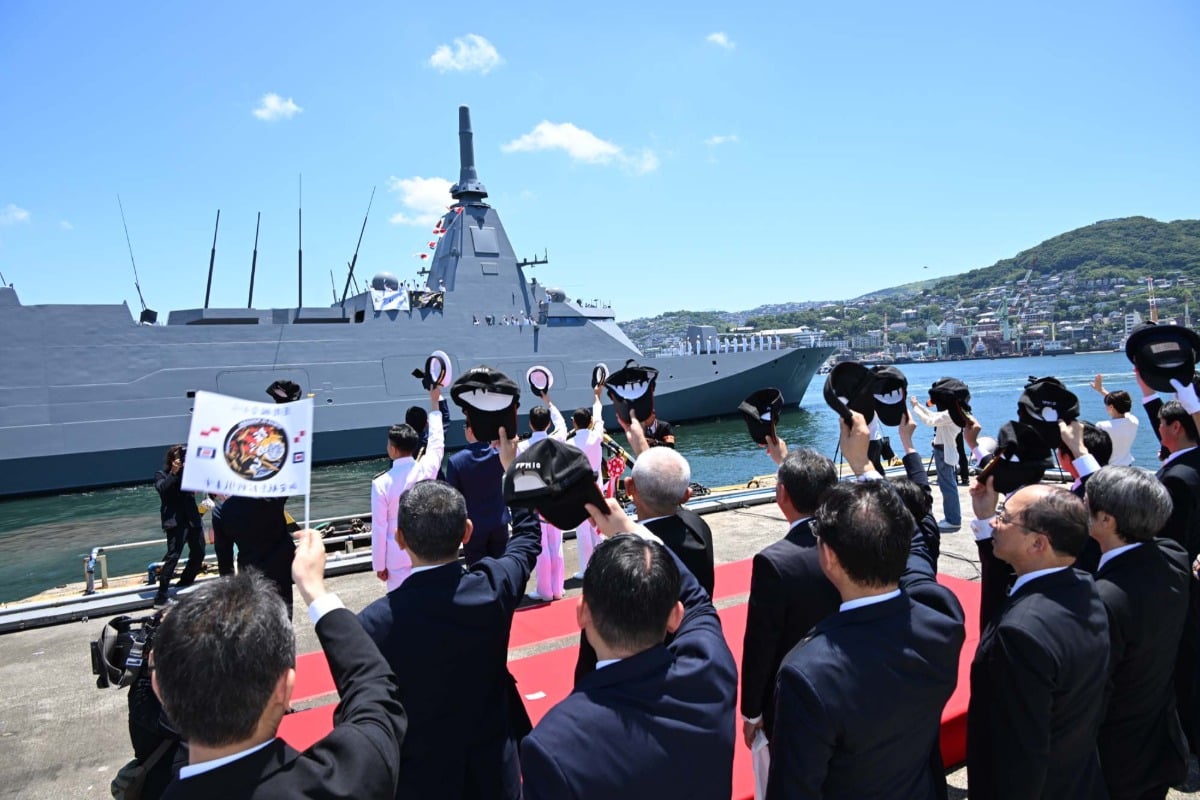
The launching of the tenth Mogami-class frigate by Mitsubishi Heavy Industries (MHI) marks a fundamental shift in naval ship construction timelines, challenging traditional paradigms of defense procurement. Standard naval acquisitions among G7 nations routinely suffer from structural inflation and multi-year schedule slippages. Japan’s Maritime Self-Defense Force (JMSDF) has reversed this trend by compressing the construction-to-launch cycle of a 5,500-ton surface combatant to less than two years per vessel.
This production velocity is not the result of simple industrial scaling. It is achieved through a deliberate alignment of modular design principles, fixed-variable cost decoupling, and a strictly enforced freeze on late-stage design modifications. Analyzing the Mogami-class program reveals a blueprint for high-density industrial execution that optimization strategists can isolate into three distinct operational pillars. If you found value in this post, you should read: this related article.
The Tri-Arch Architecture of Rapid Surface Combatant Procurement
Naval shipyards typically treat every vessel in a class as a bespoke engineering project. Minor adjustments to sensor suites or crew quarters are introduced iteratively, compounding lead times and disrupting supply chains. The JMSDF bypassed this vulnerability by establishing a rigid baseline configuration across the entire first batch of twelve vessels.
1. Geometric Modularization and Hull Division
The physical construction of a Mogami-class frigate relies on a block-construction methodology where the hull is divided into standardized geometric segments manufactured in parallel. For another look on this development, refer to the recent coverage from The Next Web.
- Pre-outfitting Efficiency: Up to 80% of internal piping, electrical cabling conduits, and structural foundations are installed within individual blocks before they are welded together in the dry dock. This eliminates the ergonomic bottlenecks associated with running cables through completed, cramped ship hulls.
- Dual-Yard Parallelism: Production load is distributed across two primary facilities—MHI Nagasaki and Mitsui E&S Shipbuilding (as a subcontractor). Because the interfaces between structural blocks are defined by precise geometric tolerances, sections fabricated at different geographic locations integrate seamlessly during final assembly.
2. The Fixed Hull, Variable Payload Cost Function
The primary driver of cost overruns in modern defense programs is the integration of evolving software and radar technologies into a static physical platform. The Mogami-class mitigates this via a decoupled lifecycle strategy. The hull, propulsion system (a Combined Diesel and Gas arrangement utilizing a Rolls-Royce MT30 gas turbine), and core electrical grid are treated as fixed infrastructure. The combat management system (CMS) and sensor arrays are treated as modular, hot-swappable variables.
Total Vessel Cost = Fixed Infrastructure Cost + Variable Payload Cost
Where:
Fixed Infrastructure = Hull + Propulsion + Electrical Grid (Low variance)
Variable Payload = OPY-2 Radar + Combat Management System + Sonar Suites (High variance)
By standardizing the interface power requirements and data buses across the vessel, the JMSDF can upgrade radar components or electronic warfare suites mid-lifecycle without requiring structural dry-dock re-engineering.
3. Personnel Minimization via Automation Economics
The underlying driver for the Mogami’s compact design is Japan's acute demographic constraint. A shrinking labor pool means the JMSDF must operate larger fleets with fewer sailors. The Mogami-class reduces core crew requirements to approximately 90 personnel, compared to the 200+ sailors required for legacy Asagiri and Murasame-class destroyers.
This 55% reduction in human capital overhead is enabled by centralized automation. The vessel features an advanced, multi-function console information center with a circular augmented reality wall. This architecture consolidates the traditional functions of the bridge, damage control center, and combat information center into a unified command locus.
Operational Trade-offs and Vulnerabilities
Accelerated production timelines and radical automation introduce specific engineering compromises that limit the operational flexibility of the platform. A rigorous analysis requires balancing manufacturing efficiency against combat survivability.
Structural Density vs. Damage Control Redundancy
Compressing a 5,500-ton displacement vessel into a length of 133 meters results in high internal density. While automation reduces the crew required for normal steaming and weapon deployment, it creates a critical vulnerability during damage control scenarios. If a kinetic impact breaches multiple compartments, a 90-person crew lacks the physical numbers required to simultaneously fight structural fires, shore up bulkheads, and maintain combat operations over an extended multi-day engagement.
VLS Hull Space Allocation Realities
The rapid launch schedule achieved by MHI was partly sustained by delaying the installation of complex vertical launching systems (VLS) on early hulls. While the vessels were delivered "fitted for but not with" 16-cell Mk 41 VLS systems, the structural space allocated for these cells sat empty during early deployments. Retrofitting these systems post-launch requires taking the vessels out of active rotation, creating a temporary operational deficit that offsets initial production speed advantages.
The Strategic Projection
The production cadence of the Mogami-class provides a definitive indicator of future surface fleet compositions in the Indo-Pacific. The structural data points collected from the first ten hulls indicate that Japan has established a repeatable manufacturing framework capable of delivering a baseline surface combatant every 10 to 12 months.
The final strategic move for regional operators is the transition from the base Mogami design to the upcoming "New FFMs" (an evolved 6,200-ton variant). Because the core block-construction interfaces, propulsion geometries, and automated command logic were validated during the rapid build of the first ten hulls, the risk profile for the larger variant is significantly lower than typical first-of-class projects. Production lines will transition to the heavier variant with minimal re-tooling layout adjustments, locking in a continuous, predictable delivery schedule of high-capability surface combatants through the early 2030s.