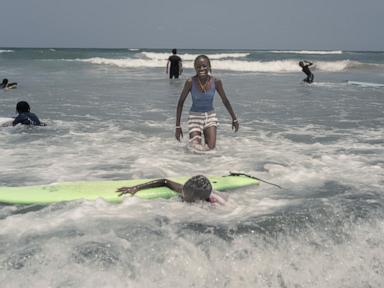
The global surf industry generates billions of dollars annually, yet the coastal nations producing world-class waves capture almost none of the equity. Nowhere is this structural imbalance clearer than in Senegal. Situated on the westernmost tip of Africa, the Cap-Vert peninsula acts as a natural swell magnet, intercepting consistent North Atlantic groundswells from November through March and South Atlantic swells during the summer months. Despite possessing elite wave infrastructure—most notably around Dakar, Ngor Island, and Yoff—local Black surfers face severe resource deficits that prevent them from transitioning from recreational participants to industry owners and professional competitors. Reclaiming these waves requires dismantling a specific set of economic, logistical, and historical barriers that currently keep surf capital concentrated in foreign hands.
The Structural Deficit of Surf Infrastructure
The primary obstacle facing Senegalese surfers is not a lack of talent or geographic advantage, but a broken supply chain. Surfing is an equipment-intensive sport reliant on imported petrochemicals, fiberglass, polyurethane foam, and epoxy resins. Senegal has zero domestic large-scale surfboard manufacturing plants. Every surfboard, leash, traction pad, and block of surf wax must be imported, primarily from Europe, the United States, or South Africa.
This import dependency creates a punitive cost function for local athletes:
- Tariff and Freight Multiplication: Shipping oversized, fragile cargo like surfboards into Dakar incurs steep air or sea freight fees, compounded by customs duties. A standard shortboard retailing for $700 in Biarritz or California often costs well over $1,000 in Dakar once logistics and import taxes are factored in.
- Purchasing Power Disparity: According to World Bank macroeconomic indicators, Senegal’s Gross National Income per capita sits below $1,700. When a single piece of essential sporting equipment costs more than half a year's average income, participation is mathematically restricted to a tiny elite or those dependent on foreign charity.
- The Repair Bottleneck: Without local access to raw materials like UV-cure resin, fiberglass cloth, and Q-cell filler, a minor ding on a reef break like Ouakam or Vivier can render a board unusable for months. Local shapers and ding-repair technicians are forced to improvise with automotive body fillers and heavy marine resins, which add dead weight to boards and destroy their hydrodynamic performance.
Because of this supply chain failure, the Senegalese surf community operates largely within a hand-me-down economy. Local surfers rely on used, often delaminated boards left behind by visiting surf tourists or donated by non-governmental organizations. While donations provide immediate access to the water, they do not build an industry. Relying on discarded foreign gear prevents athletes from riding equipment tailored to their specific height, weight, and wave conditions—a non-negotiable requirement for competitive progression at the international level.
Historical Disconnection and the Cultural Reclamation of the Ocean
To understand why Senegalese surfers must actively "reclaim" their coastline, one must examine the historical and sociological forces that severed West African populations from recreational ocean use. For centuries prior to European colonization, the Lebou people—the indigenous fishing community of the Cap-Vert peninsula—maintained an intimate, sophisticated relationship with the Atlantic. Traditional Lebou fishermen navigated heavy surf zones in wooden pirogues, reading swell intervals, rip currents, and bathymetry with precision. Some historical accounts even suggest early forms of wave-riding on wooden planks along the West African coast predated colonial contact.
The disruption of this maritime culture occurred through two distinct phases. First, the transatlantic slave trade transformed the coastline—exemplified by Gorée Island just off Dakar—from a site of sustenance and cultural identity into a locus of trauma and extraction. Second, French colonial urban planning and post-independence economic policies prioritized industrial port development and commercial fishing over recreational coastal access.
Over generations, a cultural wedge formed between utilitarian ocean labor and recreational ocean leisure. For many working-class families in Dakar, the ocean represented either dangerous physical labor or a hazard to be avoided, particularly given low formal swimming literacy rates. When recreational surfing emerged in Senegal during the late 20th century, it was introduced primarily by French expatriates, diplomats, and transient surf tourists.
This created a spatial and psychological segregation along the coast:
- Enclave Tourism: Surf camps and beachfront properties around Ngor and Almadies were largely developed by foreign capital, catering to European clientele.
- The Service-Tier Ceiling: Local Senegalese youth were integrated into the surf economy almost exclusively as low-wage service providers—acting as surf guides, ding repairmen, beach boys, or instructors for foreign-owned camps—rather than as equity owners or sponsored professionals.
- Cultural Gatekeeping: Because the sport was framed as a luxury leisure activity for wealthy outsiders, young Senegalese surfers frequently faced skepticism from their own communities, who viewed time spent surfing as unproductive compared to traditional trades or formal schooling.
Reclaiming the waves in Senegal therefore involves a dual cultural shift. Surfers must assert their historical birthright to the Atlantic against foreign commercial dominance while simultaneously legitimizing surfing as a viable athletic and economic pursuit within Senegalese society.
The Economics of Surf Tourism and Capital Flight
The modern surf tourism model in West Africa suffers from severe capital leakage. When a European surfer books a two-week surf trip to Dakar, the majority of their expenditure never enters the local Senegalese economy. Flights are booked on foreign carriers; accommodation packages are often paid through European booking platforms to foreign-owned surf camps; and equipment is purchased prior to arrival.
The local economic footprint is restricted to marginal transactions: taxi fares, local restaurant meals, boat shuttles across the channel to Ngor Island, and occasional private surf lessons. This dynamic mirrors classic resource extraction models, where the host nation provides the raw natural resource—in this case, world-class point breaks and reef breaks—while external entities capture the high-margin value chain.
Breaking this cycle requires shifting from a labor-export model to an ownership model. Currently, a talented Senegalese surfer might earn a daily wage teaching a tourist how to stand up on a foam board at Yoff beach. That transaction caps the local surfer’s earning potential at their hourly labor rate. True economic sovereignty occurs only when Senegalese entrepreneurs own the hospitality infrastructure, control the digital booking channels, and manage the brand equity associated with Senegalese surf culture.
Competitive Pathways and the Qualification Trap
The inclusion of surfing in the Olympic Games—debuting at Tokyo 2020 and continuing through Paris 2024 and Los Angeles 2028—altered the institutional incentives surrounding the sport. In theory, Olympic recognition unlocks state funding through national Olympic committees and international federations like the International Surfing Association (ISA). In practice, Senegalese surfers face a structural qualification trap.
To qualify for the Olympics or advance onto the World Surf League (WSL) Championship Tour, athletes must accumulate points across a global circuit of Qualifying Series (QS) and Challenger Series events. This system heavily penalizes athletes from the Global South through three compounding mechanisms:
- Geographic Isolation: Africa hosts very few WSL-sanctioned events, and almost none in West Africa. A Senegalese competitor must travel to South Africa, Morocco, Europe, or Latin America to earn ranking points.
- Visa Friction: Holding a Senegalese passport imposes severe bureaucratic and financial hurdles. Applying for Schengen visas for European events or visas for North America requires proof of substantial bank balances, confirmed flight itineraries, and weeks of processing time—often resulting in arbitrary denials that force athletes to forfeit entry fees and competitive opportunities.
- The Sponsorship Paradox: Corporate surf brands allocate marketing budgets based on consumer market size. Because Senegal does not represent a lucrative retail market for wetsuits, apparel, or surfboards, global surf brands have little commercial incentive to sponsor Senegalese athletes, regardless of their raw talent in heavy reef waves. Without corporate sponsorship, athletes cannot self-fund international travel; without international travel, they cannot achieve the competitive results needed to attract sponsorship.
This closed loop ensures that even elite Senegalese wave riders remain largely invisible on the global competitive stage, while athletes from wealthier nations with inferior local wave quality advance simply because they can afford the travel logistics.
Operationalizing Local Surf Sovereignty
Overcoming these deficits requires abandoning reliance on sporadic foreign charity and executing a coordinated, multi-tiered development strategy. Grassroots organizations in Dakar—such as local surf clubs and youth initiatives—have already proven that demand and athletic aptitude exist. Scaling this into a self-sustaining ecosystem requires targeted intervention across four operational pillars.
1. Localized Micro-Manufacturing and Material Sourcing
Establishing full-scale polyurethane foam production in Senegal is currently unfeasible due to industrial chemical regulations and capital requirements. However, localizing surfboard shaping and repair is entirely achievable through alternative materials.
Local shapers can bypass expensive imported foam blanks by utilizing indigenous woodworking skills—a craft already deeply embedded in Senegalese pirogue construction. Hollow wooden surfboards built from locally sourced, lightweight West African timber species (such as Samba or Obeche) combined with minimal fiberglass sealing offer a durable, high-performance alternative suited to powerful Atlantic swells. Alternatively, establishing bulk import cooperatives for raw EPS foam blocks and bio-resins allows local shapers to machine and glass boards domestically, cutting retail costs by eliminating finished-good import tariffs and retail markups.
2. Institutionalizing Federation Governance
To unlock state sports ministry budgets and international Olympic solidarity grants, the Senegalese surfing body must operate with strict administrative transparency. National federations often fail to secure funding not because money is unavailable, but because they lack audited financial reporting, standardized national ranking systems, and formal coaching certifications.
By formalizing a domestic competitive tour across Dakar’s breaks—from the forgiving beach breaks of Yoff to the heavy slab of Club Med and the technical wall of Ngor Right—the federation can generate objective performance data. This data provides the necessary justification for the Senegalese Ministry of Sports and private domestic telecom or banking sponsors to fund international travel for the top two or three ranked national athletes, concentrating limited capital where it yields the highest competitive return.
3. Capturing Domestic and Regional Tourism Equity
Senegalese surf entrepreneurs must target two under-monetized demographics: the growing West African middle class and the global Black diaspora.
Marketing surf tourism exclusively to budget-conscious European backpackers reinforces low-margin pricing. By developing mid-to-high-tier surf and cultural retreats owned entirely by Senegalese operators, local businesses can capture direct bookings from diaspora travelers seeking heritage-connected experiences in West Africa. Simultaneously, partnering with private schools in Dakar to integrate swimming and ocean safety into physical education curricula builds a domestic customer base, reducing reliance on seasonal international tourism.
4. Technical Coaching and Video Analytics
In modern competitive surfing, heat strategy and wave selection are just as critical as physical maneuver execution. Historically, Senegalese surfers learned through peer observation, which excels at building tube-riding and rail-surfing fundamentals on heavy reefs but often leaves gaps in competitive heat management, priority rules, and progressive aerial maneuvers.
Deploying low-cost video analysis tools—filming training sessions from the beach and reviewing clips immediately via mobile devices—accelerates technical progression without requiring expensive foreign coaching staff. Pairing this with structured physical conditioning tailored to rotational core power and breath-hold capacity prepares local athletes for the specific physiological demands of international competition.
Limitations of Grassroots Models
A realistic assessment must acknowledge the constraints of these strategies. Community-led surf initiatives in Senegal frequently suffer from founder burnout and resource diversion. When a local surf club doubles as an informal social safety net—providing meals, academic tutoring, and life skills to impoverished youth—its operational bandwidth for elite athletic development is severely diluted.
Furthermore, coastal erosion and rampant real estate speculation along the Dakar coastline pose an existential threat to the physical wave infrastructure itself. Unregulated beachfront construction and seawall installations alter sandbar migration and threaten public beach access points. Without municipal zoning protections safeguarding public right-of-way to breaks like Ngor and Ouakam, economic empowerment strategies risk becoming irrelevant as the coastline is privatized.
The Strategic Play for Senegalese Surf Capital
The path forward for Black surfers in Senegal is not an appeal for greater inclusion within the traditional Western surf industry, which is itself contracting and consolidating. Instead, the optimal strategy is vertical integration at the local level. Senegalese surf leaders must pivot from seeking sponsorships from legacy surf brands to forming equity partnerships with non-endemic domestic corporations—specifically Senegalese telecommunications firms, regional airlines, and financial institutions—positioning surfing as a premier youth lifestyle and national pride asset. Concurrently, establishing a cooperative shaping bay and digital booking collective in Dakar will trap tourism revenue locally, converting Senegal's natural wave capital into permanent, locally owned infrastructure.