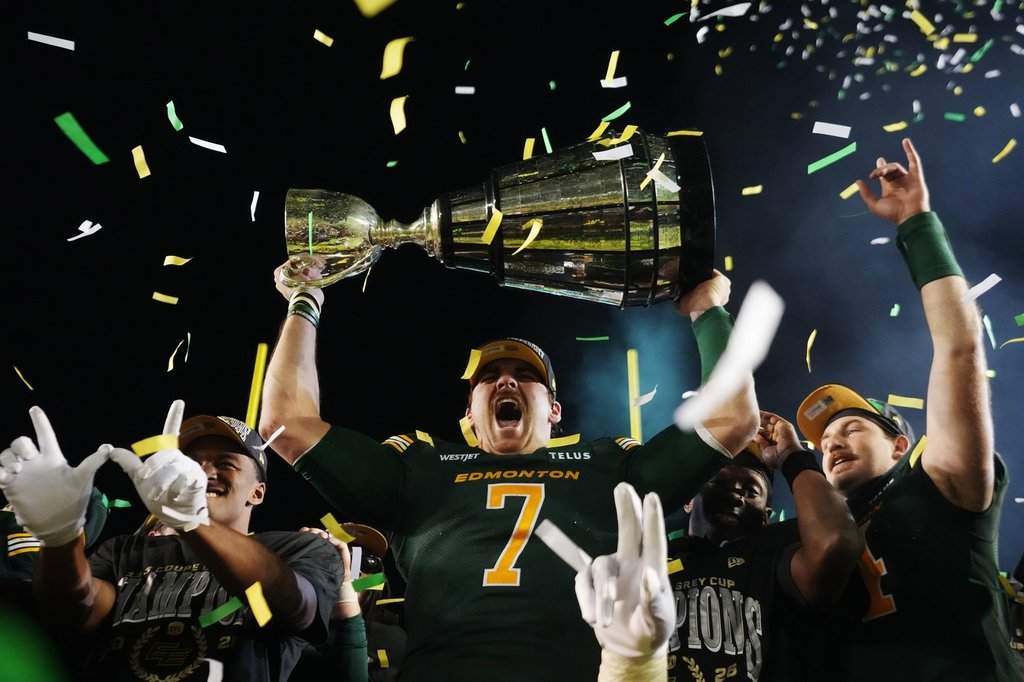
The confetti always looks the same from street level. When the Edmonton Elks roll down Jasper Avenue or gather at Sir Winston Churchill Square to celebrate a Grey Cup championship, the immediate spectacle is pure civic catharsis—thousands of fans braving the sub-zero Alberta November chill, players hoisting the tarnished silver mug from the back of flatbed trucks, and city officials proclaiming the return of the "City of Champions."
Beneath the surface of a Grey Cup parade, however, lies a far more complicated reality for the Edmonton franchise and the Canadian Football League as a whole. A championship celebration in Edmonton is never just a party. It is a high-stakes financial reset button, a desperate bid to recapture a fractured fanbase, and a temporary mask over structural challenges that have plagued the organization for over a decade.
To understand why an Edmonton Elks Grey Cup parade carries so much weight, you have to look past the highlight reels and examine the business of Canadian football in Northern Alberta.
The Economics of a Championship Parade in Edmonton
Professional sports parades are notoriously expensive, logistically brutal undertakings, and in a mid-market Canadian city dealing with late-autumn weather, the margin for error is razor-thin. Unlike Major League Baseball or NBA parades that unfold in warm spring or summer sunshine, a Grey Cup celebration happens in late November. Temperatures in Edmonton routinely dip well below freezing, turning a multi-hour outdoor rally into an endurance test for both athletes and taxpayers.
The financial split for these events is rarely simple. Typically, the municipal government absorbs the heavy operational costs—police overtime, road closures along major arteries like Jasper Avenue, transit rerouting, and emergency medical services—while the franchise covers staging, audio-visual production, and player logistics.
For the Elks, that expenditure is treated less as a celebration expense and more as an aggressive customer acquisition cost.
Consider the franchise's recent trajectory. For decades, the Edmonton football club was the gold standard of the CFL, boasting an unmatched string of 34 consecutive playoff appearances from 1972 to 2005 and regularly packing Commonwealth Stadium with over 40,000 spectators per game. Over the past ten years, however, that invincibility evaporated. A combination of on-field mediocrity, an agonizingly long home losing streak that stretched across multiple seasons, the turbulent 2021 rebranding from the Eskimos to the Elks, and shifting entertainment habits among younger demographics hollowed out the stadium bowl.
When attendance drops from 35,000 to barely 20,000, a community-owned franchise bleeds cash. Every empty aluminum bleacher seat at Commonwealth Stadium represents lost ticket revenue, unsold concession beer, and diminished merchandise sales.
In that context, a Grey Cup parade serves as the ultimate marketing blitz. You cannot buy the kind of earned media generated by tens of thousands of people lining downtown streets in green and gold. Local news broadcasts run wall-to-wall coverage. Social media feeds flood with images of civic pride. The franchise immediately deploys ticket sales representatives to convert that emotional high into season-seat deposits for the following summer.
Whether that emotional spike translates into sustained revenue, however, is where history urges caution.
The Myth of the Championship Bump
There is a persistent belief in sports management that winning a title automatically fixes everything. Win the Grey Cup, throw a parade, and the turnstiles will spin effortlessly for the next five years.
The data across the CFL tells a much colder story.
While a championship reliably produces a measurable championship bump in the immediate offseason—typically a 10 to 15 percent surge in season-ticket renewals and corporate sponsorship inquiries—that goodwill has a strict expiration date. In modern sports, fan loyalty is transactional and heavily tied to current performance rather than past glory.
If the Elks follow up a parade with a slow start the next June, the euphoria from November vanishes before Canada Day. Fans who bought into the hype during the winter freeze will stay home in July if the product on the field stagnates or if the in-stadium experience feels dated.
Furthermore, a parade highlights a growing demographic divide in Edmonton's sports culture. Walk the parade route and you will see generations of die-hard CFL traditionalists—fans who remember the Warren Moon dynasty, the Ricky Ray era, and the fierce Battle of Alberta rivalries with Calgary. What you see far less of are twenty-somethings and new Canadians who have gravitated toward the Edmonton Oilers, global soccer, or digital entertainment.
The Oilers, led by generational superstars and playing in the sleek, downtown Rogers Place arena, have effectively captured the lion's share of Edmonton's corporate dollars and youthful energy. Meanwhile, the Elks play in Commonwealth Stadium—an iconic, massive 56,000-seat concrete bowl built for the 1978 Commonwealth Games that can feel cavernous and sterile when half-empty.
A parade temporarily bridges that gap by bringing the team directly into the downtown core, literally parading the trophy past the shadow of Rogers Place. It reminds the city that the Elks still exist and can still deliver hardware. Yet once the barricades come down and the street sweepers clear the confetti, the franchise still has to convince a skeptical public to commute to Stadium Station on a Friday night in August.
Ownership Transitions and the High Stakes of Civic Pride
Another critical factor often overlooked in standard parade coverage is the governance structure of the Edmonton franchise. For nearly its entire existence, the club operated as a community-owned entity, governed by a volunteer board of directors rather than a billionaire owner.
While community ownership fostered a deep sense of public stewardship, it also left the team vulnerable during financial downturns. Without a deep-pocketed private owner to absorb multi-million-dollar operating losses during lean years, the franchise burned through its financial reserves at an alarming rate.
The shift toward private ownership—a monumental change in the club's history—fundamentally alters the meaning of a championship celebration. Under a private ownership model, a Grey Cup parade is not just a reward for long-suffering fans; it is proof of concept for an investor who stepped in to rescue a distressed asset.
Think about what a championship does for a private owner's leverage:
- Corporate Sponsorships: Negotiating naming rights, jersey patches, and stadium signage becomes exponentially easier when the pitch deck features photos of a championship trophy and a packed Churchill Square.
- Municipal Negotiations: Stadium lease agreements, facility upgrades, and transit partnerships with the City of Edmonton are always contentious. An owner riding a wave of civic popularity holds far stronger political cards at City Hall than one presiding over a last-place team.
- Brand Stabilization: For years, the Elks name and antler logo were caught in cultural crossfire, with a vocal segment of older fans boycotting the team over the name change while newer fans remained indifferent. Winning a Grey Cup in the Elks uniform legitimizes the brand in a way no PR agency ever could.
You cannot argue with a ring. When players hoist the Grey Cup wearing the double-E antler helmet, the franchise finally builds authentic, winning equity attached to its modern identity.
What Happens Inside the Locker Room After the Route Ends
From the outside, a parade looks like the end of a journey. For players, coaches, and general managers in the CFL, it is actually the starting gun for the most ruthless phase of the business: roster dismantling.
The Canadian Football League operates under a strict, non-negotiable salary cap. Unlike the NFL, where creative accounting and void years allow teams to push cap hits into the distant future, the CFL cap is rigid. Every dollar counts, and winning a championship immediately inflates the market value of the entire roster.
During the parade, fans cheer for the starting quarterback, the lockdown cornerbacks, the Canadian ratio-busting offensive linemen, and the breakout receivers. Behind the scenes, the general manager is already calculating which of those heroes the team can no longer afford.
In the CFL, where one-year and two-year contracts are the norm rather than the exception, a Grey Cup winner instantly becomes a prime target for rival clubs when free agency opens in February. Teams in Winnipeg, Toronto, Saskatchewan, and BC watch the parade knowing full well that Edmonton cannot pay market rate to keep all 45 roster spots intact.
Consider the ripple effects of that parade exposure:
- Role Players Become Overpaid Starters: A backup linebacker who makes a splash play in the Grey Cup game and gets featured on local broadcasts during the parade suddenly commands starter money from a desperate team out East.
- Coaching Staff Poaching: Coordinators who engineered the championship run become immediate head-coaching candidates elsewhere in the league, forcing the franchise to rebuild its playbooks from scratch.
- The Hangover Effect: Celebrating a title in late November compresses an already short offseason. Players who played through torn labrums, broken ribs, and concussions to win the title have less time to rehab before training camp opens in May.
The irony of a Grey Cup parade is that the very success being celebrated guarantees that the exact group of men standing on those trucks will never take the field together again.
The CFL's National Visibility Problem
Zoom out from Edmonton, and a Grey Cup parade reveals an uncomfortable truth about the Canadian Football League's broader national footprint.
In cities like Regina, Winnipeg, and Edmonton, a Grey Cup victory brings the entire municipality to a standstill. Schools adjust schedules, office workers take extended lunches, and local politicians wear jerseys to press conferences. In Western Canada, the CFL remains deeply woven into the civic fabric.
Contrast that with the league's reality in Toronto, Montreal, and Vancouver. When the Toronto Argonauts win a Grey Cup, the subsequent celebration is often a modest gathering at Maple Leaf Square that barely registers on the radar of a city obsessed with the Maple Leafs, Raptors, and Blue Jays.
This regional disparity puts immense pressure on franchises like the Edmonton Elks. The CFL relies heavily on its Western powerhouse markets to drive television ratings on TSN, generate merchandise revenue, and prove to national advertisers that Canadian football is still a major-league property.
When Edmonton thrives—when Commonwealth Stadium is loud and Jasper Avenue is clogged with celebrating fans—the entire league breathes easier. The images of a massive Edmonton parade are used by the league office in Toronto as vital promotional material to sell the CFL's relevance to broadcasters and sponsors across the country.
Yet relying on nostalgic civic parades to project league health carries massive risks. Televised crowds in cold weather look inspiring on a Sunday afternoon news clip, but they do not solve the league's struggle to capture the 18-to-34 demographic in major urban centers. A parade celebrates tradition, and while tradition is the CFL's greatest strength, clinging too tightly to the past has often prevented the league from modernizing its presentation and digital reach.
Why Fans Keep Showing Up in the Freezing Cold
If the economics are fragile, the roster is doomed to break apart, and the stadium still faces long-term attendance hurdles, why do thousands of people still stand in minus-fifteen-degree weather for hours just to catch a glimpse of a silver trophy?
Because in a northern city, sports victories function differently than they do in sunbelt markets.
Edmonton is a blue-collar, resource-driven city that endures long, dark winters and intense economic boom-and-bust cycles. Civic pride here isn't casual; it is hard-earned and fiercely defensive. For decades, winning championships was how Edmonton announced its presence to the rest of Canada, pushing back against the perception of being an isolated prairie outpost.
A Grey Cup parade taps directly into that collective psyche. It is one of the few remaining communal experiences where socioeconomic lines blur completely. Construction workers from Nisku, university students from the U of A, downtown corporate executives, and retirees who have held season tickets since the 1970s stand shoulder-to-shoulder on the exact same icy sidewalks.
In an era where entertainment is increasingly isolated—consumed on personal screens through algorithmic feeds—a championship parade forces physical, shared joy. You cannot stream the feeling of a brass band echoing off downtown office towers or the roar of a crowd when the trophy is lifted overhead.
That raw human connection is the one asset the Edmonton Elks possess that no spreadsheet can fully quantify and no rival entertainment option can easily replicate.
The Real Test Begins When the Confetti Clears
The danger for any front office is mistaking a great parade for a finished rebuild.
As the Edmonton Elks celebrate their Grey Cup triumph, the temptation will be strong to declare the dark days officially over—to assume that the losing streaks, the attendance woes, and the identity struggles have been permanently cured by a single November victory.
History proves otherwise. Championships are intoxicating, but they are terrible long-term business plans if they aren't backed by structural discipline.
If the Elks want this parade to mark the beginning of a true modern dynasty rather than a fleeting nostalgic detour, the real work starts the morning after the rally ends. It requires aggressive pricing strategies to keep families in Commonwealth Stadium, relentless community outreach to win over younger and more diverse fans, and cold-blooded roster management to navigate the brutal realities of the CFL salary cap.
The parade gives the franchise the microphone back. What they choose to do with the city's attention once the winter snow buries the last scraps of green and gold confetti will determine whether Edmonton truly stays on top.