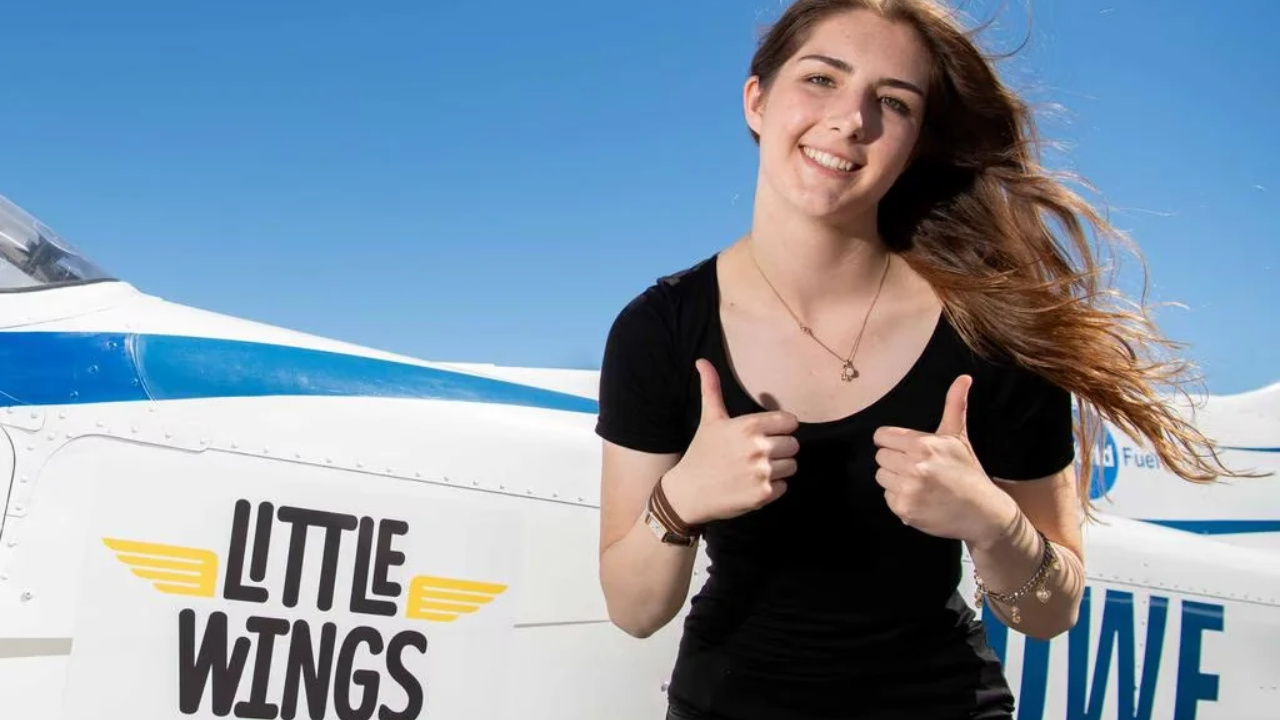
At 18 years old, Australian pilot Rose Donald flew a light aircraft 15,000 kilometers solo around the Australian continent, raising $80,000 for children's charities. While most teenagers her age were navigating university applications or entry-level jobs, Donald spent weeks managing fuel burn calculations, shifting weather fronts, and controlled airspace alone in a cockpit. Her mission went far beyond setting a personal milestone. It converted a grueling endurance test into direct financial support for hospitalized children and their families, proving that youth aviation records can serve a tangible humanitarian purpose rather than simply collecting dust in a logbook.
The mainstream press loves a neat human-interest story. A smiling teenager standing beside a single-engine propeller plane makes for easy morning television. Yet focusing exclusively on the heartwarming optics misses the actual story. Flying 15,000 kilometers solo across Australia is not a scenic joyride; it is an unforgiving exercise in risk management, logistical endurance, and financial engineering.
The Brutal Reality of General Aviation Logistics
To understand what Rose Donald accomplished, you have to strip away the romance of flight and look at the spreadsheets. General aviation in Australia operates across vast, sparsely populated distances where infrastructure is thin and mistakes carry fatal consequences. When you fly over the coastal hubs of Sydney or Melbourne, help is minutes away. When you cross the Northern Territory or the Nullarbor Plain, you are flying over terrain where an engine failure means survival depends entirely on what you packed behind your seat.
Solo cross-country pilots act as their own flight dispatchers, meteorologists, and maintenance chiefs. Every leg of a 15,000-kilometer route requires precise weight-and-balance math. Carry too much fuel, and you compromise climb performance on hot outback airstrips where high density altitude thins the air. Carry too little, and a sudden 30-knot headwind turns a routine landing into an emergency fuel exhaustion scenario.
Donald had to manage this cognitive load day after day without a co-pilot to share the workload. In a two-crew cockpit, one pilot flies while the other works the radios, checks weather updates, and monitors engine temperatures. Alone, every checklist, frequency change, and navigational diversion falls on one pair of hands. Fatigue accumulates quietly. By the third week of a multi-leg expedition, the greatest threat to a pilot is rarely mechanical failure; it is decision fatigue.
Why Charity Flights Often Fail Before Takeoff
The aviation world is littered with well-intentioned charity flights that quietly collapse under their own expenses. Fuel, landing fees, aircraft maintenance, insurance, and accommodation burn through capital at an alarming rate. Avgass—aviation gasoline—is expensive even at major airports, and prices spike dramatically at remote regional strips where fuel has to be trucked in over hundreds of kilometers.
This creates an ethical trap that veteran industry observers watch closely. If a pilot raises $100,000 from the public but spends $75,000 operating the aircraft, the charity receives a fraction of the headline number. Donors rarely ask for the expense ratio, and organizers rarely volunteer it.
Succeeding at the scale Donald achieved requires separating operational funding from charitable donations. Corporate sponsors, aviation suppliers, and local businesses have to underwrite the direct costs of keeping the propeller turning so that public donations flow directly to the intended beneficiaries. Raising $80,000 for sick children at 18 means Donald was not just flying the airplane; she was running a small fundraising enterprise, pitching sponsors, managing media appearances at regional stops, and maintaining public momentum across weeks of unpredictable weather delays.
The Structural Barriers Facing Young Pilots
Aviation remains an overwhelmingly older, male-dominated industry. According to global aviation workforce data, women still account for a single-digit percentage of commercial airline pilots worldwide, and the numbers in general aviation leadership are scarcely better. Breaking into this environment at 18 requires navigating both financial gatekeeping and subtle institutional skepticism.
Obtaining a Private Pilot Licence (PPL) demands dozens of hours of flight instruction, rigorous ground school exams covering aerodynamics, air law, and meteorology, and substantial upfront capital. Most people cannot afford to pursue flight training until their late twenties or thirties, if ever. Those who start in their teens usually rely on intense sacrifice, scholarships, or family support just to reach their first solo flight.
Once licensed, young pilots face a credibility gap. Walk into a regional aeroclub at 18 with a flight plan spanning 15,000 kilometers, and you will meet seasoned aviators who assume you lack the judgment to handle sudden coastal squalls or remote desert airstrips. Judgment in aviation is usually bought with years of accumulated minor mistakes. A teenage pilot has to prove she possesses that discipline prematurely, demonstrating strict adherence to personal weather minimums and resisting the deadly temptation of get-there-itis—the psychological pressure to push through bad weather just to stay on schedule.
The Psychology of Get-There-Itis
Consider a hypothetical scenario common to long-distance charity flights. A pilot is scheduled to land at a regional town at 2:00 PM, where a local school, two radio reporters, and a group of donors are waiting on the tarmac. Sixty miles out, a line of convective thunderstorms builds across the flight path. Turning back or diverting to an alternate airfield ruins the media event, disappoints sponsors, and disrupts hotel bookings.
For an experienced airline captain, diverting is routine. For an 18-year-old carrying the weight of public expectations and an $80,000 fundraising target, the pressure to press on into deteriorating visibility is immense. Resisting that pressure—choosing safety over publicity—is the real metric of airmanship.
What $80,000 Actually Buys in Pediatric Care
Numbers in charity headlines often feel abstract, so it helps to ground $80,000 in the operational reality of pediatric healthcare. Children's hospitals and support foundations operate on tight budgets where government funding typically covers acute medical procedures, leaving critical gaps in family support, specialized equipment, and non-clinical care.
An $80,000 injection of unrestricted or targeted charitable funding translates into concrete resources:
- Family accommodation: When a child from a regional area requires long-term oncology treatment or complex surgery in a major city, families face crippling hotel and travel bills. Eighty thousand dollars can fund hundreds of nights of free lodging near hospital wards, keeping parents beside their children during critical recovery windows.
- Specialized pediatric equipment: Standard hospital monitors and infusion pumps are often scaled for adults. Pediatric wards rely heavily on donor funding to purchase miniature diagnostic tools, distraction therapy devices for painful procedures, and portable monitoring units that allow sick children to leave the hospital sooner.
- Research seed grants: Early-stage clinical research into rare childhood diseases often struggles to attract major pharmaceutical backing. Philanthropic grants of this size frequently fund the initial data collection needed to unlock multi-million-dollar institutional funding later.
Because Australia's population is heavily concentrated along the eastern seaboard, families living in rural and outback communities bear a disproportionate burden when a child falls seriously ill. A flight that physically connects remote regional airstrips with major coastal centers mirrors the exact logistical challenge those families face every time they need specialist medical care.
Beyond the Headline Record
Youth aviation stunts often follow a predictable arc. A young pilot sets a distance or age record, enjoys a brief burst of local media attention, and then disappears from public view as the realities of building a commercial aviation career take over. Turning a solo circumnavigation into a commercial airline seat still requires hundreds of additional flight hours, an Instrument Rating, a Commercial Pilot Licence, and eventually multi-crew jet transition training.
What separates Donald's flight from a simple resume-building exercise is the discipline required to serve two masters simultaneously. Aviation demands cold, detached focus on physics, fuel, and weather. Fundraising demands warmth, vulnerability, and constant engagement with strangers on the ground. Switching between those two mental states at every refueling stop—stepping out of a noisy, cramped cockpit after five hours of turbulence and immediately speaking clearly to donors about childhood illness—requires emotional stamina that cannot be taught in flight school.
The aviation industry constantly complains about pilot shortages and struggles to attract diverse, resilient talent into the pipeline. Yet the traditional pathways into the cockpit remain expensive, rigid, and largely invisible to high school students. When an 18-year-old successfully plans, finances, and executes a 15,000-kilometer solo expedition while delivering $80,000 to pediatric healthcare, she exposes how outdated those assumptions really are. Young pilots do not need to wait until they are thirty to handle real responsibility; they just need access to the runway.


