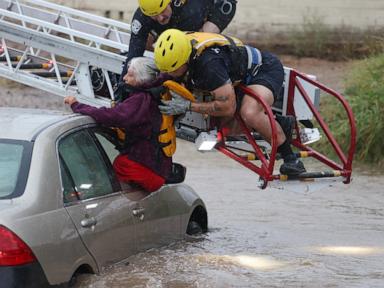
Severe flash flooding across the American Southwest regularly forces emergency evacuations and disrupts Election Day voting, exposing a fragile intersection between aging municipal drainage systems and rigid statutory election calendars. When heavy autumn rains hit arid landscapes, dry washes turn into raging torrents within hours. Local election administrators are then forced to relocate polling places, extend voting hours via emergency court orders, or deploy mobile ballot drop-off units while first responders prioritize life-saving rescues over civic logistics.
Most mainstream coverage treats these weather disruptions as freak accidents—unpredictable acts of nature that temporarily inconvenience voters. That framing misses the structural reality on the ground. In desert states like Arizona, New Mexico, Nevada, and parts of Southern California and West Texas, soil composition and rapid urban sprawl amplify the danger of late-season storms. When atmospheric rivers or remnant tropical moisture collide with hard-packed desert earth, water does not soak into the ground. It sheets off asphalt and caliche clay, overwhelming storm drains built for smaller populations decades ago.
The Physics of Desert Flash Floods and Urban Sprawl
To understand why a single storm system can paralyze a regional election, you have to look at the dirt. Desert soils often contain caliche, a hardened natural cement of calcium carbonate that forms beneath the surface. Combined with sparse vegetation, this geological layer acts like a paved parking lot during high-intensity rainfall. Instead of percolating downward to recharge aquifers, rainwater accelerates across the surface, funneling into arroyos, washes, and low-water crossings.
Decades of rapid suburban expansion around hubs like Phoenix, Las Vegas, Tucson, and Albuquerque have compounded this natural vulnerability. Developers have covered millions of acres of permeable desert floor with roofs, driveways, and multi-lane highways. Even well-engineered retention basins have limits. When rainfall rates exceed two inches per hour, municipal storm networks back up quickly, turning primary arterial roads into impassable rivers.
For county election directors, this creates an immediate logistical nightmare. Polling locations are selected months in advance based on population density, parking availability, and compliance with the Americans with Disabilities Act. Schools, community centers, and churches frequently sit near major thoroughfares or natural drainage corridors. When flash flood warnings trigger mandatory evacuations, those exact facilities often become either inaccessible to voters or commandeered by emergency management agencies as Red Cross evacuation shelters.
How Emergency Election Protocols Actually Work
Moving a polling place on Election Day is not as simple as taping a handwritten sign to a locked door. State election codes are notoriously strict, designed to prevent last-minute manipulation or voter suppression. Consequently, county clerks and registrars operate within a narrow legal straitjacket when floodwaters rise.
When a precinct becomes inaccessible, officials typically rely on three mechanisms to salvage the vote.
- Emergency Relocation Orders: Election directors must coordinate with county attorneys and, in many jurisdictions, petition a superior court judge to legally authorize moving a precinct to a dry facility. Every minute spent drafting legal filings is a minute voters are turned away from flooded intersections.
- Vote Center Redirection: Counties that utilize the vote center model—allowing any registered voter in the county to cast a ballot at any open location—fare significantly better than those tied to traditional neighborhood precincts. If one site floods, voters can theoretically drive to higher ground, provided the road network remains intact.
- Provisional and Emergency Balloting: In rural stretches of New Mexico or tribal lands across the Navajo Nation, where dirt roads wash out completely, poll workers may be cut off from central tabulators. In a hypothetical scenario where a rural bridge washes out at 10:00 AM, voters stranded on one side cannot simply drive twenty miles to the next town. Election officials must then decide whether to dispatch high-clearance vehicles with emergency paper ballots or seek court-ordered extensions of voting hours into the following day.
The chain of custody remains the biggest vulnerability during any evacuation. Poll workers are trained to secure ballot boxes, electronic poll books, and tabulating machines before abandoning a building. Yet when water is rising against the doors of a community gymnasium, human survival takes precedence over administrative paperwork. Even a brief gap in documented chain-of-custody logs invites immediate legal challenges from campaign attorneys watching close races.
The Hidden Disparity in Who Gets Cut Off
Storms do not distribute their damage equally. While heavy rain falls across entire metropolitan regions, the infrastructure designed to handle that water varies wildly by neighborhood income and municipal tax base.
Older, working-class neighborhoods and unincorporated rural communities frequently lack modern curb-and-gutter drainage, retention basins, and elevated bridges. In many parts of the Southwest, low-income housing developments sit directly within historic floodplains where land was cheaper to acquire. When floodwaters swamp these areas on Election Day, residents face a compounding barrier. Hourly workers who already have limited time to reach the polls cannot afford to spend two hours detouring around closed highways or waiting out high water.
Native American reservations across the Southwest face an even steeper climb. Vast stretches of the Navajo Nation, Hopi Reservation, and Tohono O'odham Nation rely on unpaved roads that turn into impassable mud traps during heavy autumn rains. A storm that causes a minor commute delay in downtown Phoenix can completely isolate entire chapters on tribal land for days, effectively severing in-person access to the ballot box without a single headline in national outlets.
Mail-In Ballots Are Not a Foolproof Safety Net
Whenever severe weather threatens in-person voting, pundits inevitably point to mail-in voting as the obvious cure. Southwestern states like Arizona and Nevada already see overwhelming majorities of their electorates vote by mail. On paper, early mail voting insulates an election from Election Day weather.
Reality on the ground is messier.
Thousands of voters hold onto their mail ballots until the final day, intending to drop them off in person at a polling place or secure drop box to ensure they are counted on time. When flash floods close roads, those last-minute drop-offs vanish. Furthermore, outdoor ballot drop boxes—even those bolted to concrete pads—are vulnerable to water intrusion if floodwaters rise above street level, while U.S. Postal Service trucks face the exact same road closures as civilian commuters.
In states with strict postmark vs. receipt deadlines, a storm that halts mail delivery on Monday or Tuesday can prevent thousands of valid ballots from reaching county election offices before the statutory cutoff.
The Political Fallout and Litigation Playbook
In an era of razor-thin margins across Southwestern battleground states, a weather emergency is no longer just an operational headache. It is an immediate legal flashpoint.
Whenever a judge extends polling hours in a specific county due to flooding, opposing legal teams scrutinize the decision for partisan advantage. If a predominantly urban, Democratic-leaning precinct stays open two hours late while rural, Republican-leaning precincts close on schedule—or vice versa—lawsuits follow before the polls even close.
The legal arguments usually center on the Equal Protection Clause, with plaintiffs arguing that extending hours in one flooded area alters the rules mid-game for voters elsewhere in the state. Meanwhile, ballots cast during court-ordered extended hours are often segregated as provisional ballots, delaying final election results for days or weeks while appellate courts rule on whether those votes should count.
Why Infrastructure Planning Still Ignores the Election Calendar
State legislatures and county boards spend millions of dollars hardening election systems against cyberattacks, physical security threats, and supply chain disruptions. Almost none of that capital goes toward climate resilience or hydrological risk assessments for polling locations.
Emergency management agencies and election boards often operate in separate silos. Public works departments maintain detailed FEMA flood zone maps and hydrological models showing exactly which intersections flood first during a 10-year or 50-year storm event. Yet county clerks rarely cross-reference those maps when signing facility leases for Election Day.
Fixing this disconnect does not require waiting decades for multi-billion-dollar storm sewer overhauls. Counties can map every proposed polling site against municipal flood data before finalizing precinct lists, deliberately shifting locations out of low-lying drainage basins and away from flood-prone arterial roads. State legislatures can pass clear, pre-authorized emergency continuity statutes that empower election directors to deploy mobile voting units or extend drop-box deadlines automatically when a governor or the National Weather Service issues a flash flood emergency, removing the need for frantic, partisan courtroom battles while water is still rising. Until states treat hydrological data as a core pillar of election security, every autumn storm system across the Southwest will remain a loaded weapon aimed directly at the ballot box.