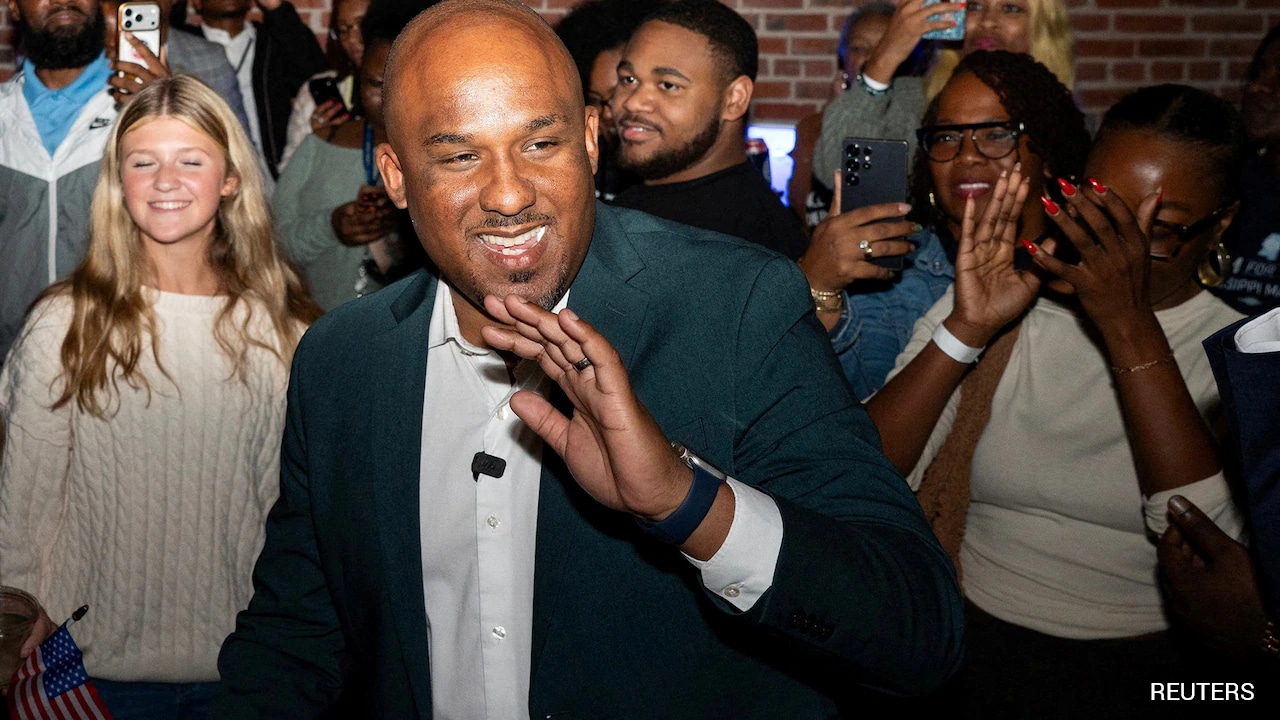
The election of Scott Colom to the United States Senate in Mississippi breaks a 152-year structural monopoly on federal upper-chamber representation, ending an era that began with the departure of Blanche K. Bruce in 1881 following his 1874 election. To understand this outcome merely as a symbolic milestone misses the underlying electoral mechanics that govern statewide races in the Deep South. In a state where racial polarization has historically functioned as an ironclad ceiling for Democratic candidates, flipping a Senate seat requires a precise convergence of demographic mobilization, coalition elasticity, and structural shifts in voter turnout.
Standard political commentary treats statewide elections in Mississippi as static exercises in partisan base turnout. Under that traditional model, the Republican nominee holds an insurmountable mathematical advantage due to inelastic voting patterns among white conservatives. When that model fails, the cause is rarely a sudden ideological conversion of the electorate. Instead, failure occurs when specific structural variables—turnout differentials, suburban realignment, and ticket-splitting mechanics—alter the denominator of total votes cast. For a different view, consider: this related article.
The Structural Ceiling of Southern Statewide Elections
To evaluate the magnitude of a Democratic Senate victory in Mississippi, an analyst must first define the baseline constraint: racialized partisan sorting. For decades, general elections in the state operated near a predictable equilibrium. Black voters, comprising roughly 37 percent of the voting-age population, voted overwhelmingly Democratic, while white voters voted overwhelmingly Republican.
Under normal turnout conditions, this demographic split produces a structural deficit of roughly 12 to 18 percentage points for any statewide Democratic candidate. Overcoming this deficit without a massive demographic migration requires manipulating three distinct operational levers: Similar insight regarding this has been provided by USA Today.
- Differential Turnout: Increasing the share of the electorate represented by high-propensity and episodic Black voters relative to non-college-educated white voters.
- Margin Compression in Suburban Counties: Reducing the Republican vote share in fast-growing, economically diversified counties such as DeSoto, Madison, and Rankin.
- Institutional Credibility: Neutralizing nationalized partisan branding through a localized, law-and-order or prosecutorial profile that appeals to moderate swing voters.
Scott Colom’s trajectory from a local district attorney in the 16th Circuit Court District—covering Lowndes, Oktibbeha, Clay, and Noxubee counties—to a statewide victor demonstrates how institutional credibility interacts with demographic math. Unlike candidates whose resumes are built entirely within partisan advocacy networks, a sitting prosecutor enters a general election with built-in immunity against standard soft-on-crime attacks. This neutralizes a primary wedge issue used to keep moderate suburban voters locked inside the Republican coalition.
Deconstructing the Coalition Architecture
A winning statewide coalition in a high-polarization environment cannot rely on a single geographic or demographic engine. It requires an asymmetric strategy that maximizes yield in core strongholds while minimizing losses in hostile territory.
The Black Belt and Delta Turnout Engine
The foundational layer of any viable Democratic campaign in Mississippi runs through the Mississippi Delta and the Black Belt counties stretching across the eastern border. In low-turnout cycles, under-mobilization in counties like Hinds, Holmes, Leflore, and Noxubee guarantees defeat before suburban ballots are even counted.
Achieving a statewide majority requires pushing turnout in these jurisdictions toward presidential-year benchmarks while maintaining vote shares above 85 percent. The operational mechanism here is field saturation rather than broadcast media. High-touch voter contact, church-to-polls infrastructure, and local down-ballot alignment ensure that registered voters convert into cast ballots. When turnout in Hinds County alone surges past historical off-year averages, it offsets tens of thousands of rural Republican votes across the Piney Woods and Hill Country regions.
The Golden Triangle Proof of Concept
Before scaling statewide, Colom’s electoral viability was tested in the Golden Triangle region—anchored by Starkville, Columbus, and West Point. This district serves as a microcosm of Mississippi’s broader demographic tension. It combines a major research university (Mississippi State University in Oktibbeha County), industrial manufacturing hubs (Lowndes County), and heavily rural, majority-Black agricultural counties (Clay and Noxubee).
Winning and holding the District Attorney seat in this circuit required building an electoral bridge across distinct voter blocs:
- University-Town Progressives and Moderates: Voters concentrated around Oktibbeha County who prioritize institutional competence, economic modernization, and judicial fairness.
- Rural Black Voters: The core base in Clay and Noxubee counties demanding equitable treatment within the criminal justice system and local representation.
- Pragmatic Business Conservatives: Voters in Lowndes County focused on economic stability, predictable law enforcement, and regional development.
Translating this regional coalition to a statewide map means applying the exact same formula to larger population centers. Lafayette County (University of Mississippi) and Forrest County (University of Southern Mississippi) mirror the Oktibbeha dynamic, providing pockets of educated, high-turnout voters who can be mobilized around pragmatic governance.
Suburban Margin Erosion
The decisive battleground in modern Southern politics is the metropolitan ring. In Mississippi, the suburbs surrounding Jackson (Madison and Rankin counties) and the Memphis spillover (DeSoto County) hold massive concentrations of Republican votes. A Democrat does not need to win Rankin or DeSoto counties to win statewide; doing so is statistically improbable in the near term. Instead, the objective is margin erosion.
If a Republican candidate wins DeSoto County by 35 points, the statewide deficit becomes nearly impossible to close. If the Democratic candidate compresses that margin to 20 points through targeted appeals to independent voters and demographic diversification, the statewide math changes entirely. Every percentage point shaved off a Republican margin in Madison or DeSoto functions as a two-point swing in the net statewide tally.
The Historical Baseline Reconstruction Era vs Modern Realignment
Comparing Scott Colom’s victory to the 1874 election of Blanche K. Bruce illuminates how completely the underlying political machinery of Mississippi has transformed over a century and a half. While both events resulted in a Black Mississippian holding a U.S. Senate seat, the selection mechanisms, voter eligibility rules, and party alignments were exact opposites.
In 1874, U.S. Senators were not elected by popular vote. Under the original text of Article I, Section 3 of the U.S. Constitution, state legislatures appointed senators. Bruce, a Republican, was elected by a Mississippi Legislature dominated by a Reconstruction-era biracial coalition. Black voters constituted a majority of the state’s population at the time, and federal enforcement of the Reconstruction Acts temporarily protected their franchise against violent suppression.
Following the end of Reconstruction in 1877, the systematic disenfranchisement of Black citizens via the 1890 Mississippi Constitution—enforcing poll taxes, literacy tests, and arbitrary registration hurdles—eliminated Black political representation at the federal level for generations. Even after the passage of the Voting Rights Act of 1965 dismantled formal legal barriers to registration, statewide elections remained insulated from Black electoral power due to polarized bloc voting and the realignment of white Southern voters from the Democratic Party to the Republican Party.
| Structural Variable | 1874 Election (Blanche K. Bruce) | Modern Election (Scott Colom) |
|---|---|---|
| Selection Mechanism | Indirect appointment by State Legislature | Direct popular vote under the 17th Amendment |
| Party Affiliation | Republican (Party of Reconstruction) | Democratic (Modern multiracial coalition) |
| Electorate Composition | Majority-Black electorate protected by federal troops | Majority-white electorate with high racial polarization |
| Primary Opposition | Disenfranchised former Confederates / Redeemers | Entrenched Republican statewide supermajority |
| Durability Factor | Dependent on federal military enforcement | Dependent on sustained voter turnout and coalition maintenance |
Understanding this distinction prevents faulty historical analogies. Bruce’s tenure ended when the federal government withdrew enforcement mechanisms, allowing state-level actors to legally erase his electorate. Colom’s victory occurred under the 17th Amendment, meaning it was secured by winning an outright plurality or majority of all ballots cast across 82 counties without external federal intervention.
Prosecutorial Positioning as a Counter-Polarization Strategy
In contemporary American politics, federal races suffer from extreme nationalization. Voters frequently cast ballots based on national party brands rather than individual candidate attributes. For a Democrat running in a state that routinely votes Republican by double digits in presidential cycles, nationalization is fatal. If the race becomes a referendum on national Democratic leadership, the structural ceiling holds firm.
Running a sitting District Attorney disrupts the nationalization playbook through three specific mechanisms:
- Preemptive Neutralization of Wedge Issues: Crime and public safety are standard instruments used by conservative campaigns to alienate swing voters from Democratic nominees. A prosecutor who manages active criminal dockets, works directly with local sheriffs, and oversees felony convictions forces the opposition to spend resources attacking their own preferred institutional framework.
- Executive Authority Framing: Legislators and activists run on ideological platforms; prosecutors run on administrative competence. Framing a Senate campaign around operational metrics—case clearance rates, violent crime reduction, and judicial efficiency—shifts voter evaluation criteria from ideological alignment to managerial capability.
- Cross-Partisan Relational Capital: Serving as a chief prosecutor in a multi-county circuit requires daily operational coordination with Republican judges, conservative county supervisors, and rural law enforcement agencies. These working relationships generate localized endorsements and quiet defections among pragmatic conservatives who prioritize personal familiarity over national party loyalty.
Operational Vulnerabilities and Strategic Limitations
While the coalition architecture that produced this victory is mathematically sound, it is not self-sustaining. Relying on high-efficiency turnout and razor-thin suburban margin compression introduces severe structural vulnerabilities that must be managed continuously.
The Turnout Elasticity Trap
A coalition built on maximizing turnout among episodic voters faces constant regression toward the mean. Midterm elections, special elections, and off-cycle contests naturally experience steep drops in participation among younger and lower-income voters. Without the gravitational pull of a top-of-the-ticket presidential race or an exceptionally polarizing opponent, the Democratic vote share in the Delta and urban Hinds County can contract by 15 to 20 percent. If Republican turnout remains inelastic, that contraction immediately restores the historical 12-point GOP advantage.
The Incumbency Polarization Paradox
Once a candidate transitions from a local administrative role to the United States Senate, their ability to localize their brand degrades rapidly. Every roll-call vote in Washington—whether on judicial confirmations, federal spending packages, or social policy—becomes permanent ammunition for nationalized attack ads. The institutional shield of the District Attorney’s office disappears, replaced by a partisan voting record that limits future crossover appeal among moderate suburbanites in Madison and DeSoto counties.
Campaign Finance Asymmetry
Sustaining a competitive statewide operation in Mississippi requires continuous capital inflows to counter national Republican super PACs. Because Mississippi is an inexpensive media market compared to states like Pennsylvania or Georgia, outside spending achieves a massive return on investment. A relatively modest $10 million independent expenditure campaign can saturate every broadcast market in Jackson, Biloxi-Gulfport, Hattiesburg, Tupelo, and Memphis for months, threatening to drown out localized messaging if Democratic fundraising lags behind national benchmarks.
Tactical Blueprint for Sustaining Statewide Viability
To prevent this victory from becoming an isolated statistical anomaly—similar to Doug Jones’s 2017 special election win in neighboring Alabama—political strategists and campaign operators in Mississippi must institutionalize the mechanics that broke the 152-year streak.
- Permanent Year-Round Field Infrastructure: Voter registration and mobilization in the Delta and Black Belt cannot operate on a six-month election cycle. Campaigns must maintain permanent field offices in Hinds, Lowndes, Leflore, Washington, and Harrison counties to track voter roll purges, manage address changes, and build continuous civic engagement between cycles.
- Down-Ballot Candidate Recruitment: Top-of-the-ticket turnout improves measurably when voters see competitive local candidates on the same ballot. Recruiting credible, moderate-to-pragmatic candidates for county supervisor, sheriff, and state legislative seats across suburban ring counties creates localized campaign engines that naturally feed votes upward to statewide candidates.
- Economic and Infrastructure Localization: Federal legislative messaging must remain tethered to tangible state-level capital allocation. Highlighting direct federal investments in rural broadband, hospital stabilization, agricultural subsidies, and Gulf Coast infrastructure insulates an incumbent from ideological attacks by framing federal office as a mechanism for state economic development.
- Suburban Micro-Targeting: Rather than treating suburban counties as monolithic blocks, data operations must isolate high-growth precincts in DeSoto, Madison, and Lamar counties containing college-educated independents and new residents. Messaging in these precincts must focus exclusively on economic stability, healthcare access, and institutional predictability.
The end of a 152-year historical drought proves that Mississippi’s electoral map is not permanently locked by demographics. However, shifting from a one-off upset to a durable competitive equilibrium requires treating politics as an operational discipline—one governed by relentless turnout engineering, disciplined candidate positioning, and continuous margin management across every county line.