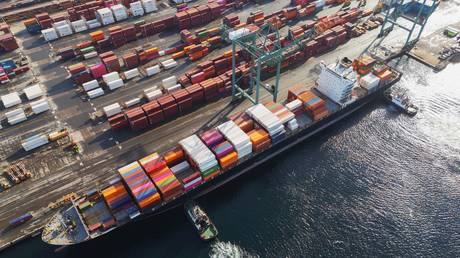
The headlines love a good blockbuster word. Indefinite. Permanent. Total. They paint a picture of grey steel warships parked off the coast of the Persian Gulf, locking down every drop of oil, freezing international trade, and turning the Strait of Hormuz into a permanent maritime lockjaw.
It makes for thrilling cable news. It is also completely detached from how modern geography, global economics, and naval logistics actually work.
Every single armchair strategist repeating the threat of an indefinite blockade is making the same lazy assumption: that maritime choke points are static doors you can simply padlock from the outside. They ignore the physics of maritime logistics, the sheer economic self-harm such an action requires, and the reality that modern supply chains have more routing options than a rogue GPS.
Let us break down why the entire premise falls apart the second it meets reality.
The Myth of the Static Wall
When people talk about a blockade, they picture the American Civil War or twentieth-century world wars. A line of grey hulls stretching horizon to horizon, stopping every freighter, checking manifests, and seizing contraband.
That model died decades ago.
An ocean is not a two-lane highway. The Strait of Hormuz is roughly twenty-one miles wide at its narrowest point, with inbound and outbound shipping lanes separated by a buffer zone. To choke that passage indefinitely, a naval force would need to maintain an unbroken, twenty-four-seven interdiction campaign against thousands of commercial vessels, supertankers, and container ships.
The resource cost of doing that permanently is astronomical. Every destroyer, carrier strike group, and patrol craft burns through billions of dollars in fuel, maintenance cycles, and munitions just sitting on station. Navies do not have infinite staying power. Ships require dry dock rotations. Crews suffer from exhaustion. Supply lines stretching thousands of miles back to home ports create vulnerabilities of their own.
More importantly, a static naval force near a hostile coast is not a checkpoint. It is a target.
The Geography of Workarounds
The lazy consensus assumes Iran is an isolated island dependent on a single front door. Look at a map for more than two minutes and you will see the absurdity of that claim.
Iran shares borders with Turkey, Iraq, Pakistan, Afghanistan, Armenia, Azerbaijan, and Turkmenistan. It has direct access to the Caspian Sea, opening trade corridors north toward Russia and Central Asia. It sits alongside major overland transit routes connecting South Asia to Europe through the International North-South Transport Corridor.
When maritime lanes tighten, trade does not stop; it shifts. Overland trucking, rail networks, and pipeline bypasses absorb the shock.
Yes, moving millions of barrels of crude oil via overland rail or alternate pipeline hubs is less efficient than loading a Very Large Crude Carrier directly at Kharg Island. But desperation breeds logistical innovation. Smuggling networks, shadow fleets of tankers with turned-off transponders, ship-to-ship transfers in international waters, and grey-market intermediaries have already been battle-tested by years of existing sanctions.
An official blockade would not starve the Iranian economy of every resource. It would simply drive the entire apparatus deeper into the underground economy, fattening the margins for middlemen and cementing black-market structures that Washington cannot touch.
The Economic Boomerang
Who actually pays for an indefinite blockade? The answer is not Tehran. The bill lands squarely on the global economy, starting with the allies the enforcing powers claim to protect.
Energy markets are hyper-sensitive. The moment a genuine, indefinite closure of the Strait of Hormuz looks remotely plausible, Brent crude futures do not just rise—they explode. Insurance rates for commercial shipping in the region would spike overnight to levels that make commercial transit economically unviable.
European economies, still healing from past energy shocks, would face immediate inflationary pressure. Asian manufacturing powerhouses like China, Japan, and South Korea, which draw a massive percentage of their imported crude through those exact waters, would see their energy security evaporate.
Imagine a scenario where a naval coalition successfully halts all tanker traffic out of the Persian Gulf for six months. Global oil prices surge past historic records. Industrial output in importing nations grinds down. Domestic political pressure mounts not in Tehran, but in Washington, London, and Berlin, as voters face crippling fuel prices and soaring utility bills.
A blockade that hurts your own coalition more than your target is not a strategy. It is economic self-sabotage.
Dismantling the People Also Ask Fallacy
If you search for details on maritime blockades, you run into a wall of repetitive questions: Can a country legally blockade another without a declaration of war? How long do naval blockades typically last?
The questions themselves are trapped in outdated legal frameworks. Modern conflicts rarely involve formal declarations of war. Instead, nations rely on economic warfare, targeted sanctions, cyber disruptions, and asymmetric naval skirmishes.
An indefinite blockade is legally and practically a myth because international law regarding blockades requires notification, impartiality toward third-party flags, and effective enforcement without discrimination. The moment a blockade starts seizing neutral vessels from non-belligerent nations—say, a Greek-flagged tanker carrying goods to a neutral port—you trigger international trade disputes, diplomatic crises, and retaliatory legal actions at the World Trade Organization and the International Court of Justice.
You cannot blockade the world while pretending to protect international commerce. The contradictions tear the policy apart from the inside out.
The Unspoken Reality
The real danger of the blockade narrative is that it treats geopolitical grandstanding as operational fact. Politicians rattle sabers about total economic isolation because it sounds decisive. Analysts parrot the talking points because it fills airtime.
Behind closed doors, military planners know the truth. True containment in the twenty-first century is not about drawing a line in the water and daring anyone to cross it. It is messy, fragmented, digital, and economic. It involves financial tracking, cyber operations, intelligence sharing, and targeted interdictions of specific illicit networks—not a medieval siege mentality applied to modern superhighways.
Stop waiting for the grand naval armada to seal off the Middle East. It is not coming, because the math does not work, the economics are suicidal, and geography refuses to cooperate.