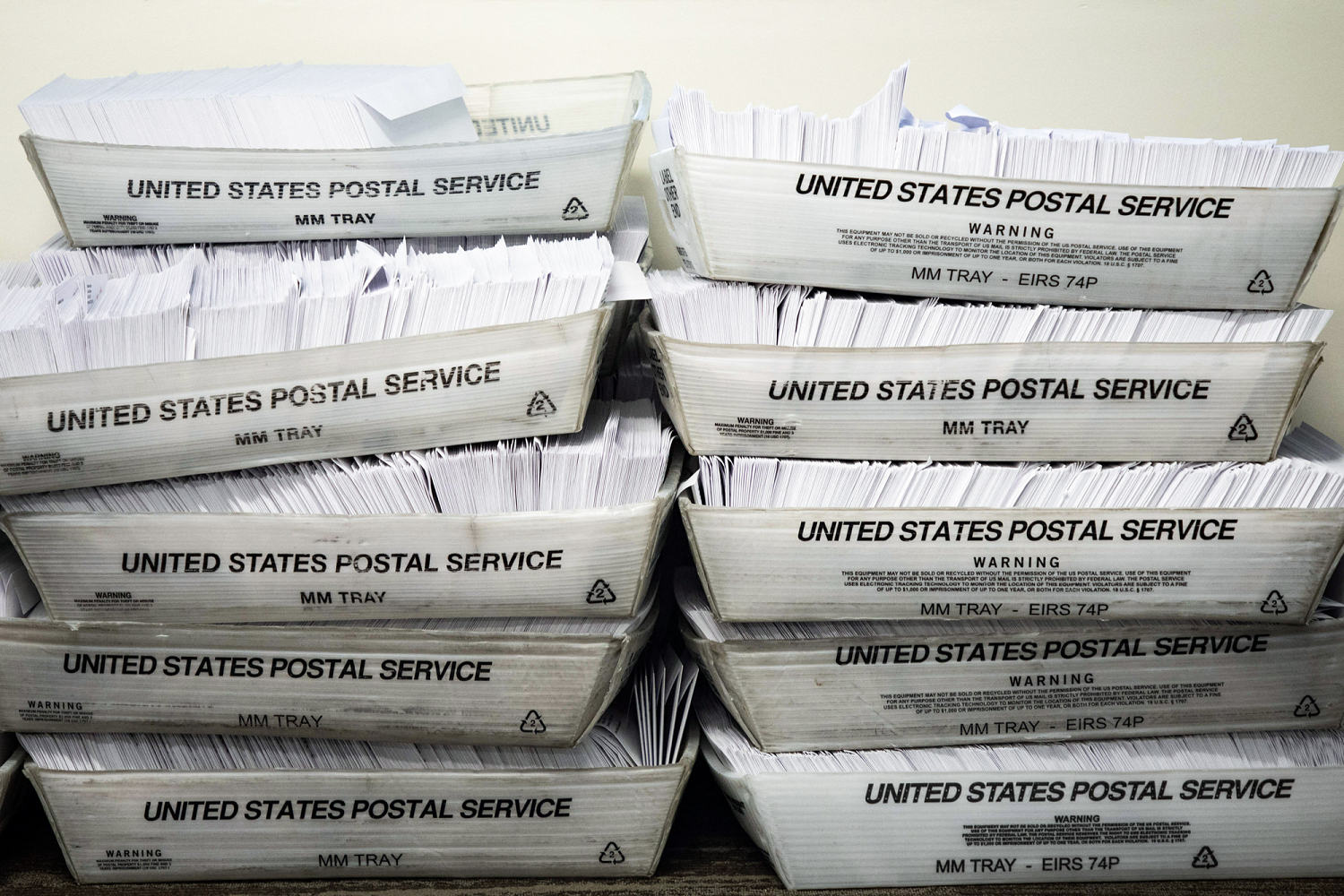
The ink on a ballot is never just ink. It is a voice captured in wood pulp and carbon, waiting for a journey across state lines, sorting facilities, and rust-belt tarmac to find its quiet resting place in a steel box. For millions of Americans, that journey begins at a kitchen table under the amber glow of a single pendant lamp. A pen scratches against paper. A tongue seals a flap. An envelope is walked out to the metal mailbox at the end of the driveway, the little red flag flipped skyward like a silent prayer.
Trust is a fragile engine. We tend to forget how much of our civic machinery runs on pure, unverified good faith. You drop a white rectangle into a blue box, and you trust the invisible machinery of the United States Postal Service to carry it faithfully to the county seat. You trust that the date stamped on the corner will be honored. You trust that a system older than the asphalt highways will hold the line.
Right now, that machinery is caught in the gears of a much heavier apparatus.
The Department of Justice has formally petitioned the Supreme Court to lift the brakes on an administrative maneuver concerning mail-in ballots ahead of the impending midterm elections. At the center of the dispute lies an operational shift originally championed by the Trump administration—one that critics argue could slow the postal crawl just enough to silence thousands of votes cast far from polling booths.
To understand why this matters, you have to look past the dry language of legal briefs and walk the floor of a mail-sorting facility at three in the morning.
Imagine a cavernous warehouse humming with the industrial growf of automated optical scanners. Millions of letters cascade through rubber rollers every hour, sorted by zip code, carrier route, and barcode. Every minute saved is an election certified on time. Every bottleneck is a discarded voice. The contested directive sought to alter how postal processing schedules interact with state election deadlines. Under the old rhythm, mail carriers and sorting facilities prioritized election mail with near-sacred urgency, treating a ballot with the same protective urgency as a beating heart. The contested operational changes introduced shifts in departure times and reduced overtime, aimed at fiscal efficiency rather than electoral timing.
Efficiency and democracy make poor bedfellows. Efficiency wants to trim the fat, cut the runs, park the trucks early to save on diesel and hourly wages. Democracy is inherently inefficient. Democracy demands redundancy. Democracy requires that a ballot mailed on a Friday in rural Nevada or upstate New York still crosses the finish line by Tuesday night, even if it means running a half-empty truck down an empty interstate.
The legal battle playing out before the highest court in the land is not merely an argument over administrative authority. It is a collision between two irreconcilable philosophies of governance. One views the postal service as a business that must balance its ledger. The other views it as the final, irreplaceable circulatory system of a continental republic.
Consider what happens next if the Court grants the government's request.
In the weeks leading up to the midterms, local election boards will watch their drop boxes with bated breath. Postal workers, already stretched thin by seasonal hiring shortages and budget constraints, will face a cruel arithmetic: deliver the circulars, the birthday cards, and the Amazon packages on schedule, or prioritize the fragile white envelopes carrying the sovereign will of the citizen. They will try to do both, of course. Postal workers always do. But heroism is a terrible substitute for a functioning infrastructure.
When a ballot arrives forty-eight hours too late, it does not make a sound. There is no shattered glass, no public outcry, no dramatic sirens wailing in the night. There is only a quiet, bureaucratic stamp that reads Received Too Late. A vote cast in good faith, rendered a ghost by a adjusted departure time or a missed connection on a loading dock.
We have arrived at a strange historical crossroads where the mechanics of voting have become a partisan sport. Every rule change, every adjustment to a delivery schedule, every legal challenge filed in a federal district court is scrutinized not for its administrative merit, but for its political yield. Who gains an edge if the mail slows down by six hours? Who loses a foothold if collection boxes are bolted shut just a little bit earlier?
When the founding generation designed this experiment, they did not envision high-speed sorting machines or multi-ton diesel trucks. They envisioned riders on horseback carrying saddlebags stuffed with broadsheets and handwritten notes. But they understood the core principle precisely: the connection between the governed and the government must remain open, unobstructed, and sacred.
The Supreme Court will decide whether an administrative directive takes precedence over the anxiety of a voter waiting for confirmation that their voice was counted. But the deeper verdict is already being written by us. Every time we treat the infrastructure of our democracy as an inconvenience to be optimized rather than a sanctuary to be protected, we trade a piece of our republic for a slightly faster delivery window.
The red flag on the mailbox remains upright, waiting for the carrier to arrive. Inside the house, the coffee is cooling. Somewhere in Washington, black-robed justices lean over briefs that will determine whether that little metal flag still means anything at all.


