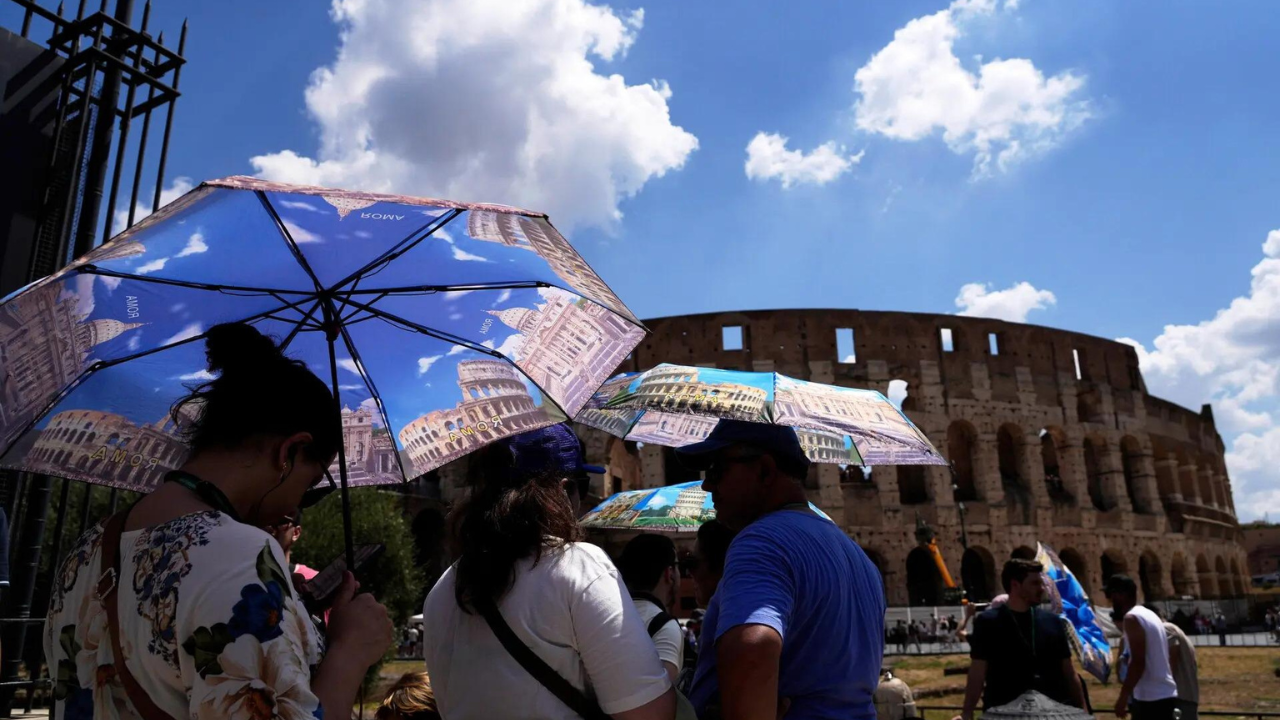
The mainstream media has a predictable summer ritual. As soon as the thermometer hits a number starting with a three in Paris or Frankfurt, the sirens start blaring. "Heatwave tightens grip!" "Red alerts issued!" "The continent is burning!"
It is lazy, copy-paste journalism designed to trigger panic rather than solve problems.
The recent coverage tracking two dozen tragic, weather-linked deaths across France and Germany misses the entire point. By treating extreme summer weather as an unprecedented, apocalyptic ambush every single year, public health officials and media outlets are actively obscuring the real crisis.
Europe does not have a weather problem. It has an infrastructure and policy problem.
And until we stop treating normal, repeating meteorological cycles as sudden acts of God, people will continue to die in perfectly preventable circumstances.
The Fatal Flaw of the Red Alert Culture
When a government issues a "red alert," what actually changes on the ground?
Mainstream coverage treats these declarations as monumental public health victories. In reality, they are bureaucratic cover-your-ass maneuvers. A flashing red banner on a weather app does not cool down a top-floor apartment in a 19th-century Parisian Haussmann building.
I have spent fifteen years analyzing urban climate adaptation strategies. I can tell you exactly what happens when these alerts go out: local municipalities panic, close public parks—which happen to be the only shaded, cool areas available to low-income residents—and tell people to "stay indoors."
This advice is actively dangerous.
According to data from the Euro-Mediterranean Center on Climate Change, indoor temperatures in uncooled, poorly insulated European housing stock can rise up to 5°C higher than the ambient outdoor temperature during prolonged sunny spells. Telling an elderly citizen in a concrete apartment block to stay inside with a desktop fan is not a health directive. It is a death sentence.
The "lazy consensus" dictates that extreme heat is an equal-opportunity killer. It is not. Heat is a class weapon. The deaths we see in France and Germany are not caused by the sun; they are caused by a systemic refusal to mandate structural retrofits.
The Air Conditioning Taboo
Let us address the elephant in the European room: the cultural, almost religious resistance to air conditioning.
In North America and parts of Asia, cooling is understood as a basic utility, akin to heating or indoor plumbing. In Europe, it is frequently sneered at as an American luxury or an environmental sin.
Look at the numbers. While over 90% of households in the United States and Japan have some form of air conditioning, the penetration rate across western Europe remains under 15%. In Germany, it sits in the single digits.
The argument against AC is always wrapped in green morality. Critics argue that widespread cooling will increase energy grid strain and accelerate carbon emissions. This is a false dichotomy.
- Solar Coincidence: The peak demand for cooling aligns perfectly with peak solar energy generation. When the sun is beating down on Europe, the grid is flooded with renewable energy.
- The Heat Pump Equation: Modern air conditioning units are simply air-to-air heat pumps. The exact same technology European governments are subsidizing for winter heating can protect vulnerable populations in July.
By framing AC as an environmental enemy, policy makers are sacrificing real human lives today on the altar of hypothetical carbon offsets tomorrow. We have the technology to deploy localized, hyper-efficient cooling centers and targeted residential incentives. What we lack is the political courage to abandon a outdated cultural bias.
Dismantling the "People Also Ask" Myth
When tragedy strikes during a summer spike, the public searches for simple answers. The questions are always the same, and the institutional answers are always wrong.
Why are so many people dying if the temperatures are similar to other regions?
The premise here is fundamentally flawed. A 38°C day in Phoenix, Arizona is a mild Tuesday. A 38°C day in Stuttgart, Germany is a mass casualty event.
Why? Because human physiology does not operate in a vacuum; it operates within built environments.
European cities were built to trap heat. The thick stone walls, narrow streets, and lack of urban tree canopies were brilliant design choices during the Little Ice Age of the 17th century. Today, they act as massive thermal batteries. They absorb shortwave radiation during the day and re-radiate it at night, preventing the human body from entering the crucial nocturnal recovery phase.
Can't people just drink more water and use fans?
No. This is the most dangerous piece of medical folklore in circulation.
When ambient indoor temperatures exceed 35°C (95°F), blowing hot air across the skin with a fan does not cool the body down. In fact, it increases thermal stress by accelerating dehydration and forcing the heart to pump faster to try and shed heat.
The World Health Organization explicitly warns against relying on fans above this threshold, yet public safety campaigns still routinely recommend them as a primary defense. It is cheap advice that costs lives.
Stop Managing the Panic. Start Engineering the Solution.
If we want to stop writing these obituaries every July, we need to stop treating heat as an emergency and start treating it as a permanent urban parameter.
This requires an immediate, uncomfortable shift in priorities:
- Mandatory Cool Roofs: Every flat-roof commercial building in Europe should be legally required to paint its roof white or install green vegetation layers. This single intervention can reduce internal building temperatures by up to 3°C without drawing a single watt of electricity.
- Reverse the Subsidies: Shift a portion of the billions currently funneled into winter insulation toward summer ventilation and reflective glazing.
- Acknowledge the Trade-offs: Yes, retrofitting old European cities is incredibly difficult. Yes, it will alter the aesthetic of historic districts. But a preservation policy that prioritizes 400-year-old facades over the lives of the people living behind them is morally bankrupt.
I have watched cities like Madrid try to engineer their way out of this with temporary misting tents and public fountains. It is theater. It is a band-aid on a gunshot wound.
The competitor articles will keep running their doom-scrolling headlines, counting bodies, and blaming the sky. They want you to feel helpless so you keep clicking. But the reality is far simpler, and far more frustrating: Europe is not suffering from a changing climate nearly as much as it is suffering from a stubborn, institutional refusal to adapt.
Stop looking at the thermometer. Start looking at the architecture.