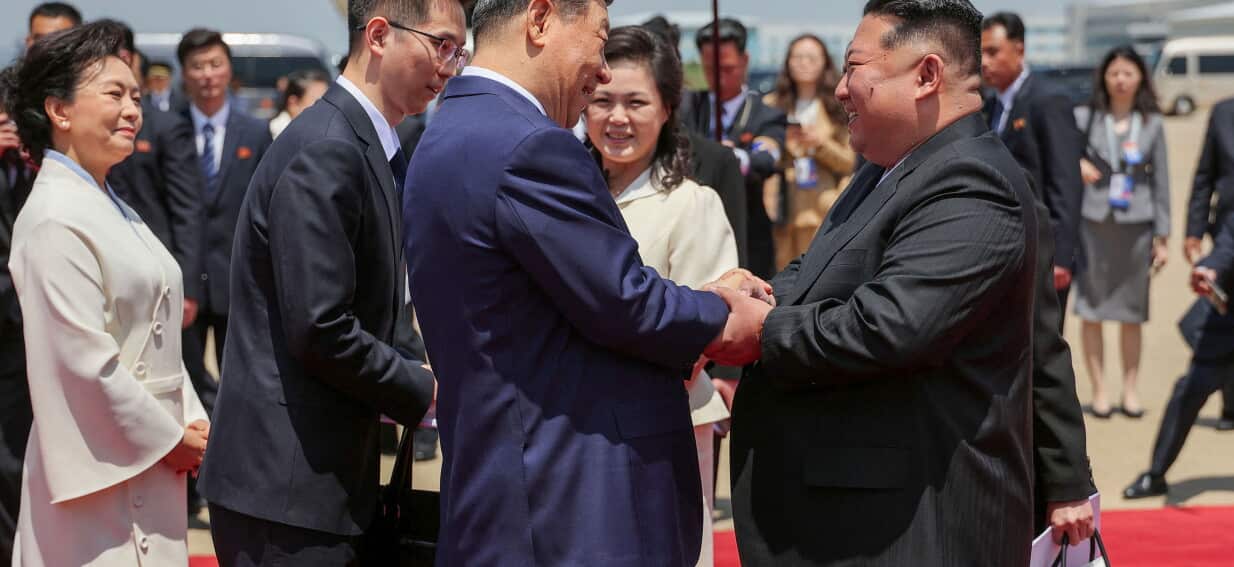
Mainstream geopolitical analysis has officially lost its mind. For the past twenty-four hours, the foreign policy establishment has been breathlessly parsing the "important consensus" reached during Chinese President Xi Jinping’s two-day visit to Pyongyang.
The lazy consensus among talking heads is that this summit represents a terrifying new consolidation of a Beijing-Pyongyang axis. Pundits point to the lavish red carpets, the pledges of military and law enforcement cooperation, and the glaring absence of the word "denuclearization" from official communiqués as proof that China has formally blessed North Korea's nuclear arsenal. They look at Kim Jong Un's newfound status as Vladimir Putin's arms dealer and declare that North Korea is suddenly an indispensable strategic powerhouse operating at the center of the global stage.
This reading is not just lazy; it is completely backwards.
What we actually witnessed in Pyongyang was not a celebration of a brand-new era of alliance. It was a desperate, transactional damage-control mission disguised as a victory lap. Xi Jinping did not fly to Pyongyang because North Korea is suddenly a critical strategic asset. He went because Kim Jong Un is a volatile liability whose recent geopolitical maneuvers are actively undermining Beijing’s long-term regional dominance.
The Illusion of the Indispensable State
The core flaw in the current media narrative is the belief that North Korea has successfully parlayed its weapon shipments to Russia into permanent strategic relevance. Analysts at institutions like the Harvard University Asia Center argue that Kim is no longer a mere recipient of aid, but a vital provider of military assets.
This fundamentally misunderstands how Beijing views its backyard.
China’s grand strategy for Northeast Asia relies on stability and subordination. For decades, Beijing has tolerated North Korea's nuclear temper tantrums for one reason: a stable, buffer-state autocracy is preferable to a collapsed regime that brings a unified, US-aligned Korea right to the Yalu River.
But Kim Jong Un’s recent behavior has shattered that delicate equilibrium. By bypassing Beijing to sign a mutual defense treaty with Moscow and shipping millions of artillery shells to fuel Russia's war effort, Kim thought he was playing the great powers against each other. Instead, he violated the primary rule of being a client state: never drag your patron into a fight they didn't pick.
Imagine a scenario where an unstable neighbor starts running an illegal arms depot out of his garage, attracting the attention of federal law enforcement to your entire street. You do not invite him over for dinner because you respect his new business model; you do it to tell him to shut it down before he brings the house down.
Xi's trip was a direct response to this unwanted regional escalation. The "important consensus" is not an alliance upgrade. It is an algorithmic leash.
Reading Between the Blatant Propaganda Lines
Let us look at what was actually agreed upon, rather than the flowery prose generated by Xinhua and the Korean Central News Agency.
- Law Enforcement and Military Exchanges: Mainstream articles treat this as a terrifying escalation of joint military planning. In reality, "law enforcement and security cooperation" between China and North Korea translates to a single, brutal reality: border control and defector suppression. China is tightening the screws on the border to ensure that economic desperation inside North Korea does not spill over into Northeast China.
- Economic Cooperation: The reopening of border crossings and transport links is being framed as an economic reward for Pyongyang. It is the exact opposite. It is a tool of economic leverage. By controlling the literal valve of North Korea's economy, Beijing ensures that Kim remains utterly dependent on Chinese lifelines, effectively diluting any economic independence Kim thought he bought from Vladimir Putin.
- The "One-China" Lip Service: North Korea's public reaffirmation of the One-China principle regarding Taiwan is being heralded as a major diplomatic win for Beijing. This is a baseline requirement for doing business with China, not a new concession. Kim would pledge allegiance to the moon if it kept the oil flowing for another six months.
The absence of "denuclearization" in the summit text is not a Chinese endorsement of a nuclear North Korea. It is a pragmatic acknowledgment of reality. Beijing has long known that convincing the Kim regime to disarm via diplomatic sweet-talking is a fool's errand. Forcing the issue during a public state visit would only expose the limitations of Chinese influence. Instead, Beijing chose to ignore the nuclear elephant in the room to focus on the real threat: Pyongyang's dangerous strategic drift toward Moscow.
The Fatal Flaw in the Russia-North Korea Pivot
The conventional wisdom asserts that Kim Jong Un holds all the cards because he can play China and Russia off one another. This is an incredibly short-sighted view of authoritarian geometry.
Russia's interest in North Korea is highly transactional, desperate, and temporary. Moscow needs conventional artillery shells and low-tier military hardware to sustain a war of attrition. Once that conflict reaches a conclusion or a frozen state, Russia's structural need for North Korean munitions plummets. Russia is not going to underwrite the North Korean economy for the next fifty years; it simply does not have the financial bandwidth or the geographic proximity to do so.
China, by contrast, is a permanent neighbor with an economy roughly ten times the size of Russia's.
+--------------------------------------------------------------+
|                    THE REALITY OF DEPENDENCY                 |
+--------------------------------------------------------------+
|  RUSSIA:                                                     |
|  - Transactional relationship based on wartime needs         |
|  - Temporary demand for low-tech munitions                   |
|  - Zero long-term financial capacity to sustain Pyongyang     |
+--------------------------------------------------------------+
|  CHINA:                                                      |
|  - Permanent geographic neighbor                             |
|  - Controls 90%+ of North Korea's historic trade lifelines   |
|  - Ultimate veto power over the survival of the Kim regime  |
+--------------------------------------------------------------+
When Kim Jong Un stood next to Xi Jinping at the Kumsusan State Guesthouse, he wasn't negotiating as an equal partner. He was face-to-face with the only leader on earth who can turn off his country's lights with a single administrative order. The lavish performances at the Pyongyang Gymnasium and the symbolic tree-planting ceremonies at the Central Cadres School were theatrical performances designed to mask a harsh power dynamic.
The Price of Miscalculating Beijing’s Patience
The real danger of the current analytical consensus is that it validates Kim Jong Un’s dangerous miscalculation. If western policymakers believe that China has given North Korea a blank check, they will inevitably respond by increasing the Western military footprint in Northeast Asia.
We are already seeing this play out. Trilateral security cooperation between the United States, Japan, and South Korea has reached historic levels. Joint military exercises are larger, more frequent, and more technologically advanced.
This outcome is Beijing's absolute worst nightmare.
Every time North Korea launches an Intercontinental Ballistic Missile or signs a theatrical defense pact with a European pariah, it gives the United States a flawless justification to deploy advanced missile defense systems, stealth fighters, and carrier strike groups directly to China's maritime doorstep. Xi Jinping did not travel to Pyongyang to pat Kim on the back for this. He went to deliver a stark warning: stop providing Washington with the perfect excuse to encircle the Chinese mainland.
The downside to this contrarian view is obvious: it assumes Beijing still possesses the absolute leverage required to dictate terms to a nuclear-armed, increasingly erratic Kim Jong Un. There is a distinct, terrifying possibility that the tail is now wagging the dog. If Kim truly believes his own press releases—if he genuinely thinks his backing from Moscow makes him untouchable—he may ignore Beijing's quiet demands for restraint. If that happens, the region moves closer to an uncontrolled escalation that neither superpower can easily contain.
But interpreting this summit as a harmonious meeting of minds is an analytical failure. It ignores the deep-seated historical animosity and strategic divergence that has always defined the Sino-North Korean relationship. Xi Jinping’s visit was an exercise in geopolitical containment, targeted squarely at his own supposed ally.