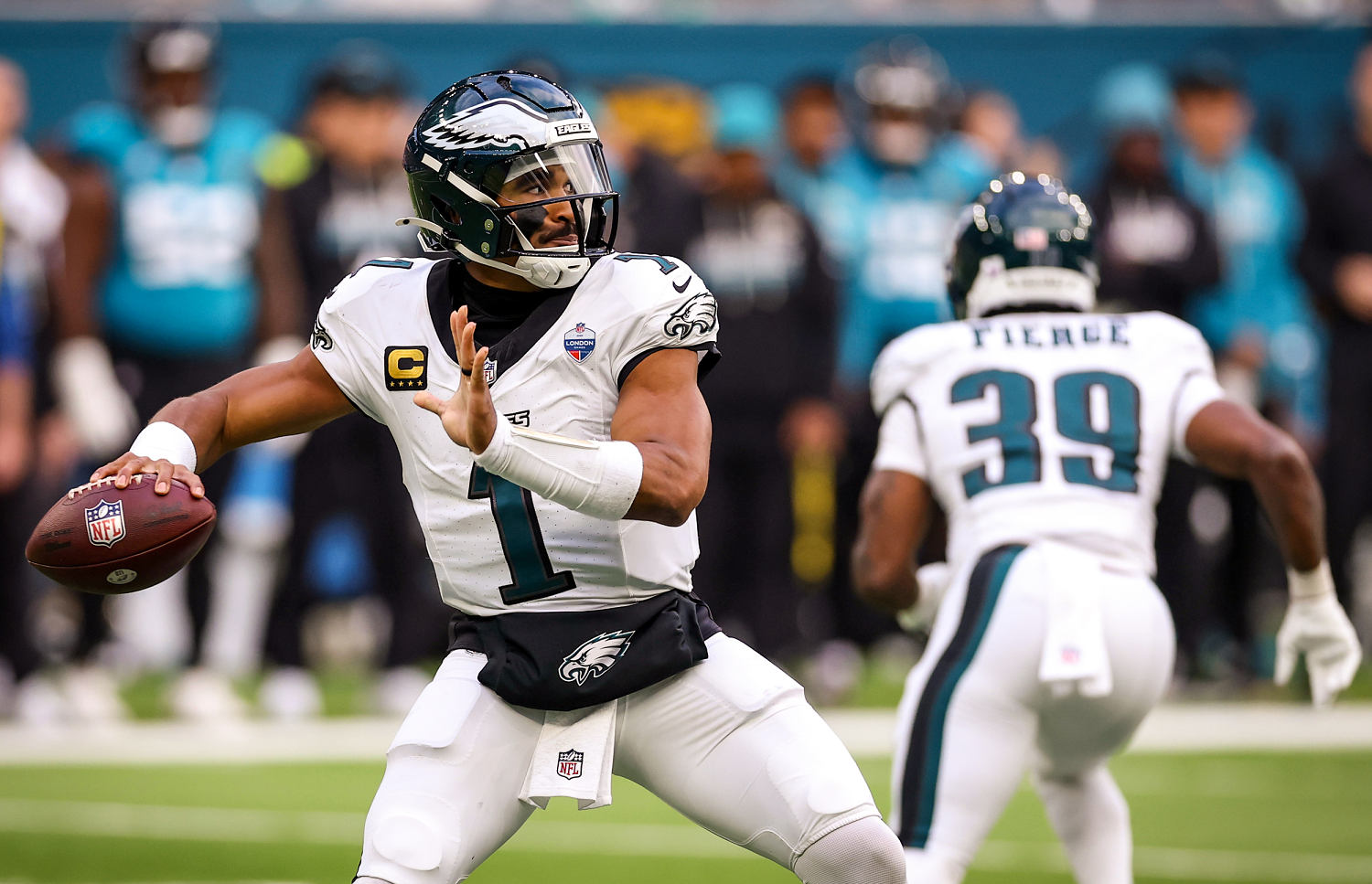
Read the headline again. "Eagles are not being punished for handling of Jalen Hurts’ blood clots."
Lazy. Comforting. Completely beside the point.
When a front office gets tangled up in a medical scare around its franchise quarterback, the reflex on sports talk radio is always the same: look for a whistle from the league office. Did the team hide an injury report? Did they push a player back onto the field ahead of a vascular evaluation? Will the NFL dock a draft pick or drop a six-figure fine on the owner's desk?
That question assumes the league office is the scariest room in the building. It is not.
I have sat in enough boardrooms and medical briefings across pro sports to watch front offices sweat the wrong audit. I have seen franchises burn seven-figure legal and PR retainers trying to prove they followed league disclosure rules while ignoring the actual operational clock ticking inside a vascular clinic. A fine from Park Avenue hurts a balance sheet. A mismanaged blood clot—or a botched return-to-play timeline on a starting quarterback—can detonate a championship window, an insurance policy, and a locker room's trust in one afternoon.
Stop asking whether the NFL is punishing the Philadelphia Eagles over Jalen Hurts' blood clots. Start asking what happens when a medical protocol collides with cap leverage, roster construction, and high-contact football.
The Lazy Consensus About League Discipline
Sports coverage loves binary verdicts. Either a team gets hammered by the commissioner's office, or it walks away clean. Because league discipline usually requires clear proof of a rules violation—such as scrubbing an injury designation or violating collective bargaining health standards—commentators treat the absence of a headline penalty as an all-clear.
That logic confuses compliance with competence.
In professional football, league rules set a floor, not a ceiling. Front offices and athletic training staffs are governed by a dense web of overlapping obligations: NFL injury-reporting guidelines, team physician independence standards set by the NFL Physicians Society, union oversight from the NFL Players Association, and commercial disability or contract-guarantee structures. Even when no disciplinary hammer drops from the commissioner, every decision around vascular health leaves a paper trail.
Let's get precise about the terms before we go further. A blood clot—clinically referred to as a thrombus when stationary inside a blood vessel, or deep vein thrombosis when it forms in a deep vein, with a pulmonary embolism being the life-threatening migration to the lungs—is not a sprained ankle. You do not "tape it up" and test it out in pregame warmups. Anticoagulant therapy reduces the risk of clot extension or recurrence, yet blood thinners carry an obvious, non-negotiable hazard in a collision sport: bleeding risk under blunt trauma.
When people say the Eagles are not being punished, they usually mean there is no pending league sanction on the docket. Fine. That still tells you nothing about the real friction points inside an organization when a quarterback faces vascular scrutiny.
Why "Are They Being Punished?" Is the Wrong Question
Ask yourself: if you run a contender, which risk keeps you awake at 3 a.m.?
- A league fine that rounds to noise against franchise revenue.
- Putting a franchise quarterback into live pocket pressure while anticoagulation status, imaging follow-ups, or exertion tolerances are still being locked down.
- Creating ambiguity between the team medical staff, independent specialists, and the player's camp over who cleared whom—and when.
The third point is where reputations actually bleed. Modern players have their own doctors, their own trainers, and sharp representation. If a quarterback feels rushed, or if medical communication feels filtered through competitive secrecy, trust erodes fast. You cannot rebuild that trust with a press release saying no league rule was broken.
Here is the nuance the lazy consensus misses: the absence of league punishment does not mean the cost is zero. Every hour a franchise quarterback spends navigating vascular evaluations, modified workouts, or return-to-play clearance carries opportunity cost in practice reps, game-plan install, and offensive rhythm. Even when there is no formal penalty, the football tax is real.
The Vascular Reality Inside a Collision Sport
To understand why vascular events trigger immediate alarm in football, strip away the drama and look at the mechanics. Blood clots do not appear out of thin air without physiological triggers. Clinicians often reference Virchow's triad—stasis of blood flow, endothelial injury, and hypercoagulability—to frame why clots form. A high-output athlete might seem like the last person at risk for sluggish blood flow, yet travel schedules, long flights, immobilization during recovery, anatomical compression, or localized trauma can all play a role depending on the exact location and cause.
Imagine a scenario where a team's starting quarterback experiences a suspected deep vein clot late in the week before a divisional game. Even if imaging is fast and treatment begins immediately, the coaching staff faces a brutal operational wall. Can he practice in full pads? Is contact permitted? If he is on blood thinners, even a routine helmet-to-limb hit carries heightened bleeding stakes that no sane medical director wants to gamble on.
Now layer in the quarterback position itself. Unlike a rotational defensive lineman who can be spelled for twenty snaps, the quarterback touches the ball on nearly every offensive play. His availability shapes fourth-down aggressiveness, play-calling volume, and free-agent or trade contingencies across the entire roster.
That is why medical transparency matters far more than spin. The NFL's injury report rules exist largely to protect competitive fairness and wagering integrity, not to hand out moral grades. Teams sometimes chafe at disclosure rules because they want to keep opponents guessing. Yet when health and clotting risks are involved, gamesmanship with medical timelines is a losing bet. Get the diagnosis right. Get the clearance right. Protect the human being first, and let the football math follow.
What "People Also Ask" Gets Backward
Search engines fill up with predictable questions whenever a story like this surfaces. Most of them start from a shaky premise.
Can the NFL punish a team for how it handles a player's blood clots?
Technically, the league can investigate and penalize a club if it violates league rules—such as failing to accurately report a known injury or health condition that affects availability, or breaching collective bargaining protocols. Practically, punishing "bad medicine" in the abstract is not the league's job unless a specific rule or safety standard is broken. Do not mistake a lack of league discipline for a stamp of medical perfection.
Do blood clots end a football career?
Not automatically. Outcomes depend heavily on the type of clot, where it occurs, whether there is an underlying anatomical or clotting disorder, and how the athlete responds to treatment and rehabilitation. Some athletes return to high-level competition after completing a course of therapy and receiving clearance from vascular specialists; others face longer timelines or ongoing precautions. Treating every clot as a career sentence is lazy fearmongering. Treating every clot like a bruised shoulder is reckless.
Should teams hide health details to gain a competitive edge?
No. Short-term competitive secrecy on a health issue rarely pays off in pro sports. Word leaks, locker rooms notice discrepancies, and league compliance audits have teeth when injury reports do not match reality. Clear, accurate reporting is basic operational hygiene.
The Downsides of Playing the Contrarian Card
I am arguing that league punishment is a sideshow compared to medical governance, locker-room trust, and operational readiness. Let's be honest about where that argument can trip.
First, it can sound dismissive of real rule enforcement. When clubs actually cross injury-reporting lines, the league does step in, and accountability matters. Second, without access to private medical charts, any outsider analysis of a specific player's case has limits. Speculating beyond verified facts is a trap I refuse to walk into—you stick to physiology, governance, and incentives, never fabricated medical details.
Third, contrarianism for its own sake gets boring fast. Sometimes the obvious headline is right on the narrow point it makes. The Eagles not facing a league penalty over Jalen Hurts' blood clots can be true on paper while still being the least interesting part of the story.
Actionable Moves for Front Offices and Fans Who Want Signal Over Noise
If you run a sports operation—or simply want to read coverage without getting played—change your filter.
- Audit the decision chain, not just the fine list. Look at who signs off on return-to-play milestones: team doctors, independent specialists, performance staff, and the player. When authority is blurry, mistakes happen.
- Build real quarterback depth before a crisis hits. A backup quarterback is not just insurance for a sprained MCL. He is protection against sudden, unpredictable medical stand-downs.
- Separate league compliance from competitive readiness. Being rule-compliant on a Friday afternoon does not mean an offense is in sync on Sunday. Track practice participation, timing routes, and decision speed—not just whether a fine was levied.
- Demand precision over panic. When you hear "blood clot," ask the right questions: What kind? What is the treatment window? What are the physical restrictions? Precision beats noise every single time.
Stop cheering or jeering over whether the league office drops a penalty flag on Jalen Hurts' blood clots. The real test of a franchise starts the moment health, leverage, and Sunday kickoff collide—and no press release can fake your way through that.


