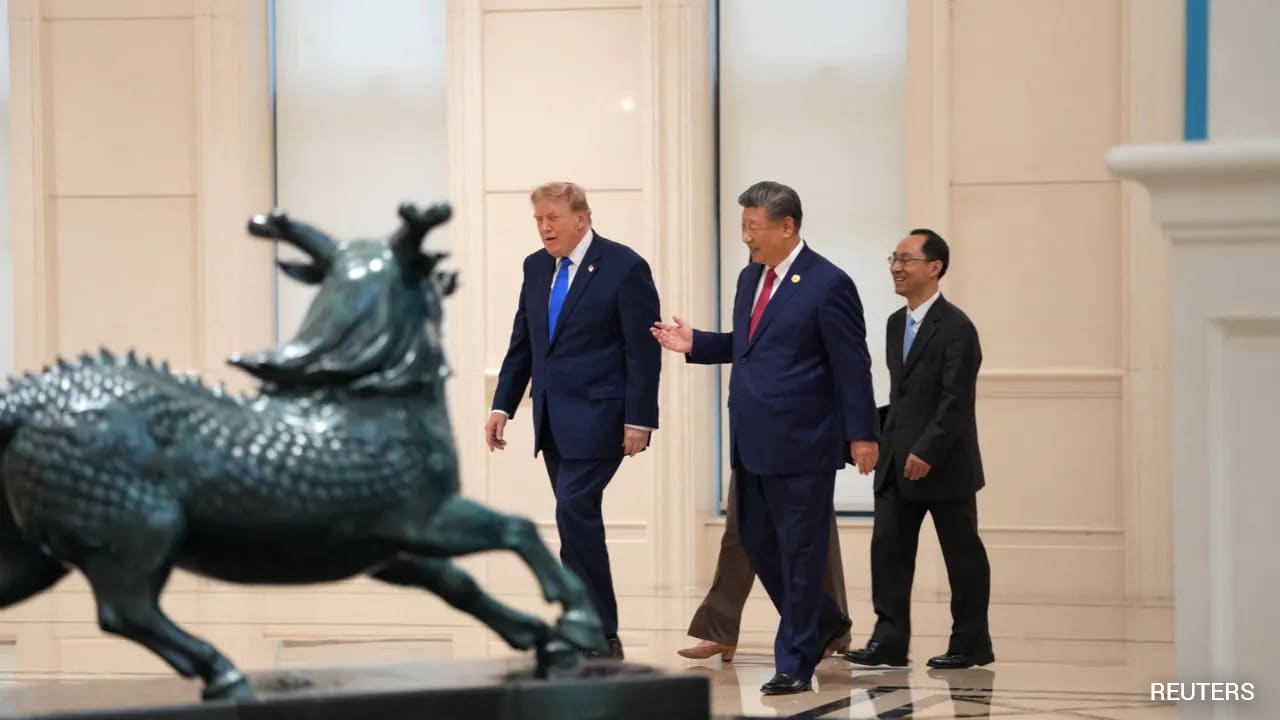
Mainstream tech pundits love a simple villain. When a Western reporter gets booted from a high-stakes diplomatic summit involving Donald Trump, Xi Jinping, and Vladimir Putin over a pointed question about Nvidia CEO Jensen Huang, the commentary writes itself. Free speech advocates clutch their pearls. Geopolitical commentators scoff at thin-skinned authoritarianism. Everyone nods along to the lazy consensus that Beijing simply lost its temper over a breach of etiquette.
That reading is completely detached from how high-level statecraft and semiconductor supply chains actually operate.
If you think an intelligence apparatus as disciplined as the Chinese Ministry of Foreign Affairs revokes press credentials because a journalist hurt someone's feelings, you do not understand the room you are watching. In diplomatic summits where nuclear superpowers negotiate trade, territory, and compute dominance, nothing happens by accident. A question about Jensen Huang is never just about a tech executive in a leather jacket. It is a live wire touching the most sensitive national security vulnerability on Earth.
The Lazy Consensus vs. Operational Reality
Standard reporting frames press ejections at international summits through the lens of Western media norms. In Washington or Brussels, shouting a sharp question at a leader during a photo spray is theater. It signals journalistic independence. When Beijing shuts that down and labels the inquiry rude, Western outlets treat it as a textbook case of censorship and fragility.
They are asking the wrong question entirely. The real issue is not why China suppressed a reporter. The real issue is why a private chip designer's name acts as a diplomatic tripwire capable of derailing a room containing Trump, Xi, and Putin.
To understand that, you have to strip away the personality cult around Jensen Huang and look at what Nvidia actually represents in sovereign negotiations. Nvidia is no longer a commercial hardware vendor. Its GPUs—specifically the Hopper and Blackwell architectures, alongside the proprietary CUDA software stack—are the foundational ammunition of modern state power. Whoever controls the training clusters controls autonomous weapons development, cyber warfare modeling, biological synthesis simulation, and domestic surveillance infrastructure.
I have sat in boardrooms where enterprise infrastructure buyers burned tens of millions of dollars trying to source gray-market compute clusters just to keep their AI roadmaps alive. When private companies treat silicon like blood diamonds, imagine what sovereign states are doing behind closed doors. When a reporter forces the name of the world's single choke-point supplier onto the public record during a trilateral summit, they are not making small talk. They are exposing the exact leverage point every leader in that room is trying to conceal.
Why Jensen Huang Is the Third Rail of Geopolitics
Look at the triangle in that room.
- The United States holds the architectural monopoly through Nvidia, AMD, and the electronic design automation tools from Synopsys and Cadence. Washington weaponized this through successive waves of Bureau of Industry and Security export controls, restricting advanced node chips and high-bandwidth memory from reaching Chinese data centers.
- China holds the manufacturing scale, rare earth refining dominance, and massive domestic demand, while pouring hundreds of billions of yuan into domestic alternatives like Huawei's Ascend series and SMIC's fabrication nodes. Yet Beijing remains acutely aware of its current compute deficit at the frontier.
- Russia operates under severe Western sanctions, relying heavily on illicit transshipment networks and Chinese intermediaries to acquire dual-use electronics and enterprise hardware for its defense industrial base.
Now put Trump, Xi, and Putin in the same venue. Every single word uttered near a microphone is calibrated for domestic consumption and market signaling. Trump uses tariffs and export licenses as transactional bargaining chips. Putin needs uninterrupted hardware pipelines without publicly humiliating his primary economic lifeline in Beijing. Xi needs to project absolute technological self-reliance while quietly managing the reality that Chinese hyperscalers like ByteDance, Tencent, and Alibaba still crave Nvidia silicon.
Into that pressure cooker walks a reporter asking a blunt, adversarial question about Jensen Huang—likely probing Beijing's reliance on American chips, Nvidia's compliance with U.S. sanctions, or backchannel access to restricted hardware.
Calling the question rude was not an emotional outburst. It was a diplomatic circuit breaker. In Chinese statecraft, protocol violations serve as an immediate, low-cost mechanism to terminate an unscripted line of questioning before a head of state is forced into an on-the-record trap. If Xi answers, he either admits vulnerability to U.S. tech embargoes or threatens retaliation that spooks global markets. If he ignores it, Western press clips the silence as weakness. Ejecting the reporter resets the board instantly.
Dismantling the Myths Around Tech Diplomacy
When events like this hit the news cycle, the same tired misconceptions flood the discourse. Let's dismantle them directly.
Did China ban the reporter because of thin skin?
No. Authoritarian states do not survive by being emotionally reactive; they survive by controlling information framing. At major summits, credentialing is a privilege tied to strict adherence to choreographed media pools. When a correspondent breaks pool rules to ambush principals on a sensitive topic, revocation is standard enforcement. Western press corps routinely accept similar pool restrictions at the White House or Downing Street when National Security Council aides threaten to pull hard passes—they just dress it up in polite bureaucratic language instead of calling it rude.
Does Jensen Huang actually hold independent political power?
People love painting Huang as a rogue statesperson operating above governments, flying between Taipei, Washington, and Beijing like a semiconductor Henry Kissinger. That is pure mythology. Huang is a brilliant operator, and his creation of CUDA built the widest moat in modern computing history. But at the end of the day, Nvidia is a fabless designer incorporated in Delaware. It relies entirely on TSMC in Taiwan for fabrication, ASML in the Netherlands for extreme ultraviolet lithography machines, and SK Hynix or Micron for high-bandwidth memory. If the U.S. Commerce Department revokes an export license, Huang complies the next morning. He is not the player; he is the board they are playing on.
Can China simply innovate around Nvidia overnight?
Anyone claiming Huawei's Ascend 910B or 910C chips have already achieved seamless parity with Nvidia's top-tier clusters is selling propaganda, not engineering analysis. Hardware is only half the battle. You can manufacture a chip with respectable raw FLOPS, and Chinese engineers have pulled off remarkable feats under extreme lithography constraints. However, training massive foundation models across tens of thousands of interconnected GPUs requires ultra-fast interconnects like NVLink and an infinitely mature software ecosystem. CUDA has nearly two decades of developer lock-in, libraries, and kernel optimizations baked into every major AI framework. Ripping that out and replacing it at scale causes massive yield drops, cluster downtime, and thermal bottlenecks. Beijing knows this gap exists, which is precisely why public reminders of Nvidia's dominance are politically toxic during high-level summits.
The Uncomfortable Truth About Press Access and Power
Here is where the contrarian view carries a serious downside that needs to be acknowledged honestly: normalizing the expulsion of journalists over uncomfortable questions degrades the very market intelligence investors and executives rely on.
If every superpower treats corporate supply chain questions as state secrets punishable by credential revocation, financial markets fly blind. Enterprise leaders trying to forecast semiconductor availability, tariff exposure, or geopolitical risk lose the ground-level reporting that exposes cracks in official narratives. Pretending Beijing's move was purely tactical does not mean it is harmless. It sets a precedent where asking basic questions about commercial technology becomes categorized as diplomatic hostility.
At the same time, Western media organizations bear responsibility for their own blindness. When reporters treat a trilateral summit between nuclear powers like a cable news shouting match, they hand Beijing the exact pretext it wants. Foreign ministries across Asia and the Middle East watch how Western correspondents behave at these events. By framing complex industrial policy as a gotcha moment about a billionaire CEO, the press corps makes it effortless for state media to portray Western journalists as disrespectful agitators rather than serious analysts.
Imagine a scenario where a correspondent instead asked a technically precise question about semiconductor tariff exemptions or dual-use export classifications under existing trade frameworks. It is infinitely harder to dismiss a dry, surgical policy question as "rude" without looking defensive. When you swing with tabloid framing, you get bounced like a tabloid heckler.
How Analysts and Executives Should Read Summit Signals
If you work in tech, finance, or policy, stop consuming geopolitical coverage written by general assignment reporters who cannot tell a lithography scanner from a wafer foundry. When diplomatic friction erupts over a tech figure, use a disciplined framework to extract the actual signal:
- Track the choke points, not the personalities. Ignore the soundbites about individual CEOs. Watch regulatory filings, customs enforcement actions, and capital expenditure guidance from TSMC, ASML, and hyperscalers. That is where real power shifts occur.
- Treat protocol disruptions as deliberate messaging. When a state actor publicly penalizes a journalist or diplomat over a specific topic, map out what domestic audience that message is intended for. Usually, the target is not the Western public—it is internal bureaucrats being reminded which topics are strictly off-limits.
- Discount sovereign self-reliance timelines by at least five years. Every major power claims it will achieve total supply chain independence on an aggressive schedule. Semiconductor manufacturing involves thousands of specialized chemical, optical, and software dependencies that cannot be decreed into existence by state subsidies.
- Separate public posture from procurement reality. Leaders will denounce foreign tech dependency at the podium while their state-backed enterprises quietly route orders through third-party shell companies in Southeast Asia or the Middle East. Follow the grey-market pricing of enterprise GPUs in Shenzhen, not the press releases from Beijing.
The next time a reporter gets escorted out of a summit for mentioning a Silicon Valley executive, skip the outrage cycle. Look at the seating chart, check the export control registry, and ask yourself which vulnerability just got exposed in front of the cameras.