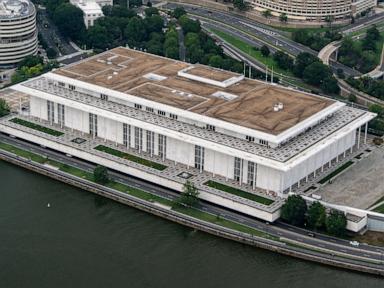
The media is having a collective meltdown over a filing regarding the marble facade of a brutalist concrete monolith on the Potomac. Headlines scream that a fresh legal document reveals Donald Trump's moniker might end up plastered across the building not once, but twice. Pundits clutch their pearls. Congressional Democrats rush to courthouse microphones. Lawyers draft emergency injunctions over stone carvings and metal lettering.
Everyone is arguing about text placement, vanity, and architectural real estate. Everyone is completely wrong. Recently making waves recently: Institutional Cost Allocation and the Economics of Campus Child Care.
The fixation on whether a name appears twice on an exterior wall misses the structural reality of institutional power in Washington. This isn't a branding dispute. It is a masterclass in bureaucratic jujitsu, and the critics falling for the trap are playing checkers while the board is being fundamentally redesigned.
The Architecture Of Institutional Capture
Let us define terms clearly. When a board of trustees gets packed with political loyalists, legal purists act surprised. They point to federal statutes and congressional charters as if parchment can stop a steamroller. I have watched corporate boards and non-profit directors maneuver around structural mandates for decades. Statutes are only as resilient as the enforcement mechanisms backing them up. Additional insights on this are explored by Al Jazeera.
Imagine a scenario where a private developer takes over a distressed corporate asset. They do not ask permission for every structural alteration; they change the operational baseline until compliance becomes too expensive or logistically absurd for the opposition.
The Kennedy Center board did not just vote to tweak a sign. They tied the signage debate directly to an existential operational question: a multi-year facility shutdown for sweeping renovations. That is the real play. By making the physical plant itself a construction zone, the board creates a moving target for federal judges. A tarp over a sign or a revised suffix like "Restored and Renovated By" isn't just about ego. It is a calculated legal stress-test designed to exhaust judicial patience and drain opposing legal funds.
Why The Dual-Name Panic Is A Distraction
The lazy consensus in every mainstream outlet is that the second mention of a president's name on a memorial represents a direct assault on historic preservation. Opponents argue that adding descriptive text to the building's formal designation violates the spirit of a federal monument.
This argument relies on a romanticized view of public spaces that has not existed in modern politics for half a century. Memorials are political battlegrounds. They always have been. The federal government does not maintain cultural properties in a state of pristine, apolitical neutrality. Every square inch of the capital is a monument to whoever holds the institutional levers at any given moment.
Focusing on whether the lettering counts as one inscription or two misses the financial and physical decoupling happening underneath. While lawyers argue over stone panels, the National Symphony Orchestra is splitting its season across half a dozen disparate venues. The institutional footprint is scattering. Once an anchor tenant or resident orchestra is forced into diaspora, the physical building matters far less than who controls the balance sheet and the programming calendar.
The Unspoken Downside Of The Contrarian Play
Let us be completely transparent about the strategy here. This aggressive institutional takeover carries a massive execution risk. Alienating legacy donors, driving away resident artistic directors, and triggering endless cycles of litigation can hollow out the cultural capital of the institution entirely. You can rename a building twenty times and cover it in gold leaf, but if the world-class talent refuses to perform on its stages, you are left running an expensive, empty concrete shell.
That is the vulnerability the opposition should be exploiting instead of filing motions over metal typography. They are fighting a tactical skirmish over punctuation while the operational model of the venue is being dismantled from the inside out.
Stop treating a real estate and governance struggle like a grammar quiz. The letters on the wall are a symptom, not the disease.
US President Trump's Name Returns to Kennedy Center Amid Legal Fight
This video provides a look at the ongoing dispute surrounding the board's decisions and the public reaction in Washington, D.C.