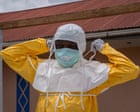
We've officially entered dangerous territory. The headlines coming out of Central Africa look terrifyingly familiar, and they should. New modeling from the US Centers for Disease Control and Prevention drops a massive reality check on us. If we don't change how we're fighting the current Ebola outbreak in the Democratic Republic of Congo and Uganda, we could see up to 20,000 cases in the next three months alone.
Let that sink in. A single three-month window could push this crisis toward the scale of the devastating 2014-2016 West Africa epidemic, which ultimately infected over 28,000 people and killed 11,000. You might also find this related article interesting: The Dark Reality of Underground Penis Filler Clinics Exposed.
But public health modeling isn't a crystal ball. It's a warning system. The real problem isn't just the math; it's the specific strain of the virus and the chaotic environment where it's spreading.
The Zero Vaccine Problem Nobody Is Talking About
When people hear "Ebola" today, they usually think of the highly effective vaccines used in recent years. Those vaccines saved countless lives during the 2018 outbreak in eastern Congo. But here's the catch you won't hear in casual conversation: those tools are completely useless right now. As extensively documented in recent reports by Medical News Today, the results are notable.
The current outbreak is driven by the Bundibugyo virus strain.
The standard vaccines and monoclonal antibody treatments we developed after the 2014 disaster only target the Zaire strain of Ebola. For Bundibugyo, we have absolutely nothing in our medical arsenal. No approved vaccines. No targeted therapies. If you catch it, your survival relies almost entirely on basic supportive care, like staying hydrated and managing symptoms.
To make matters worse, the outbreak got a massive head start. Health officials believe infections were quietly spreading as early as February. Why? Because initial diagnostic tests were looking for a different Ebola strain entirely. By the time the World Health Organization declared this a global health emergency in May, the fire had already spread. The Africa CDC currently counts around 400 confirmed cases and 63 deaths, but experts openly admit that's just the tip of the iceberg. Undiagnosed cases are moving silently through communities.
Why Isolation Math Rules This Crisis
The CDC published three new papers outlining how this plays out over the next 90 days. It all boils down to a single metric: how fast can we isolate infected people?
Take a look at the stark contrast in the CDC's projection models.
If only 20% of infected individuals enter isolation within two days of showing symptoms, the virus explodes. Under that low-isolation scenario, two out of three computer models show the case count rocketing past 20,000 very quickly. That would immediately make this the second-largest Ebola outbreak in history. If the timeline extends past three months, it could easily eclipse the 2014 record.
Flip the script, though, and the power of basic public health becomes obvious. If we can get 70% of symptomatic people into isolation within 48 hours, there is a 94% probability of keeping the total case count under 10,000.
Isolation cuts the transmission chain dead in its tracks. Ebola isn't COVID. It isn't the flu. It doesn't travel through the air when someone coughs. It requires direct contact with infected bodily fluids like blood, vomit, or semen. If you isolate a patient early, you protect their family and neighbors.
Active War Zones Make Containment a Nightmare
It sounds simple on paper. Just isolate people, right? On the ground in North Kivu and surrounding regions, that advice feels incredibly detached from reality.
You can't run a textbook outbreak response in the middle of a war zone. The eastern DRC is currently choked by brutal armed conflict. The Congolese government is locked in battle with the Rwanda-backed M23 rebel group. Simultaneously, the Allied Democratic Forces, an Islamic State-affiliated militant group, routinely terrorizes local villages.
This violence triggers massive, chaotic population movements. Thousands of displaced people are constantly fleeing into crowded temporary camps or crossing the border into Uganda. Tracking down contacts of an Ebola patient is hard enough in a peaceful village. Trying to do it when an entire neighborhood has fled into the bush to escape gunfire is virtually impossible.
Health workers face extreme danger just trying to set up isolation tents. Mistrust runs high, fueled by displacement, fear, and a history of international interventions that local populations feel bypassed them. Dr. Satish Pillai, the incident manager for the CDC's Ebola response, noted that current isolation rates are hovering on the lower end of their scenarios. We're actively tracking toward the worst-case line.
What This Means for the Rest of the World
Let's address the inevitable panic question: is this coming to the West?
No. The CDC explicitly analyzed the domestic risk to countries like the United States and concluded it remains extremely low. Pillai confirmed there's zero reason for the general public outside Central Africa to alter their daily routines or fear travel to unrelated regions. The international medical infrastructure can catch and isolate sporadic travel-related cases before they seed a local outbreak.
The real threat is the collapse of regional stability in Africa and the moral failure of the international community. Anthony Banbury, a former UN official who led the historic response mission in 2014, recently warned that the response strategy will completely spin out of control without an immediate, massive shift in global funding and logistics.
We can't rely on a silver-bullet drug this time. We need boots on the ground, secure supply chains, decentralized isolation centers, and intense community engagement.
If you want to help alter this trajectory, support organizations delivering direct, on-the-ground medical logistics and community trust-building in the DRC and Uganda. Groups like Doctors Without Borders (MSF) and local African public health networks are the ones actually pushing isolation rates closer to that vital 70% target. Watching from the sidelines and waiting for the numbers to hit 20,000 isn't an option.


