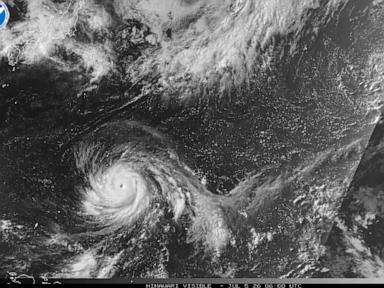
You don't really know what a Category 5 super typhoon sounds like until it's right outside your concrete walls. It's not a whistle. It's a heavy, rhythmic roar that vibrates through the floorboards.
Right now, the tiny island of Rota is taking the absolute worst of it. Super Typhoon Bavi just made landfall on this small U.S. territorial island in the western Pacific, bringing catastrophic winds and relentless rain. If you're looking at a map, Rota sits just northeast of Guam, home to fewer than 2,000 residents who are currently hunkered down in interior rooms, praying their roofs hold.
The National Weather Service didn't mince words this morning. They called the situation an "imminent danger to life."
This isn't just another bad storm. It's a massive, erratic monster packing sustained winds of 165 mph, with gusts screaming up to 215 mph. To put that in perspective, that's well above the threshold for a Category 5 hurricane. When winds hit those speeds, loose objects become lethal projectiles, utility poles snap like toothpicks, and anyone caught outside faces a legitimate risk of death.
The Reality of Back to Back Super Typhoons
What makes Bavi particularly brutal is the timing. The Mariana Islands are still actively recovering from Super Typhoon Sinlaku, which battered the exact same region back in April.
On nearby Saipan, the international airport just clocked wind gusts clearing 100 mph. Many families on Saipan and Tinian haven't even had their power restored from the last disaster. Now, they're sitting in the dark again, listening to the zinc sheets on neighboring roofs tear away.
"It's just a tough year," said Marcus Landon Aydlett, a meteorologist with the weather service in Guam. That might be the understatement of the century for the people living through this.
Local business owners are feeling the financial whiplash. In Guam, Pinky Cubacub spent her Saturday morning waiting in a massive line at a lumber store to buy $500 worth of plywood just to board up her small eatery. When you're running a new business, a prolonged power outage isn't an inconvenience. It's a financial death sentence. She noted that right now, everything she makes goes straight to rent, utilities, and her staff. She hasn't even paid herself yet.
Concrete Houses and the Normalization of Terror
There's a weird dichotomy in how people view these storms. On one hand, you have the absolute terror of the forecast numbers. On the other, you have the hardened resilience of people who have lived in the Marianas for decades.
Take the Rev. Francis Hezel, a priest at Santa Barbara Catholic Church in Dededo, Guam. He woke up before dawn to the sound of howling winds, but he wasn't panicking. Why? Because most houses on Guam are built from solid concrete specifically to withstand these literal storms. He figures it's mostly going to be a massive headache regarding power outages rather than structural devastation.
Hezel even suggested officials should consider toning down the warnings a bit so people don't live in constant fear. "By this time, people are used to typhoons," he said. "They know what they have to do to prepare."
Maybe. But Bavi is proving to be a bit of a wildcard. Overnight, the storm's track was erratic, wavering north and south as it pushed west. While it's moving fast—which means the worst of the wind might pass quickly—the sheer size of the storm system means torrential rains and flash flooding will stick around through Monday night.
What Happens Over the Next 24 Hours
If you're in the region, the danger isn't over when the eye passes. The National Weather Service issued a Flood Watch for Guam through late Tuesday night. We are looking at a projected 12 to 20 inches of rainfall. That kind of water causes immediate flash flooding and mudslides, especially in areas where the volcanic soil is already totally saturated.
Then there's the ocean. A Coastal Flood Watch is active, with massive breaking waves between 25 and 35 feet high in the surf zone. That is roughly the height of a ten-story building slamming into the reef. Combined with a 4-foot storm surge, low-lying coastal roads and infrastructure are going to be underwater.
If you are currently sheltering in Guam, Rota, Tinian, or Saipan, don't let up your guard just because the wind dips. Stay inside. Keep away from windows. Avoid the roads entirely so emergency crews can do their jobs once the clouds break. The grid is going to take a massive hit, so conserve your phone batteries, keep your water supplies close, and wait for the official all-clear from the Joint Information Center. This region knows how to rebuild, but you have to survive the night first.