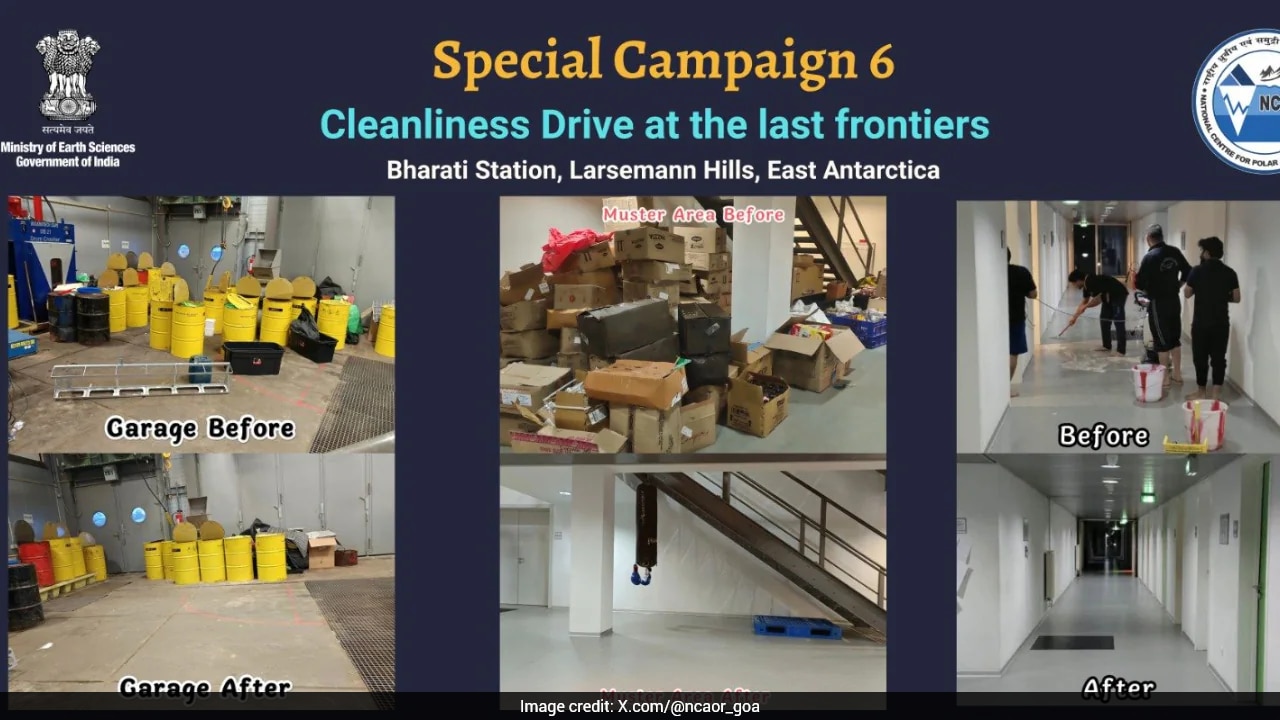
We love a good gimmick. Take a pristine, sub-zero wasteland where the human footprint is supposed to be minimal, fly a flag of eco-triumph into the teeth of a negative-forty-eight-degree gale, and call it progress. That is the essence of applying India's Swachh Bharat Mission to the frozen reaches of Antarctica. The headlines cheered it. The PR machines hummed. Another heroic triumph of cleanliness over chaos.
Except it is a masterclass in misplaced priorities. In similar news, read about: Operational Realities of High Altitude Flight Diversions.
When national prestige projects measure success by hauling trash out of polar stations while domestic rivers choke on untreated industrial effluent back home, we have lost the plot. The lazy consensus says that exporting our obsessive cleanup drives to the ends of the earth proves environmental maturity. I call it a high-latitude distraction.
The Optics Trap
Let us look at what actually happens when you export domestic sanitation campaigns to the white desert. Antarctica operates under the Madrid Protocol on Environmental Protection. Every nation with a station there is legally required to pack out what it packs in. Human waste management, greywater treatment, and solid waste segregation are baseline operational requirements for survival and compliance. It is not an innovative policy breakthrough born of a domestic sanitation awakening; it is basic janitorial housekeeping mandated by international treaty. Reuters has also covered this critical topic in extensive detail.
Calling routine polar waste mitigation a badge of national sanitation honor is like praising a homeowner for not throwing garbage on their living room floor. It misses the structural rot happening outside.
I have watched policy budgets get sucked into high-visibility flag-planting exercises while municipal waste systems in tier-two cities remain absolute disasters. We treat sanitation as a media event. A broom in front of a monument makes a great photo. Fixing a decentralized sewage treatment plant in a mid-sized district headquarters does not generate morning chyrons.
The Real Crisis Is Domestic Density
The Swachh Bharat Mission changed the conversation around open defecation in India. That deserves real credit. It built millions of toilets. But building a porcelain bowl is only step zero. Step one is water supply. Step two is sewage treatment networks. Step three is stopping untreated sludge from being dumped straight into local aquifers.
When you ignore those downstream failures and instead redirect national pride toward polar cleanups, you are practicing environmental tourism. You are treating sustainability as a branding exercise.
Consider how we talk
Why Exporting Garbage to the Ice Sheet is an Expensive PR Stunt Not Sanitation
news, travel
Every few years, institutions decide that the best way to prove their commitment to cleanliness is to haul their operational waste to the most hostile environment on earth. The headlines write themselves. India takes its sanitation campaign to Antarctica, dropping garbage management frameworks onto the frozen bedrock of the southern pole. It sounds noble. It makes for excellent broadcast segments. It is also an expensive distraction from the systemic failures back home.
When people read about waste management protocols operating at minus forty-eight degrees Celsius, they sigh with relief, assuming that if governance can conquer the white desert, it can handle anything. That is the illusion. Shipping ideological branding packages to an inhospitable wasteland where human foot traffic is statistically negligible does nothing to fix the crisis unfolding in urban centers where millions actually live and breathe.
Let us be precise about what is happening here. Antarctica is governed by the Madrid Protocol to the Antarctic Treaty, which treats environmental protection as an absolute requirement. Every nation operating a research station there is legally bound to remove its waste. You pack it in, you pack it out. This is not a heroic innovation of public policy; it is the baseline legal price of admission to a pristine international scientific reserve. Calling basic compliance with an international treaty a triumph of domestic sanitation policy is a triumph of marketing over reality.
I have spent decades watching governments substitute grand theatrical gestures for gritty, unglamorous execution. It is easy to design a bespoke waste segregation bin for a research station populated by a few dozen scientists. It requires almost zero political capital because nobody lives there to complain, no local municipal unions threaten strikes, and no dense informal settlements complicate logistics. It is a controlled laboratory exercise scaled up for television cameras.
The real test of any sanitation framework is not how it performs where nobody lives. It is how it holds up at three o'clock on a Tuesday afternoon in a crowded transit hub or a densely packed urban slum. When a policy cannot solve the drainage crisis in a megacity, painting a slogan on it and shipping it to a glacier is not progress. It is evasion.
We need to talk about why this happens. Bureaucracies suffer from what behavioral economists call the visibility bias. Fixing local municipal sewage plants, upgrading underground piping networks, and forcing corporate polluters to internalize waste costs are hard, boring, and politically perilous tasks. They invite friction with powerful local stakeholders. They take decades to show results.
Deploying a high-profile initiative to a remote continent, on the other hand, delivers immediate visual payoff. It generates clean media cycles without stepping on any domestic toes. It allows administrators to check a box that says international leadership while local infrastructure rots from neglect.
The defense usually rests on the idea of technology transfer. The narrative claims that engineering solutions developed for extreme cold will trickle down to everyday municipal use. This is a fairy tale. The material constraints of a polar station have almost zero overlap with the realities of a tropical or temperate urban center with high humidity, heavy organic waste loads, and millions of daily transient users. A compact incinerator or a specialized cryogenic containment unit designed for a research station does not scale down into a cost-effective solution for a municipal ward.
Furthermore, this obsession with exotic deployments distracts from the core failures of modern waste management. Real sanitation requires three things: continuous funding, aggressive enforcement against illegal dumping, and structural accountability for packaging waste at the manufacturing source. None of these require a trip to the southern pole. All of them require political courage that no PR campaign can manufacture.
When we applaud symbolic compliance while ignoring structural decay, we signal that appearances matter more than outcomes. The frozen crust of Antarctica does not need our slogans. The communities choking on unmanaged urban refuse do.
Stop funding the theater. Fix the pipes.