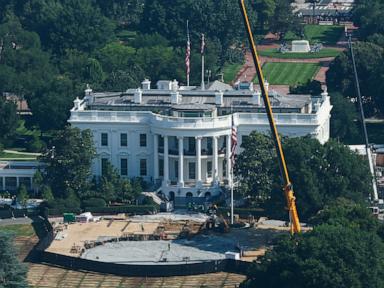
The media freak-out over Donald Trump installing a granite helipad on the White House South Lawn is a masterclass in missing the point.
Commentators are wringing their hands over historic preservation, visual aesthetics, and the apparent "ruining" of a pristine landscape. They treat the South Lawn like an untouched national park. It is not. It is an operational command center.
The lazy consensus screams that this is a vanity project. The reality is far more boring—and far more critical. This is a overdue infrastructure upgrade disguised as a political lightning rod.
The Myth of the Pristine South Lawn
For decades, Marine One has landed on the South Lawn. Every single landing tortures the turf.
Imagine a 22,000-pound Sikorsky VH-60N Nighthawk or a massive VH-92A Patriot descending onto soft grass. The downwash from the rotors bakes the ground. The tires tear up the sod. Every departure requires a small army of groundskeepers to patch, re-seed, and pray that the mud does not swallow the next arrival.
When you look at the logistics, the traditionalist argument falls apart completely.
- The Mud Factor: Heavy rain turns the South Lawn into a swamp. Landing a multi-ton military aircraft on unstable, wet earth is a safety hazard, not a historical tradition.
- The Maintenance Drain: Maintaining that specific patch of grass costs tens of thousands of dollars in constant turf replacement and labor.
- The Safety Reality: Debris from torn-up turf can get sucked into helicopter engines. It is called Foreign Object Damage (FOD), and it ruins multimillion-dollar turbines.
Pouring a temporary granite pad isn't an act of vandalism. It is basic facility management.
Why Granite Makes Actual Operational Sense
Critics are obsessed with the word "granite," viewing it as a symbol of luxury. They assume it is an aesthetic choice meant to mirror a country club.
Step back and look at the engineering.
Granite is incredibly dense, highly resistant to heat, and handles immense structural loads without cracking. If you pour standard asphalt, the intense heat from helicopter exhaust softens it over time, leading to rutting. If you use standard concrete, it requires a significant curing time and stands out like a sore thumb against the green.
Granite pavers, laid over a stable base, can be removed in the future without leaving permanent scars on the landscape. It is a modular, heavy-duty solution for a high-traffic zone.
I have watched public sector projects waste millions on "aesthetic compromises" that fail within two years because someone cared more about optics than engineering. When you build for utility, you build for the weight of the machine, not the feelings of the onlookers.
The Flawed Premise of Historic Preservation
The underlying argument against the helipad relies on a flawed premise: that the White House grounds are frozen in time.
The White House has constantly adapted to modern technology and the security needs of the executive branch.
- 1902: Teddy Roosevelt tore down greenhouses to build the West Wing because the original structure could no longer support the modern presidency.
- 1940s: Harry Truman completely gutted the interior, replacing the rotting timber frame with structural steel. He also added the Truman Balcony, which critics at the time claimed ruined the South Portico.
- 1970s: A permanent outdoor swimming pool was installed over the old West Wing press facilities.
The South Lawn is not a museum piece; it is a working asset. Denying an infrastructure upgrade because of "history" ignores the fact that the building's history is defined by constant renovation.
The Real Cost Counter-Argument
To be fair, any project inside the White House gates comes with an inflated price tag. The security clearance protocols for contractors, the specialized materials, and the hyper-vetted labor pool mean this pad costs significantly more than a driveway in the suburbs.
If there is a valid critique here, it is the lack of transparency around the exact line-item budget. Government procurement is notoriously bloated. But attacking the existence of the pad rather than the efficiency of the spend is lazy journalism.
Stop looking at the helipad as a political statement. It is a slab of rock designed to keep a massive helicopter from sinking into the mud. Treat it like infrastructure, or stop pretending you care about how the government runs.
The presidency requires logistics that outrank landscaping. Get over the grass.