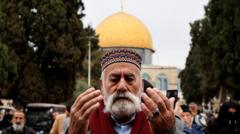
Jerusalem is built on friction, but right now, the friction is grinding down the last gears of a decades-old truce. For over half a century, a delicate gentleman’s agreement known as the "status quo" kept the peace at the city’s most volatile flashpoint. To Muslims, it is the Haram al-Sharif (the Noble Sanctuary) housing the Al-Aqsa Mosque. To Jews, it is the Temple Mount, the historical site of the biblical temples.
The rule was always simple. Muslims pray there. Non-Muslims, including Jews, can only visit.
But that rule is being systematically dismantled. If you think this is just about a few people muttering prayers into their smartphones, you are missing the bigger picture. Right now, right-wing Israeli nationalists are openly flouting the restrictions with the quiet backing of high-ranking government officials. The thin line between a tense peace and regional escalation has never looked more fragile.
The Slow Erosion of the Rules
The status quo isn't a formal, signed treaty. It is a set of understandings hammered out by Israeli Defense Minister Moshe Dayan in 1967 after Israel captured the Old City. Dayan left the internal, civilian management of the compound to the Islamic Waqf, a Jordanian-backed religious trust. Israeli forces took charge of external security.
For decades, the Israel Police strictly enforced the prayer ban. If a Jewish visitor so much as bowed their head or started whispering, officers would quickly escort them out or arrest them.
That version of reality is gone. Over the last several years, the police have radically shifted their approach. It started with looking the other way during silent, unmoving prayers. Then it evolved into allowing small groups to stand together. By early 2026, the police officially permitted Temple movement activists to bring printed prayer sheets into the Holy Esplanade.
This isn't a grassroots accident. National Security Minister Itamar Ben-Gvir, who oversees the police force, has repeatedly ascended the mount to assert a new reality. During major fast days like Tisha B'Av, Ben-Gvir didn't just visit; he led a quorum of Jewish men in loud, public recitations of the Amida prayer right in front of the Dome of the Rock.
When the person in charge of enforcing the law is the one breaking the agreement, the old rules cease to exist.
The Political Tinderbox
Every major escalation in Jerusalem over the past thirty years has a thread tying back to this specific plateau of stone. The Second Intifada in 2000 ignited after Ariel Sharon's high-profile visit to the site. The 2021 conflict saw rockets flying after tensions boiled over at Al-Aqsa.
The strategy used by activist groups like "Temple Mount in Our Hands" (Bedeinu) is transparent. They want to establish a temporal and spatial division of the site, similar to how the Ibrahimi Mosque in Hebron is split between Jewish and Muslim prayer times. Prominent political figures, including Likud MK Amit Halevi, have publicly pushed for opening the compound to nationalist marches and flag-raising events on sensitive days like Jerusalem Day.
On the other side, the Palestinian population and the broader Arab world view these moves as an existential threat. The Jerusalem Governorate frequently issues warnings that these systematic incursions are designed to completely erase Islamic custodianship. Jordan, the official custodian of the site, routinely flags these visits as unacceptable provocations that risk triggering a much larger religious conflict across the Middle East.
While Prime Minister Benjamin Netanyahu continuously releases statements insisting that Israel's policy of maintaining the status quo has not changed, the facts on the ground tell a completely different story. The government says one thing to international diplomats while its coalition partners execute a different agenda on the ground.
Secular Pragmatism Versus Religious Nationalism
The debate inside Israel isn't unified either. There is a deep, internal divide about whether Jews should even be stepping foot on the mount, let alone praying there.
For the strictly Ultra-Orthodox (Haredi) community, ascending the Temple Mount is traditionally forbidden by Jewish law. Because the exact location of the ancient Holy of Holies is unknown, rabbinic decrees argue that walking on the site risks defiling the most sacred ground on Earth while in a state of ritual impurity. Furthermore, traditional edicts emphasize living in peace with non-Jewish neighbors and avoiding unnecessary provocations.
But the religious Zionist movement has largely discarded those warnings. For nationalist activists, this is an issue of basic civil rights and national sovereignty. They argue that banning Jews from praying at their holiest historical site is a form of appeasement to threats of violence.
This ideological shift has turned a theological debate into a political tool. The number of Jewish pilgrims ascending the mount has skyrocketed, breaking records year after year, while the number of young Muslim worshippers allowed through the gates is tightly controlled by arbitrary police restrictions.
What Needs to Happen Next
The current trajectory is unsustainable. Managing the crisis by pretending the status quo is intact while it is being actively dismantled invites a catastrophic miscalculation.
If you want to understand where this heads next, watch how the authorities handle upcoming flashpoints. To prevent an outright explosion of violence, several concrete shifts are required from the security apparatus:
- Enforce Consistent Group Limits: The Israel Police must strictly limit the size of political activist groups entering the compound during highly sensitive periods to maintain operational control.
- Restore Transparent Security Coordination: De-escalation requires a return to direct, quiet channels between the Israel Police, the Islamic Waqf, and Jordanian authorities, completely bypassing partisan ministers who use the site for political theater.
- End Arbitrary Access Restrictions: Sweeping bans based on age or residence for Muslim worshippers trying to access the Al-Aqsa compound during Friday prayers must be replaced by targeted, individual security screenings to lower the atmospheric tension in the Old City.
Ignoring the erosion of the historic arrangement won't make the problem disappear. The longer the government allows ideological factions to dictate policy on the ground, the closer the entire region moves toward a conflict that nobody will be able to contain.
For a deeper dive into how these changing dynamics look on the ground, this Israeli minister sparks anger by praying at sensitive Jerusalem holy site provides a direct look at the recent high-profile visits and the immediate diplomatic fallout they caused across the region.