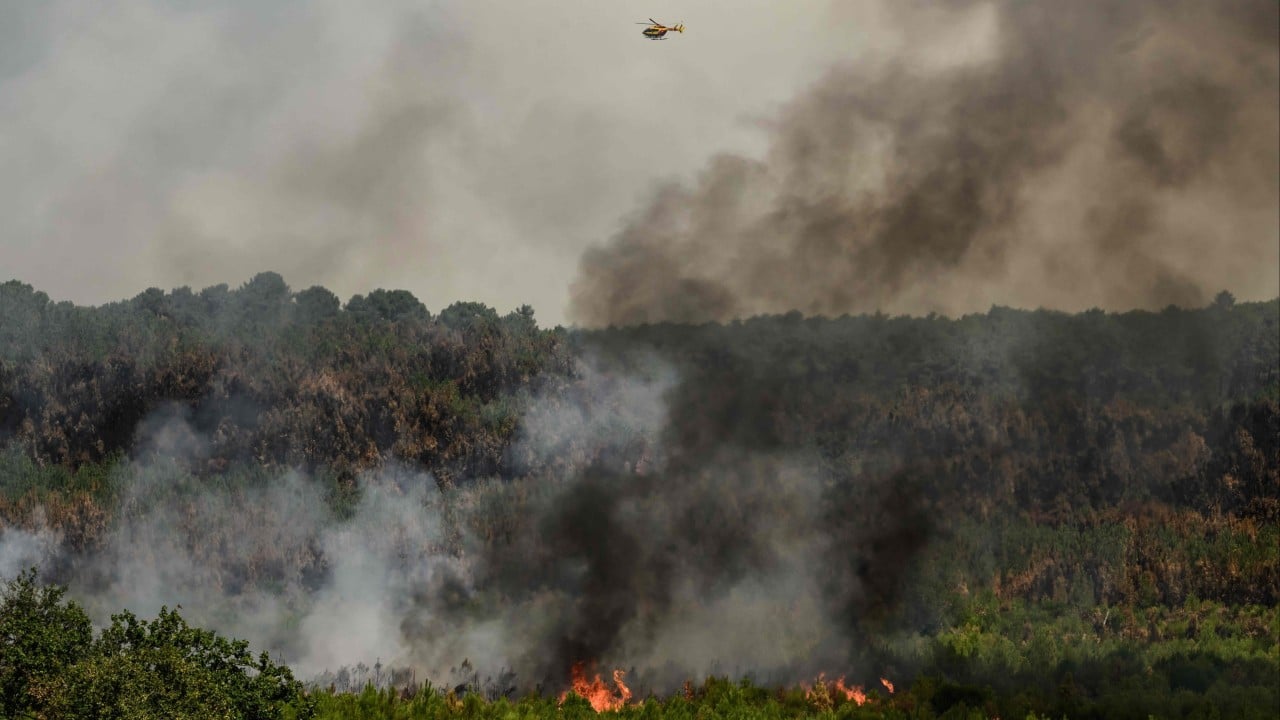
France and Spain are currently declaring temporary control over their most destructive seasonal wildfires, yet emergency management professionals know the celebration is entirely premature. Another punishing atmospheric heatwave is already tracking across the Mediterranean basin. The temporary containment of active fire lines across Andalusia and the Gironde masks a systemic vulnerability in Southern Europe. Fire services are winning daily tactical battles against the flames while steadily losing the long-term strategic war against climate acceleration.
The immediate reality on the ground involves exhausted crews rotating out of scorched pine forests, containment lines holding by a narrow margin, and local officials assessing millions of euros in agricultural damage. Yet meteorological data confirms that the atmospheric ridge responsible for the current crisis is simply shifting position, not dissipating. Soil moisture levels across the Iberian Peninsula and southwestern France have plummeted to historic lows following months of below-average winter precipitation. When the next thermal spike arrives, dry timber and parched undergrowth will ignite with minimal provocation, overwhelming even heavily reinforced municipal response teams.
The Mirage of Containment
Governments love a successful press conference. Prime ministers and regional presidents stand before charred backdrops to praise the extraordinary valor of firefighters, declaring that the worst has passed.
This performance obscures a dangerous structural reality.
Containing a wildfire does nothing to alter the environmental conditions that created it. When wind speeds drop and relative humidity creeps upward during the night, aviation assets can finally dump tons of water effectively. Ground crews can cut firebreaks through dry brush. The smoke clears from local tourist towns, and flights resume.
Statisticians mark this down as a victory. Ecologists view it as a brief intermission.
The underlying fuel load across Mediterranean ecosystems has reached unprecedented levels. Decades of aggressive fire suppression policies have paradoxically created hyper-combustible landscapes. Instead of allowing low-intensity, natural fires to clear out dead undergrowth over generations, authorities extinguished every spark instantly. The result is a dense accumulation of organic fuel. When a modern blaze finally breaches containment lines, it feeds on decades of accumulated timber, burning with a thermal intensity that melts aluminum equipment and sterilizes the soil down to bedrock.
The Economics of Exhaustion
Emergency budgets are bleeding out. France and Spain allocate hundreds of millions of euros annually to aerial firefighting fleets, heavy machinery, and overtime pay for civil protection units. This reactive spending model resembles a homeowner who continually repairs water damage from a leaking roof without ever patching the holes in the shingles.
Aircraft are extraordinarily expensive to operate. A single Canadair water bomber burns thousands of liters of fuel per hour and requires massive logistical support teams on the ground. When consecutive heatwaves stretch across three or four months, these fleets experience critical maintenance bottlenecks. Parts wear out. Engines overheat. Pilots face dangerous fatigue limits.
Meanwhile, municipal councils bear the brunt of the recovery costs. Vineyards in the Languedoc and olive groves in Extremadura take years to return to commercial productivity after a severe fire. Rural depopulation compounds the crisis. With fewer young people living and working in agricultural regions, traditional land management practices like grazing and controlled clearing have vanished. Brush grows unchecked right up to the edges of rural residential properties, turning villages into indefensible islands during a wind-driven crown fire.
The Atmospheric Driver
To understand why these fires keep returning with escalating ferocity, one must look upward at the jet stream.
Persistent high-pressure systems are stalling over Western Europe for weeks at a time. These thermal domes trap hot air near the surface, baking soil moisture out of the earth like moisture from a kiln. Meteorologists call these blocking patterns, and their frequency has accelerated dramatically over the past two decades.
When a blocking high-pressure system parks itself over Spain and France, it creates a feedback loop. Dry soil cannot cool the air through evaporation. The air becomes hotter, which dries the soil even further. By the time a dry lightning strike or a careless cigarette ignites a roadside patch of grass, the surrounding countryside is primed to explode.
Civil protection agencies are upgrading their predictive modeling, utilizing satellite data to track relative humidity down to the square kilometer. Yet better data does not equal more water. Knowing precisely where a fire will start three days in advance is useful only if sufficient ground units are stationed nearby to intercept it before it crowns into the tree canopy.
Shifting the Defensive Paradigm
Southern European forestry management is caught in an ideological transition that is moving far too slowly.
For generations, the default strategy was total exclusion. Fire was treated exclusively as an enemy to be hunted down and destroyed with maximum force. Today, forward-thinking silviculturists argue for a radical pivot toward fire-resilient landscapes. This approach accepts that fire is an inevitable natural process in Mediterranean biomes. Instead of fighting nature at every turn, the goal is to shape the landscape so that fires remain low-intensity ground fires rather than catastrophic canopy infernos.
This requires unpopular policy choices.
It means intentionally setting controlled burns during cooler, wetter months to clear out the accumulated underbrush. It means subsidizing small-scale livestock grazing in vulnerable forest zones so that goats and sheep naturally manage the fuel load. It means restricting real estate development in high-risk wildland-urban interfaces where suburban sprawl bleeds directly into dense pine forests.
Property developers and local tourism boards consistently push back against these measures. Prescribed burning generates smoke that disturbs tourists and sparks public anxiety. Clearing brush around luxury rental villas reduces privacy and aesthetic appeal. Local politicians seeking re-election often find it easier to promise bigger water-bombing fleets than to implement restrictive zoning laws that anger landowners.
The Human Element on the Front Line
Behind the satellite maps and government budgets stand the firefighters themselves, a demographic under severe strain.
Professional brigades are working extended shifts with aging equipment. Volunteer fire departments, which form the backbone of rural response in both France and Spain, are experiencing recruitment shortfalls. The physical toll of battling wind-driven fires in forty-degree Celsius heat is staggering. Heatstroke, smoke inhalation, and exhaustion send dozens of emergency personnel to hospitals every week during peak season.
The psychological burden is equally heavy. Firefighters now regularly confront fire behavior that defies their historical training. Entire valleys can be engulfed in minutes by fire tornadoes and sudden wind shifts. When the next heatwave rolls across the Mediterranean, these individuals will once again be asked to hold the line against an impossible imbalance of forces.
The Looming Test
The atmospheric models are clear. The upcoming heatwave will test the resilience of municipal infrastructure, civil protection logistics, and political resolve across Southern Europe.
Temporary containment measures will buy a few days of relative calm. Smoke will temporarily vanish from coastal horizons. Airports will resume normal schedules, and tourists will return to outdoor cafes. But beneath the surface veneer of normalcy, the core vulnerabilities remain entirely unaddressed. Until governments pivot from purely reactive firefighting to systemic landscape management, every seasonal reprieve will simply be the quiet before the next storm of embers.


