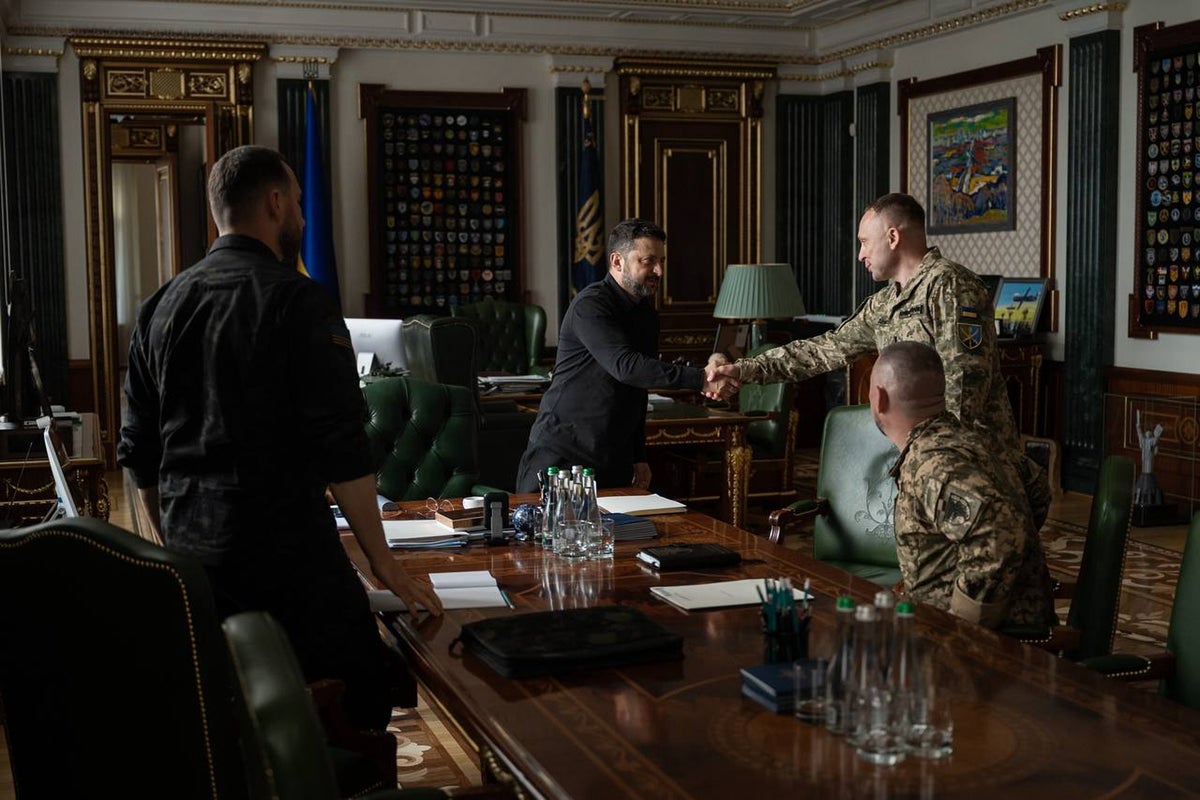
Western commentators panicked when Volodymyr Zelensky replaced General Valerii Zaluzhny with Oleksandr Syrskyi. The media narrative was immediate, uniform, and wrong. Outlets framed the move as a dangerous political purge driven by jealousy, internal rivalries, and presidential insecurity.
That framing ignores the brutal reality of the battlefield.
Zaluzhny was a heroic figure for the initial defense of Kyiv. He deserves eternal credit for surviving the opening salvo of 2022. But wartime strategy cannot be anchored in gratitude. By late 2023, Ukraine's war effort had ground to a catastrophic halt. The multi-billion-dollar summer counteroffensive failed to achieve its strategic objectives, crashing directly into deep Russian minefields and defensive fortifications. Zaluzhny himself admitted in late 2023 that the war had reached a "stalemate"—a word that carried devastating consequences for Western military aid.
Calling a war of survival against an enemy with five times your population a "stalemate" is a strategic admission of defeat. Attrition favors the bigger country every single time. Standing still meant dying slowly. Zelensky didn't fire his top general because of political polls; he fired him because Zaluzhny’s doctrine had run out of answers.
The Myth of the Untouchable General
Military history is littered with brilliant generals who were indispensable in one phase of a conflict and completely useless in the next.
Lincoln fired McClellan because McClellan refused to press the advantage. Churchill swapped commanders repeatedly in North Africa until he found Montgomery. The idea that military command should remain static during an existential war out of fear of bad PR is a luxury for civilian commentators sitting three thousand miles away.
The mainstream consensus insisted that Zaluzhny’s dismissal would fracture troop morale and destroy national unity. Look at the actual data from the frontlines following the change. Unit cohesion did not collapse. The military apparatus did not shatter. Ukrainian soldiers on the zero line cared far less about who was sitting in Kyiv offices and far more about whether they had artillery shells, effective electronic warfare jamming, and clear operational objectives.
Zaluzhny’s defensive success in 2022 created a dangerous dogma. His approach relied heavily on classic NATO operational concepts—combined arms maneuver against a deeply entrenched, heavily artillery-backed adversary without air superiority. NATO doctrine was built for armies with massive air power. Expecting Ukrainian brigades to execute maneuver warfare across mined plains without air support wasn't sound military planning; it was wishful thinking.
Attrition Is a Mathematical Death Sentence
Ukraine cannot win a classic Western-style land war against Russia.
Consider the arithmetic:
- Russia possesses a vast demographic reservoir to draw conscripts from.
- Russian defense production converted to a total war footing faster than Western defense contractors could sign supply agreements.
- Russian artillery volume outmatched Ukrainian firepower for extended periods during the height of the trench gridlock.
If Ukraine continued under the doctrine of grinding positional warfare, it would simply run out of men before Russia ran out of artillery shells. Zaluzhny’s vision offered no operational way out of that mathematical trap. Continuing down that path meant accepting slow, predictable exhaustion.
Syrskyi was brought in not because he was a compliant yes-man, but because he represented a fundamental shift toward operational flexibility and ruthless adaptation. The transition signaled an admission that traditional Western military doctrine had failed in the Ukrainian theater.
The Pivot to Asymmetrical Reality
Replacing top leadership was the prerequisite for changing how Ukraine fought. You cannot change your grand strategy while leaving the architect of the failed strategy in charge.
The tactical shift required three immediate adjustments:
- Abandoning deep-thrust armored operations against fortified lines. The age of massed tank charges through dense minefields under constant drone surveillance is over.
- Prioritizing deep strategic strikes. Shifting resources away from grinding territorial defense toward destroying Russian oil refineries, airfields, and logistics hubs inside Russian territory.
- Pivoting to drone-first defense. Replacing high-cost artillery shells with low-cost first-person-view (FPV) strike drones to bleed Russian advancing columns before they reach line of sight.
Critics claim Syrskyi relies too heavily on Soviet-era rigidity and high-casualty defense tactics, particularly in places like Bakhmut. That criticism ignores the Strategic holding action function. Holding Bakhmut and Avdiivka wasn't about land; it was about degrading Russia’s offensive capability, eating up Wagner units, and buying time to build secondary defenses while waiting for Western aid packages to clear political bottlenecks.
The Real Risk Nobody Wants to Talk About
Admitting that a change in high command was necessary comes with a uncomfortable truth.
Changing commanders mid-conflict always creates operational friction. Staff officers must adjust to new communication styles, priorities, and internal politics. Transition periods invite tactical vulnerabilities that an aggressive enemy can exploit.
Furthermore, a leadership change does not magically fix structural supply deficits. Removing a general does not manufacture 155mm artillery rounds out of thin air, nor does it resolve severe mobilization shortages. If the Ukrainian political leadership fails to fix the military recruitment pipeline, changing commanders merely delays the inevitable.
To pretend the military shakeup was free of political calculation would be naive. Zelensky needed to assert civilian control over a military structure that was becoming an independent political power center. In a democracy, even one under martial law, the elected executive must maintain supreme command over the armed forces. A general who publicly contradicts presidential strategy on international media creates two competing centers of power—a dynamic no state at war can tolerate.
Stop Nostalgic Military Worship
The Western media's fixation on Zaluzhny was rooted in a romanticized view of military command. People like simple hero narratives. They like fixed characters in fixed roles.
War doesn't care about hero narratives. It demands rapid, cold evolution.
When a strategy stops working, you burn it down and try something else. You change the leadership, you rewrite the tactics, and you force the enemy to adapt to a new set of problems.
Zelensky didn't break the Ukrainian war effort by firing his top general. He saved it from an early grave built on strategic inertia.


