Five.
That is the number that appeared across wire services and mobile alerts in the early hours after the strikes, reduced to a single digit before most commuters had finished their morning coffee. Five people killed in Gaza, including a child, according to Palestinian rescue services.
In the architecture of modern journalism, a headline like that is designed for speed. It delivers the essential data points in less than fifteen words, allows the reader to register the event, and clears the screen for the next update. We read the number, feel a brief, familiar tightening in the chest, and scroll down. The mind, overwhelmed by repetition, files the report into an existing mental folder labeled with the name of a conflict that has spanned decades.
Yet behind that compressed syntax lies a profound distortion. When a tragedy is summarized in a headline, the math looks small. Five is a manageable integer. You can count it on one hand. In reality, five is not a small number at all; it is the sudden, violent erasure of five separate universes, each containing decades of memory, unfinished conversations, and the intricate web of people who relied on them to make sense of the world.
To understand what actually happened when those Israeli bombardments hit, we have to step outside the sterile vocabulary of breaking news and look at the invisible stakes that never make it into a wire dispatch.
The Architecture of a Wire Dispatch
Consider how information travels from a rubble-strewn street in Gaza to a smartphone screen thousands of miles away.
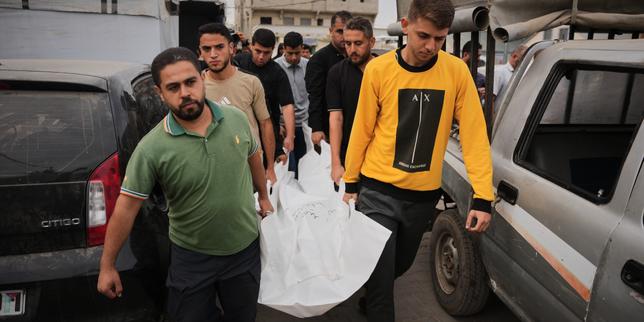
First comes the sound—a low, tearing roar that arrives a fraction of a second after the impact, shaking dust from ceiling cracks and shattering window glass across adjacent blocks. Then come the Palestinian rescue services, often working with limited fuel, damaged equipment, and unstable communication lines. They pull survivors and the dead from collapsed concrete, tallying the casualties so that hospitals and international observers have a baseline record of the event.
By the time those figures reach an editor's desk in Paris, London, or New York, the sensory reality has been stripped away. What remains is attribution and verification: cinq personnes, dont un enfant, tuées par des bombardements israéliens, selon les services de secours palestiniens.
I have spent years reading, analyzing, and living alongside the psychological weight of these dispatches, and the hardest thing to explain to someone who has never heard an airstrike is the silence that follows it. In newsrooms, coverage is loud; phones ring, tickers update, anchors speak in urgent cadences. On the ground, right after the dust settles, there is a stunned, ringing quiet broken only by the sound of people calling out names in the dark.
Notice the phrasing that always accompanies these reports: "according to Palestinian rescue services." That attribution is journalistically necessary—in a zone where independent international access is heavily restricted, reporters must cite their sources clearly. Still, over months and years, that cautious phrasing creates a subtle psychological distance for the reader. It turns a physical reality—a child's body pulled from crushed masonry—into a contested claim, something abstract and administrative rather than immediate and irreversible.
Five Universes, Hypothetically Drawn
Because wire reports rarely include full biographies in the initial hours, let us construct a hypothetical portrait—explicitly imagined, yet grounded in the documented demographics and daily realities of Gaza—to see what the number five actually contains.
Imagine, first, an older man in his late fifties, a retired schoolteacher whose knees ache when the humidity rises off the Mediterranean. He spent the afternoon rationing water from a plastic jerrycan and trying to fix a battery-powered radio so his family could listen to the news without draining their last phone charge. His entire life was built around small, stubborn routines meant to preserve a sense of normalcy inside an abnormal reality.
Next to him, imagine his daughter, thirty-two, a former pharmacy clerk who has spent the last year calculating dosages of scarce antibiotics in her head and keeping track of which neighbors have asthma or diabetes. Her world narrowed long ago to the walls of a single room, yet she remained the logistical center of an extended family of fourteen people.
Add to them a neighbor who stopped by to borrow a wrench, a young man in his twenties whose dreams of studying civil engineering had been indefinitely suspended, replaced by the daily labor of hauling firewood and clearing debris.
And then there is the fifth casualty. The clause separated by commas in the headline: dont un enfant. Including a child.
Imagine a seven-year-old boy who still kept a smooth white pebble in his pocket because he liked the way it felt cool against his thumb. He did not understand geopolitical strategy, deterrence theory, or the mechanics of international diplomacy. He understood that loud noises meant running toward his mother's voice, and that the dark felt less frightening when someone held his hand.
When a munition strikes a residential structure, it does not distinguish between these histories. In a fraction of a second, the teacher's memory, the pharmacist's knowledge, the young man's unfinished future, and the boy's small, warm hand are all collapsed into a single statistical entry.
Why the Human Brain Numbs to Small Numbers
There is a well-documented cognitive phenomenon that psychologists call "psychic numbing." First studied extensively in the context of humanitarian crises and mass atrocities, it describes a counterintuitive quirk of human empathy: our emotional response does not scale linearly with the number of victims.
In fact, the opposite happens.
When we hear about one specific person in danger—a child trapped in a well, a hiker lost in the mountains—societies mobilize vast resources, media networks broadcast live around the clock, and millions of strangers feel an acute, personal ache. Yet when the number rises to five, or fifty, or five hundred, our emotional circuitry begins to overload. We stop picturing faces and start processing figures.
In prolonged conflicts, this effect compounds over time. Readers develop what researchers call compassion fatigue, though the term is slightly misleading. People do not necessarily stop caring; rather, their minds build a protective callous to survive the constant exposure to helplessness. If you allowed yourself to feel the full, unedited grief of five deaths every single morning, you would struggle to function at your job, speak calmly to your children, or navigate ordinary life.
So we skim. We read that five people were killed in Gaza, note the attribution to local emergency responders, and move on to weather forecasts or sports scores. The danger is not that we are cruel. The danger is that we mistake our own emotional self-defense for an accurate measure of the event's significance.
The Invisible Ripple Effect of a Single Strike
Even if we could measure the loss solely through the five people who died, the accounting would still be incomplete. A fatal strike does not end when the ambulance doors close. It radiates outward through a community like a crack spreading across a windshield, weakening everything around it.
Consider what happens next in the hours and days following a bombardment that kills five people.
First, there is the immediate medical strain. In a healthcare system already operating beyond capacity, a sudden influx of trauma cases—burns, crush injuries, internal bleeding—forces doctors into impossible triage decisions. Supplies used to treat the wounded from one strike are supplies no longer available for a premature infant in the neonatal ward or a patient undergoing emergency surgery an hour later.
Second, there is the psychological tremor felt by everyone within earshot. Every parent who hears that a child was killed three streets away absorbs a terrifying lesson: there is no reliable formula for safety. You can stay indoors, keep away from windows, follow every precaution, and still watch the ceiling collapse. That realization alters how people sleep, how they speak to their children, and how much hope they dare to invest in tomorrow.
Third, there is the economic and social erasure. In tightly knit neighborhoods, every adult plays multiple informal roles—mediator, caregiver, tutor, breadwinner. Removing four adults from a single block leaves behind orphans, elderly relatives without support, and dozens of dependents whose fragile survival networks suddenly snap.
A headline tells you that five lives ended. It cannot tell you how many dozens of lives were permanently hollowed out in the exact same instant.
Reading Between the Lines of Conflict Reporting
How, then, are we supposed to engage with news like this without either drowning in despair or retreating into indifference?
It begins with changing how we read. When you encounter a brief, matter-of-fact report about casualties in Gaza—or in any conflict zone where violence has become routine—treat the headline not as the full story, but as an envelope. Inside that envelope is a reality vastly larger than the words printed on the outside.
Look closely at the language. Notice when passive voice softens agency, or when standard journalistic formulas turn human beings into categories. "Five people, including a child" is accurate, stripped-down reporting, yet it relies on the reader to supply the humanity that a wire service cannot fit into a lede paragraph.
I am not pretending that pausing for thirty seconds to reflect on a headline changes the trajectory of a war or rebuilds a shattered neighborhood. It can feel deeply uncomfortable, even futile, to sit with grief from a distance when you have no lever to pull that will stop the next strike. That vulnerability—the admission that we are witnesses without immediate power—is precisely what makes most people turn away.
Yet attention is not nothing. Collective memory is built out of millions of individual acts of refusal: the refusal to let a child's death become background noise, the refusal to treat recurring tragedy as natural weather, the refusal to confuse brevity with insignificance.
The Weight of a Comma
Go back to that original sentence one more time. Look at the punctuation tucked right in the middle of it: Gaza : cinq personnes, dont un enfant, tuées par des bombardements israéliens.
Two commas. A tiny grammatical pause inserted to set off a clarifying detail.
Inside that small enclosure of punctuation sits an entire childhood that will never reach adolescence—no first day of secondary school, no awkward teenage arguments, no quiet pride of learning a trade or raising a family of their own. Just a pair of commas holding space for a life that was cut short before it had the chance to leave its own footprints in the world.
When the next alert flashes across your screen, carrying another number and another attribution, the numbers will still look small against the vast, indifferent scroll of the daily news cycle. Do not trust the math. Hold the page still for a breath, look past the digits, and remember that every single count begins with one person who expected to wake up tomorrow.