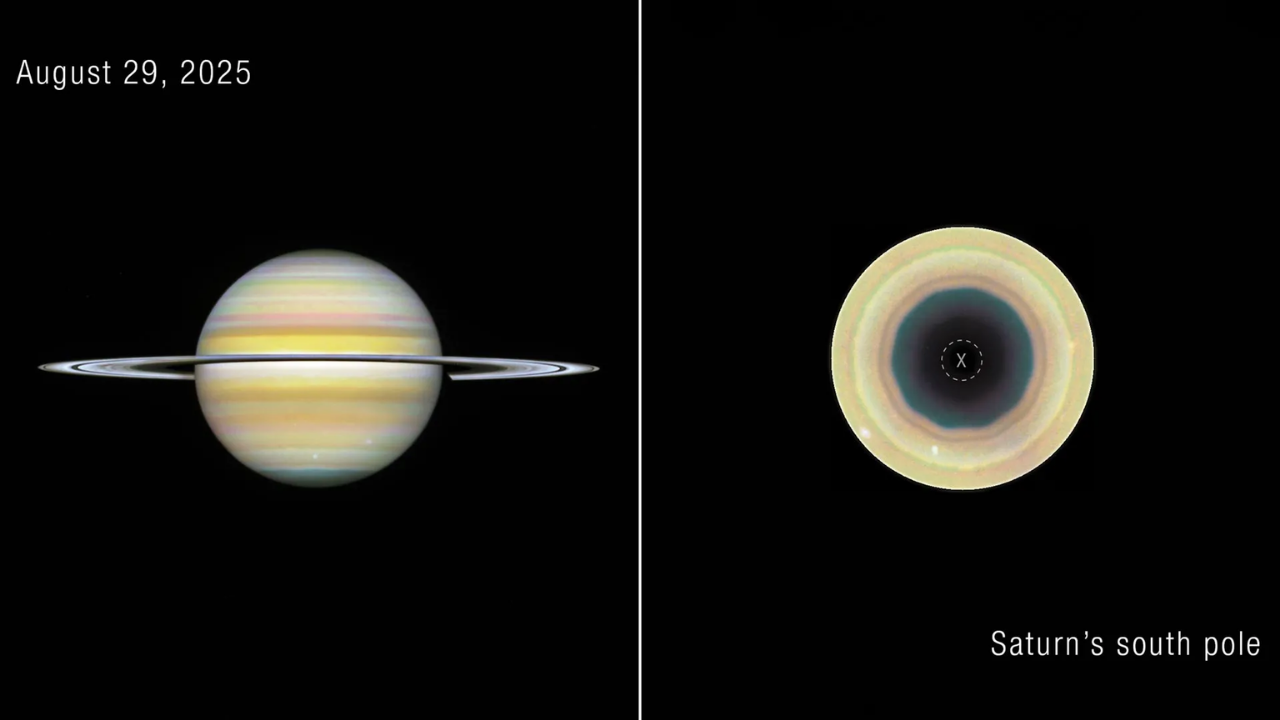
Planetary atmospheres maintain complex momentum balances that resist simple intuitive modeling. The detection of a ten-sided wave structure circling Saturn’s southern pole provides a singular opportunity to examine how stable wave patterns form within high-velocity gas giant jet streams. Unlike transient meteorological phenomena on terrestrial planets, giant planet wave systems persist through stable zonal winds and deep convective forcing. Analyzing the emergence of this southern decagon requires evaluating observational constraints, planetary fluid mechanics, and the persistent variables governing atmospheric standing waves.
The Observation Problem and Temporal Resolution
Mapping atmospheric structures on outer planets depends heavily on observational continuity. When NASA's Cassini spacecraft ended its mission in 2017, direct orbital monitoring of Saturn ceased, creating an operational data gap. Bridge initiatives such as the Outer Planets Assessment and Legacy program relied on ground-based networks and Earth-orbiting telescopes like Hubble to monitor planetary shifts.
The discovery of the decagon highlights the value of distributed observation architectures. Professional researchers partnered with advanced amateur astronomers using ground-based instruments under stable seeing conditions. These distributed captures flagged early ripple patterns in mid-2024, prompting targeted multi-wavelength analysis using Hubble Space Telescope polar projections. Archival backtracking confirmed that the structure originated between 2023 and early 2025 as Saturn's southern hemisphere tilted back into a favorable viewing angle relative to Earth.
This sequence underscores a structural limitation in planetary science: reliance on intermittent high-resolution orbital assets creates blind spots during seasonal transitions. Ground-based contributors effectively mitigate this vulnerability by maintaining high-frequency temporal surveillance, proving that continuous low-aperture monitoring can complement capital-intensive space telescope missions.
Fluid Mechanics of Polar Wave Structures
Saturn is unique in hosting persistent polygonal wave patterns at both poles. The northern hemisphere has maintained a stable six-sided hexagon since its discovery during the Voyager flybys in the early 1980s. The newly identified southern decagon introduces a ten-sided wave structure operating within the south polar collar region.
The physical mechanism driving these polygons involves Rossby waves trapped within high-speed zonal jet streams. In planetary fluid dynamics, when a westerly jet stream encounters sharp latitudinal shear gradients, it can undergo instability that organizes the flow into regular polygonal geometries. The number of sides $n$ in such a wave pattern is a function of the velocity profile of the jet, the planetary rotation rate, and the meridional scale of the shear zone.
$$\frac{\partial q}{\partial t} + J(\psi, q) = 0$$
Where $q$ represents potential vorticity and $\psi$ denotes the streamfunction governing the zonal flow. The disparity between the northern hexagon ($n=6$) and the southern decagon ($n=10$) implies asymmetric boundary conditions or differences in deep interior heat flux between the two hemispheres. While the northern hexagon has exhibited long-term stability spanning decades, numerical simulations have shown that the southern decagon is actively evolving and strengthening, indicating a dynamic transition phase rather than a static equilibrium.
Analytical Comparison of Polar Asymmetries
Evaluating the structural differences between Saturn's poles reveals fundamental constraints on gas giant atmospheric models.
| Parameter | Northern Hexagon | Southern Decagon |
|---|---|---|
| Symmetry Order | Six-sided ($n=6$) | Ten-sided ($n=10$) |
| Discovery Era | Early 1980s (Voyager) | Mid-2020s (Hubble / Ground Arrays) |
| Temporal Status | Multi-decade steady state | Actively evolving and strengthening |
| Penetration Depth | Extends deep into upper troposphere | Confined near south polar collar vortex |
The variation in side count between the poles challenges standard barotropic instability models. If the atmospheric circulation were entirely symmetrical between hemispheres, the modal selection of the wave pattern should match under equivalent shear conditions. The existence of a ten-sided wave points to localized thermal gradients or variations in deep convective overturning that alter the local Rossby deformation radius.
Operational Forecasts for Planetary Modeling
Resolving the genesis and permanence of the decagon requires targeted integration of multi-spectral data and high-performance fluid simulations. Current numerical models fail to reproduce the exact decagonal geometry using standard thermal perturbation inputs alone, indicating missing variables in deep interior thermodynamics.
Future observation campaigns must prioritize simultaneous thermal infrared sounding from spaceborne platforms to measure vertical wind shear beneath the cloud decks. Researchers should couple these observational datasets with high-resolution three-dimensional anelastic hydrodynamic models to isolate the specific buoyancy forces driving the ten-fold symmetry. Continuous tracking via ground-based networks remains essential to capture the transition velocity as the decagon approaches either dynamic stabilization or structural decay.