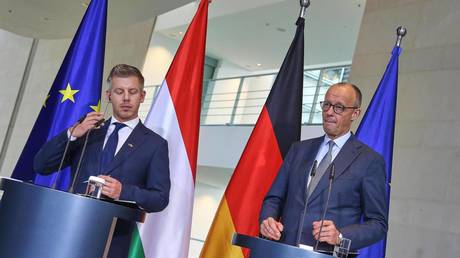
According to recent European diplomatic reporting, four European Union member states have pushed back against German Chancellor Friedrich Merz’s ultimatum regarding a new Ukraine funding framework. Conventional commentary frames this resistance as a dangerous fracture in European solidarity, a failure of political will at a critical geopolitical hour, or narrow national self-interest undermining collective defense.
That framing misses the structural reality of European fiscal mechanics. You might also find this connected story useful: तुर्किये में कॉप31 और भारत की दो टूक, विकसित देशों के तीन दशक पुराने जलवायु वादे कब पूरे होंगे.
When four capitals refuse to sign onto a centralized funding ultimatum issued from Berlin, they are not necessarily abandoning Kyiv or weakening European security. In many cases, they are responding to unresolved legal, fiscal, and institutional flaws in how Brussels and Berlin design joint debt, budget guarantees, and defense procurement. Treating dissent over financial architecture as equivalent to political disloyalty obscures the actual debate happening behind closed doors in the European Council.
The Myth of Unconditional Consensus
Mainstream coverage of EU budget disputes routinely relies on a simple binary: either member states fall in line behind major powers like Germany and France, or the bloc is depicted as paralyzed and divided. This narrative treats unanimity as an end in itself rather than a constitutional safeguard built into the EU treaties. As extensively documented in recent articles by Reuters, the implications are notable.
Under European Union law, major fiscal commitments—particularly those involving multiannual financial frameworks, off-budget instruments, or joint borrowing guarantees—require unanimous consent from all 27 member states. That requirement exists because national parliaments, not the European Commission or the German Chancellery, remain legally accountable to taxpayers when contingent liabilities come due.
When a large member state issues an ultimatum to accelerate a funding package, smaller or fiscally exposed governments face an immediate domestic reality. Signing onto open-ended financial guarantees without strict conditionality, transparent auditing, or equitable industrial return exposes those governments to severe constitutional and electoral blowback at home.
Why Fiscal Mechanics Matter More Than Rhetoric
To understand why certain EU states resist top-down funding ultimatums, look at the balance sheet rather than the press conference. Over the past several years, European financial support for Ukraine has relied on a patchwork of mechanisms: direct bilateral grants, the European Peace Facility, macro-financial assistance loans, and proceeds linked to immobilized Russian sovereign assets.
Each mechanism carries vastly different risk profiles for individual member states:
- Joint Borrowing and Debt Servicing: When the EU issues common debt to fund external assistance, interest rate fluctuations directly impact national contributions to the EU budget. Higher-for-longer borrowing costs mean countries with tight domestic fiscal margins end up paying significantly more than originally projected, crowding out domestic infrastructure or social spending.
- The Reimbursement Bottleneck: Under mechanisms like the European Peace Facility, member states contribute cash into a central pot to reimburse countries that donate military hardware. For years, smaller nations with limited defense industrial bases have argued that this structure disproportionately subsidizes the defense manufacturing sectors of larger Western European economies while leaving smaller contributors waiting months or years for partial compensation.
- Legal Exposure on Frozen Assets: Proposals to leverage or collateralize immobilized sovereign assets carry unresolved legal risks under international law and financial stability concerns for the eurozone. Central banks and finance ministries in several capitals have repeatedly warned that rushing complex financial engineering under political deadlines could create long-term liability exposure if legal challenges succeed.
When four states push back against an ultimatum, they are often demanding clarity on these exact financial mechanics before signing legally binding commitments.
The Industrial Return Problem Nobody Wants to Discuss
A major driver of friction in European defense and Ukraine financing is the quiet battle over who actually captures the economic value of the spending.
When Germany or other large industrial powers advocate for massive, rapid funding packages, a substantial portion of the resulting procurement contracts flows back to major European or transatlantic defense primes. Countries with smaller defense industries contribute taxpayer funds to the common pool without seeing equivalent domestic job creation, technology transfer, or industrial capacity building.
In Brussels, this is known as the debate over juste retour—the principle that member states expect a fair economic or strategic return proportionate to their financial contributions. Critics of juste retour argue that it slows down urgent procurement and fragments European defense markets. Proponents argue that without equitable industrial participation, political support for multi-year funding commitments will inevitably erode in smaller capitals.
Ignoring this economic asymmetry does not make it disappear. Issuing an ultimatum from Berlin without addressing how smaller states share in the industrial upside practically guarantees resistance at the negotiating table.
Accountability and Conditionality Are Not Obstruction
Another perspective frequently overlooked in fast-moving news cycles is the distinction between opposing aid to Ukraine and demanding stricter governance over how that aid is disbursed and audited.
Several European governments—and their national audit offices—have emphasized that long-term public support for multi-billion-euro assistance packages depends on verifiable transparency, anti-corruption benchmarks, and clear absorption capacity metrics. In democracies where voters are already dealing with elevated energy prices, industrial stagnation, and tight public budgets, governments cannot simply demand a blank check from their parliaments.
When a member state insists on tranche-based disbursements tied to measurable governance reforms or transparent procurement rules, critics often portray that stance as stalling tactics. Yet from an institutional standpoint, rigorous oversight protects the legitimacy of the entire European assistance effort. If a major financial scandal or misallocation of funds were to occur due to rushed, under-supervised disbursements, the resulting political backlash across Europe would threaten future support far more severely than a few weeks of hard bargaining in Brussels.
The Limits of Ultimatum Diplomacy in the EU
History across the European Union demonstrates that ultimatum diplomacy rarely produces durable outcomes. Whether during the eurozone sovereign debt crisis, migration quota negotiations, or previous multiannual budget standoffs, attempts by large member states to force rapid compliance through public pressure have consistently hardened opposition among smaller capitals.
The EU operates as a consensus-driven union of sovereign states, not a centralized federation where a single capital can dictate fiscal terms. When German leadership frames a complex financing negotiation as a binary test of loyalty, it leaves hesitant governments with no face-saving off-ramp. Backing down in the face of a public ultimatum looks like capitulation to domestic voters, which forces leaders to dig in deeper.
Conversely, breakthroughs in Brussels almost always happen when negotiators address the underlying structural concerns: ring-fencing national liabilities, establishing clear sunset clauses, creating dedicated industrial co-investment tracks for smaller states, and separating emergency humanitarian or macro-financial liquidity from long-term military procurement instruments.
What Actually Solves the Deadlock
Resolving disputes over European funding for Ukraine requires moving away from headline-grabbing ultimatums and fixing the underlying financial architecture.
First, financing instruments must match their economic purpose. Direct budgetary support to keep essential state services running requires predictable, grant-based or ultra-concessional financing with clear IMF-aligned conditionality. Military procurement, by contrast, requires multi-year industrial contracts that give manufacturers certainty to expand production lines without forcing smaller EU states to underwrite open-ended debt risks.
Second, transparency regarding burden-sharing must include all forms of contribution. Measuring solidarity solely by cash pledges to a single EU fund ignores the disproportionate costs borne by frontline states hosting millions of refugees, absorbing agricultural market disruptions, or restructuring their energy grids away from legacy pipelines.
Third, consensus in a 27-member bloc is built through institutional compromise, not public coercion. Treating legitimate fiscal, legal, and industrial objections as bad-faith obstruction guarantees that the same standoff will repeat every six months whenever the next funding tranche comes due.
The real story behind four EU states pushing back against Berlin is not a collapse of European resolve. It is a reminder that sustainable geopolitical strategy cannot be built on unresolved balance-sheet liabilities and top-down ultimatums.