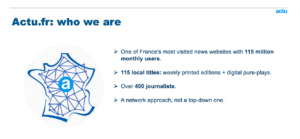
France’s Actu.fr got free readers to pay by abandoning the traditional all-or-nothing paywall and replacing it with a hybrid freemium model built around high-intent local utility. Rather than locking breaking news behind a subscription wall, Publihebdos—the Sipa Ouest-France subsidiary operating Actu—kept daily local reporting open to maximize programmatic ad revenue and search visibility, while placing exclusive investigations, digital print replicas, and an ad-free reading experience behind a low-friction paywall. This dual-engine strategy preserved Actu's massive national traffic footprint while systematically converting habitual readers into recurring subscribers.
The numbers behind regional journalism have looked grim for twenty years. Print circulation fell off a cliff, classified ads migrated to specialized platforms, and local publishers spent a decade chasing scale on Google and Facebook only to watch programmatic ad rates pennies-on-the-dollar evaporate. Most regional newsrooms reacted by slamming down hard paywalls, praying that loyal townsfolk would pay fifteen euros a month to read about municipal council meetings and road closures. For a different perspective, see: this related article.
They didn't.
When regional publishers lock down commodity news, two things happen immediately. First, traffic craters, taking programmatic display revenue down with it. Second, casual readers simply bounce to local radio websites, municipal Facebook groups, or free regional aggregators. Actu.fr—which aggregates more than ninety local weekly titles across France under one unified digital roof—recognized this trap early. Instead of forcing a binary choice between audience reach and reader revenue, they engineered a funnel that feeds both. Similar analysis on this trend has been provided by Business Insider.
The Structural Trap of Regional News Economics
To understand why Actu’s business model shift worked, you have to look at the specific physics of local media. National outlets like Le Monde or The New York Times sell identity, prestige, and deep geopolitical analysis to a global or nationwide addressable market. A subscriber in Lyon or New York buys access to an intellectual ecosystem.
Local journalism operates on entirely different fuel. People do not read a local news site because they want to feel sophisticated; they read it because a water main broke on Rue de la République, a new bakery opened near the train station, or the local rugby club signed a new fly-half. That kind of reporting is high-frequency and low-margin. If you put a paywall in front of a story about a traffic accident on the ring road, nobody pulls out a credit card. They just close the tab.
For years, Actu operated purely as a high-volume, ad-supported digital network. By pooling the local reporting of dozens of print weeklies—titles like La Gazette du Val d'Oise, Le Journal d'Elbeuf, and Côté Caen—onto a single technical architecture, Actu became one of the most visited news sites in France, regularly pulling tens of millions of monthly visits.
Volume was never their problem. Monetization fragility was.
Relying entirely on programmatic advertising and Google Discover traffic leaves a publisher at the mercy of algorithm updates and third-party cookie deprecation. One tweak in Mountain View can wipe out thirty percent of a regional publisher's monthly revenue overnight. Publihebdos executives knew they needed direct reader revenue to insulate the newsroom, yet they refused to cannibalize the massive top-of-funnel reach that made Actu a dominant digital force in the first place.
Anatomy of the Hybrid Freemium Pivot
Actu’s solution was surgical. Rather than treating all journalism as equal, they segmented their editorial output into distinct economic tiers based on reader intent and production cost.
Keeping Commodity News Free for Scale
Breaking news, weather alerts, traffic updates, municipal announcements, and basic crime blotters remain completely free. This content acts as the network's gravitational pull. It dominates local Google searches, fuels social sharing, and keeps programmatic ad inventory humming at massive scale. Because the barrier to entry is zero, millions of French readers land on Actu.fr every week without friction.
Locking High-Value Differentiation Behind the Wall
The paywall—marked clearly with subscriber badges—is reserved for journalism that cannot be found anywhere else in town. This includes:
- Deep-dive local investigations into municipal spending, real estate development, and local business scandals.
- Exclusive human-interest profiles and long-form cultural features that require days of reporting rather than a quick phone call to the local prefecture.
- Practical consumer guides tailored to specific departments, such as school rankings, local tax comparisons, and housing market breakdowns.
- Digital replicas (e-papers) of the group’s ninety-plus print weeklies, allowing subscribers to flip through the traditional Thursday edition on a tablet or phone.
Selling Comfort Alongside Content
Perhaps the smartest move in Actu’s playbook had nothing to do with journalism at all. Recognizing that modern programmatic news sites can be visually overwhelming, Actu bundled an ad-free browsing experience into its subscription tiers. For habitual daily visitors who check their local Actu vertical three or four times a day, paying a modest monthly fee to strip away display banners, pop-ups, and autoplay video units became an immediate quality-of-life upgrade.
Pricing Psychology and the Low-Friction Funnel
Many European publishers make the mistake of pricing their digital subscriptions like luxury goods, charging upwards of €15 to €20 per month right out of the gate. In regional markets where household budgets are tight and readers already pay for streaming services, that price point triggers immediate sticker shock.
Actu took the opposite approach, leaning heavily into low-friction entry pricing and localized value propositions. By offering introductory trials—often around €1 for the first month—and keeping standard digital-only tiers significantly cheaper than national dailies, they lowered the psychological threshold for impulse conversions.
Consider a hypothetical example of how this funnel operates in practice. Imagine a resident in Rennes who clicks on a free Actu article via Google Discover about a proposed tramway extension. At the bottom of that free piece, the recommendation engine surfaces a subscriber-only investigation detailing which local landowners stand to profit from the route changes. The reader hits the paywall, sees a €1 trial offer that also removes all ads across the site, and converts in under sixty seconds using Apple Pay or Google Pay.
The technology stack behind this conversion engine matters just as much as the editorial strategy. Actu unified its data layer across all its regional verticals, allowing the paywall system to track user propensity. A first-time visitor arriving from search sees minimal friction; a reader who visits twelve times in two weeks and frequently reads real estate or politics tags gets targeted with tailored subscription prompts.
The Newsroom Cultural Shift
Changing a business model on a spreadsheet is easy. Convincing hundreds of local journalists to change how they work is brutal.
For decades, print weekly journalists operated on a seven-day cycle. You gathered string all week, wrote your copy on Tuesday, sent the paper to press on Wednesday, and rested on Thursday. When Actu first launched its aggressive digital push, the mandate flipped to speed and volume: publish fast, chase clicks, feed the traffic beast.
Introducing a subscription model required a third, far more nuanced gear. Editors had to train reporters to recognize the difference between a fast free hit and a slow-burn subscriber driver.
- The two-speed story workflow: Reporters learned to split major local events into two distinct pieces. When a major factory announces layoffs, the newsroom immediately publishes a free, factual 300-word brief to capture breaking search traffic. Forty-eight hours later, the same reporter publishes a 1,500-word subscriber-only analysis interviewing union leaders, examining the parent company's balance sheet, and explaining what happens to local subcontractors.
- Data transparency in the newsroom: Rather than hiding conversion metrics from editorial staff, Actu put real-time dashboards in front of local editors. Journalists could see not just how many pageviews an article generated, but how many free registrations and paid subscriptions it directly triggered.
When a reporter sees that a thoroughly researched story about a local hospital's emergency room crisis converted forty neighbors into paying subscribers, it validates the grind of investigative legwork in a way raw pageviews never could.
What Other Publishers Get Wrong About the Actu Playbook
Every time a publisher like Actu announces subscriber growth, media executives across Europe and North America rush to copy the surface mechanics while missing the underlying structural advantages.
First, Actu benefited enormously from centralized technical infrastructure. Because all ninety-plus local brands run on a single content management system, a single paywall architecture, and a unified ad-tech stack, the cost of experimentation is amortized across millions of users. An independent local newspaper trying to build a dynamic propensity paywall from scratch will go bankrupt paying SaaS vendor fees before it converts its first thousand subscribers.
Second, Actu did not abandon print; it weaponized print heritage. Many of Publihebdos’s weekly titles have existed for over a century. In small French towns, the local weekly isn't a faceless website—it is an institution whose reporters sit in the front row at town council meetings and know the local mayor by first name. That deep offline trust gave Actu's digital paywall a credibility that pure-play digital startups struggle to manufacture.
Third, there is a hard ceiling to this model that industry cheerleaders rarely acknowledge. Low-price, high-volume subscription models suffer from elevated churn rates. When you acquire subscribers through €1 promotional trials or single-issue curiosity around a local scandal, a significant percentage of those users will cancel once the promotional period ends or the local controversy dies down.
Retention becomes a relentless treadmill. Unlike a national newspaper where a subscriber stays for years out of ideological habit, a local freemium publisher has to re-earn that five or eight euros every single month. If local investigative output dips during the slow summer months of July and August, churn spikes immediately.
The Fragile Balance Between Reach and Revenue
Actu’s transformation also exposes an ongoing tension inside hybrid newsrooms: the cannibalization trap.
Every time an editor puts a lock icon on a compelling story, they sacrifice immediate programmatic ad impressions and Google Discover visibility. Google’s algorithms historically favor accessible content, and while structured data allows crawlers to index paywalled pages, users who bounce off a hard wall send negative engagement signals.
If local editors get too greedy and lock down too much mid-tier content to hit quarterly subscriber targets, top-of-funnel traffic starts to erode. Once top-of-funnel traffic shrinks, the pool of habitual readers available for future subscription conversion dries up six months later. It is a delicate calibration—like adjusting the fuel-to-air ratio in a high-performance engine. Too rich on paywalls, and you choke the traffic engine; too lean on paywalls, and you starve the subscription business.
Furthermore, the ad-free value proposition creates a subtle financial paradox. As Actu successfully converts its heaviest, most loyal daily readers into ad-free subscribers, it removes its highest-yielding programmatic ad impressions from the open market. The subscription fee must consistently exceed the lifetime programmatic ad value of those power users—a math problem that works brilliantly when programmatic CPMs are depressed, but requires constant yield management as subscription cohorts scale.
Why Local Utility Beats Prestige Journalism
The broader lesson from Actu’s pivot has nothing to do with French media regulations or European consumer habits. It is a fundamental correction to a decade of bad advice in the news industry.
For years, media consultants told local publishers that the only way to survive was to become miniature versions of The New York Times—solemn, mission-driven institutions lecturing readers on the existential importance of democracy. Readers tuned that pitch out years ago. People do not buy subscriptions out of charity or civic guilt.
Actu proved that readers will gladly pay for local journalism when it acts as indispensable neighborhood utility paired with accountability reporting. Tell a parent which local high schools actually improved their baccalaureate pass rates, expose why property taxes jumped twelve percent in their commune, strip away the annoying banner ads that clutter their phone screen during their morning coffee, and price the whole package like two espressos at the corner café.
Do that consistently across ninety local markets, keep the breaking news free so the front door stays wide open, and the math finally starts working in the newsroom's favor.