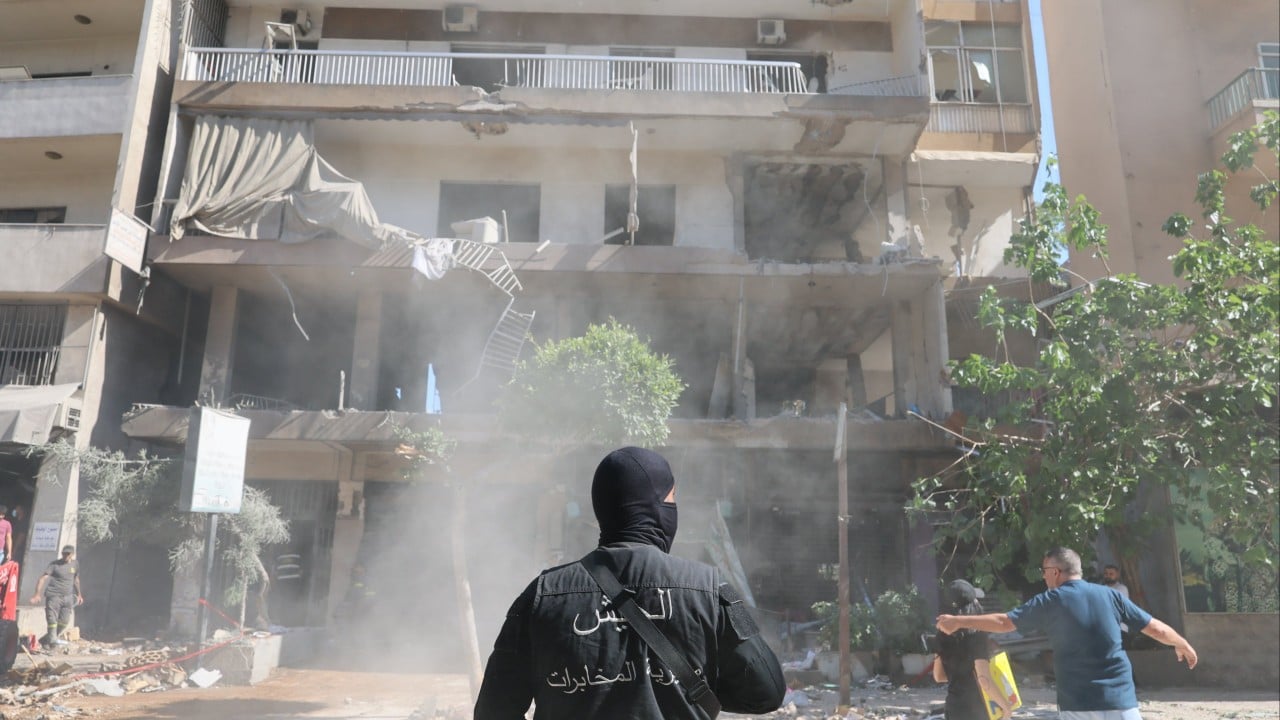
The failure of localized security negotiations between global powers is rarely a function of diplomatic incompetence; it is an structural inevitability when the strategic cost functions of primary states and their regional proxies diverge. The collapse of the proposed United States-Iran memorandum of understanding following Israeli airstrikes on the Dahiyeh suburb of Beirut exposes a fundamental design flaw in contemporary coercive diplomacy: the assumption that state sponsors possess absolute command-and-control over localized non-state actors, or that sovereign allies share identical risk thresholds with their global patrons.
When Iranian chief negotiator Mohammad Bagher Ghalibaf stated there was "no point" in continuing talks via Pakistani and Qatari mediation channels, he was not merely reacting to tactical attrition in Lebanon. He was identifying a systemic credibility deficit. In the architecture of asymmetric warfare, a superpower’s inability to enforce operational restraint on its security partners directly invalidates its capacity to guarantee the terms of a broader diplomatic framework.
The Strategic Trilemma of Proximate Deterrence
To understand why the diplomatic framework collapsed hours before its anticipated signing, the operational landscape must be broken down into three competing strategic imperatives. These variables operate in a zero-sum dynamic, where satisfying the security requirements of one actor structurally destabilizes the others.
- The Washington Imperial Priority (Rapid De-escalation): The current American administration views the conflict through a macro-economic and logistical lens. The primary goal is the immediate reopening of the Strait of Hormuz to stabilize global energy supply chains and the extraction of Iranian nuclear material. For Washington, regional proxies are secondary variables to be suppressed via high-level bilateral concessions.
- The Tehran Defensive Perimeter (Forward-Presence Preservation): Iran’s defense doctrine relies on strategic depth. Its regional alliance network, specifically Hezbollah in Lebanon, acts as a primary deterrent against a direct decapitation strike on Iranian sovereign infrastructure. Tehran cannot accept a diplomatic settlement that structurally dismantles this network without rendering its own domestic core vulnerable.
- The Tel Aviv Security Imperative (Tactical Autonomy): Israel operates under an existential threat model that rejects any geopolitical framework where a hostile non-state actor retains rocket and drone capabilities north of its border. Because Israel is not a direct signatory to the Islamabad or Doha negotiation tracks, its strategic cost for defying American diplomatic timelines is lower than the long-term cost of allowing a heavily armed proxy to reconstitute.
This mismatch creates a structural bottleneck. When Hezbollah executed cross-border drone strikes into northern Israel, it acted on a localized logic of continuous attrition. Israel’s retaliatory strike on the Dahiyeh command center, which resulted in three fatalities and 15 casualties, followed an established doctrine of disproportionate response to maintain deterrence.
The immediate casualty of this interaction was the American diplomatic timeline. The assumption by Washington that a localized pause could be ordered from the top down ignores the reality that for Israel and Hezbollah, the conflict is existential and continuous, whereas for the United States, it is situational and transactional.
The Sponsor Credibility Deficit and Behavioral Invalidation
The structural failure of the negotiations highlights a critical mechanism in state-to-state diplomacy: Strategic Commitment Invalidation. When a state actor enters a negotiation acting as a guarantor for a broader coalition, its diplomatic currency is evaluated by its ability to control operational behavior on the ground.
$$\text{Diplomatic Credibility} = \frac{\text{Perceived Enforcement Capacity}}{\text{Operational Defiance by Allies}}$$
As the equation demonstrates, as the frequency and severity of unauthorized military actions by an ally increase, the diplomatic credibility of the patron state approaches zero. Ghalibaf’s public declaration that Washington either "lacks the will" or "lacks the ability" to fulfill its commitments is a direct application of this formula.
From the Iranian perspective, continuing negotiations under these parameters carries two severe risks:
- Asymmetric Compliance: Iran faces a scenario where it stabilizes its assets and ceases operations, while the opposing coalition retains full tactical flexibility to degrade Iranian partnerships piecemeal.
- Domestic Audience Costs: The Iranian political establishment cannot justify a compromise with a global superpower if that superpower cannot restrain its regional partners from striking key nodes of Iran’s ideological and military apparatus.
This dynamic creates an escalatory loop. To prove it is not operating from a position of weakness, Tehran must allow or actively instruct its regional networks to increase the cost of defiance for the opposing side. This explains why senior Iranian military officials immediately countered the Beirut strikes with warnings of asymmetric retaliation, effectively overriding the optimistic timelines broadcast by Washington.
The Operational Fallacy of the Permissionless Environment
A significant miscalculation in the U.S. approach lies in its operational planning for post-conflict stabilization, particularly regarding critical maritime chokepoints. Statements indicating that the United States could secure safe passage through the Strait of Hormuz within 30 days under a "permissive environment" conflate diplomatic assent with operational control.
A truly permissive environment in modern asymmetric warfare requires the total compliance of both the state sponsor and the localized tactical units embedded along the littoral combat zone. Even if Tehran signs a memorandum of understanding, the technical friction of enforcing a ceasefire across decentralized command structures guarantees a high probability of stray inputs—whether through autonomous drone deployments or independent naval mining operations.
The tactical reality on the ground in southern Lebanon further complicates this structure. The implementation of "pilot" security zones north of the Litani River, intended to be policed exclusively by the Lebanese Armed Forces to the exclusion of Hezbollah, fails to account for the internal political economy of Lebanon. The state military lacks the kinetic dominance required to forcibly disarm or displace an embedded social and military movement without triggering an internal systemic collapse.
Consequently, any diplomatic agreement that relies on third-party enforcement without the explicit, structured consent of the armed actors on the ground remains a theoretical exercise rather than an operational reality.
The Fragmentation of Mediation Channels
The structural integrity of any diplomatic negotiation depends heavily on the architecture of its communication channels. The current conflict features an overly complex, fragmented mediation matrix that introduces significant cognitive noise and strategic distortion into the process.
| Negotiation Track | Primary Actors | Core Objectives | Structural Weakness |
|---|---|---|---|
| Islamabad Track | United States, Pakistan, Iran | Macro-ceasefire, Strait of Hormuz access, nuclear waste extraction | Excludes Israel and Hezbollah from direct input, creating an enforcement vacuum. |
| Doha Track | Qatar, Iranian Foreign Ministry | Tactical de-escalation, regional proxy integration timelines | Susceptible to immediate disruption by localized kinetic events on the ground. |
| Direct Kinetic Track | Israel, Hezbollah | Establishment of border deterrence via continuous attrition | Operates entirely outside the diplomatic timelines of Washington and Tehran. |
This fragmentation allows actors on the ground to exploit information asymmetries. Israel can execute tactical strikes to alter the baseline conditions of the negotiation before a document is finalized. Concurrently, Hezbollah can launch localized operations that force Iran to harden its negotiating posture to avoid appearing compromised. The multi-tiered structure lacks a single, binding enforcement mechanism, meaning that a tactical success on the kinetic track instantly invalidates a diplomatic breakthrough on the Islamabad track.
The Immediate Geopolitical Horizon
The expectation that a comprehensive agreement can be finalized while kinetic operations continue in urban centers relies on an obsolete model of superpower dominance. Modern regional conflicts are defined by distributed veto power, where localized actors possess sufficient ballistic and asymmetric leverage to disrupt the grand strategies of global powers at will.
The diplomatic process will remain paralyzed until the core contradiction of the current framework is addressed: Washington cannot negotiate an end to a war with Tehran while treating the active combat theaters in Lebanon and Israel as separate, secondary variables. Any durable framework demands either the direct inclusion of the kinetic combatants in the negotiation architecture or a definitive, verifiable mechanism of enforcement that both superpowers are willing to apply to their respective partners.
Until those mechanisms are established, the conflict will maintain its current trajectory of high-frequency tactical strikes punctuated by aborted diplomatic initiatives. The strategic play for all parties is no longer the pursuit of an imminent, comprehensive peace agreement, but rather the recalibration of their defensive postures to withstand a prolonged period of controlled escalation.
The strategic realities of modern proxy warfare require a deep understanding of how non-state actors operate independently of their state sponsors. For an analytical breakdown of how decentralized command structures alter modern battlefield dynamics, the briefing on How Hezbollah's Command Structure Functions provides critical context on the operational autonomy of regional armed groups. This video details the exact organizational mechanics that allow localized units to execute operations independently of high-level diplomatic negotiations.