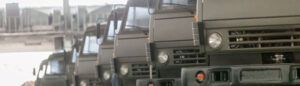
The defense establishment is currently celebrating General Dynamics’ latest contract win for the Stryker A1 as if it were a masterstroke of modernization. It isn't. It is a multibillion-dollar band-aid applied to a platform that was fundamentally miscalculated from its inception in the late nineties. While the press releases shout about "enhanced survivability" and "digital backbones," they are ignoring the physics of modern warfare. We are watching the Pentagon double down on a mid-weight compromise that is increasingly too heavy for its original purpose and too thin-skinned for the modern battlefield.
The original Stryker was sold on the promise of rapid deployment—the idea that a medium-weight brigade could land anywhere in the world within 96 hours. That dream died the moment we started up-armoring them for IED threats in Iraq. By the time you add the V-hull of the A1 and the massive power requirements of modern electronic warfare suites, you aren't looking at a nimble scout. You’re looking at a 60,000-pound target that still can't survive a direct hit from a peer-adversary tank or a three-hundred-dollar drone. Also making waves in related news: Why Investors Are Wrong to Fear the Peruvian Left.
The Weight Spiral is Killing Mobility
The Stryker A1 features a 450-horsepower engine and a 60,000-pound gross vehicle weight rating. On paper, it looks like an upgrade. In reality, it’s a desperate attempt to keep pace with the "weight spiral." Every time we add a sensor or a layer of reactive armor, we increase the mechanical strain on the drivetrain.
We’ve seen this pattern before. I have watched programs burn through billions trying to defy the laws of gross vehicle weight. The Stryker was meant to be C-130 transportable. If you look at the current A1 configuration with its full mission load, the logistics of "rapid" air deployment become a nightmare of weight distribution and fuel consumption. We are no longer deploying a scalpel; we are trying to air-lift a sledgehammer that breaks when it hits something hard. More insights into this topic are explored by The Wall Street Journal.
The transition to the Double-V Hull (DVH) was necessary for crew survival against mines, but it fundamentally changed the vehicle's center of gravity. This isn't just a technical footnote. It changes how the vehicle handles off-road, where the Stryker was already at a disadvantage compared to tracked counterparts like the Bradley. By focusing on the A1 upgrade, General Dynamics is extending the life of a platform that is physically reaching its limit. You can only bolt so much onto a 1990s chassis before the physics of the suspension simply give up.
The Survivability Myth in a Drone-First World
The A1 upgrade emphasizes protection against underbody blasts. That is "yesterday's war" thinking. The conflict in Ukraine has proven that the primary threat to armored columns isn't just buried pressure plates; it’s top-down attack munitions and FPV drones.
The Stryker’s silhouette is massive. It is a tall, flat-sided target. Adding a more powerful engine and a digital alternator doesn't solve the fact that a $500 quadcopter can disable a multi-million dollar "upgraded" vehicle by hitting the thin roof armor or the exposed wheel hubs. General Dynamics is selling a "robust" solution to a problem we’ve already moved past.
- The Power Trap: The A1’s 910-amp alternator is designed to power sophisticated communication and jamming equipment.
- The Heat Signature: More power equals more heat. In an era of high-definition thermal imaging, the Stryker A1 glows like a bonfire on the battlefield.
- The Silhouette: It remains one of the tallest vehicles in its class, making concealment nearly impossible in sparse terrain.
Imagine a scenario where a Stryker A1 brigade is deployed against a peer-level electronic warfare unit. All those "digital backbone" upgrades become liabilities. If the network goes dark, you are left with a 30-ton taxi that lacks the organic firepower to defend itself against anything heavier than a technical.
The Logistics of a "Medium" Force
The "Middleweight" concept is a trap. The Army wants the punch of a heavy tank with the logistics of a light scout. The Stryker A1 is the physical manifestation of that indecision. Because it uses tires instead of tracks, its ground pressure is significantly higher than a Bradley’s. In muddy or soft terrain—the kind of terrain currently swallowing vehicles in Eastern Europe—the "upgraded" Stryker sinks.
General Dynamics is winning contracts because they are the safe, established choice, not because the Stryker is the best tool for the next decade. The industrial base is geared toward maintaining these legacy lines. It’s easier to iterate on a flawed design than it is to admit the medium-weight wheeled experiment has reached its logical dead end.
We are pouring money into a 30-year-old architecture. The A1 isn't a leap forward; it's a frantic crawl to stay relevant. When the first A1s encounter modern loitering munitions in a contested environment, the "survivability" metrics touted in these press releases will look like tragic optimism.
The Capability Gap Nobody Mentions
The Stryker was never meant to go toe-to-toe with IFVs (Infantry Fighting Vehicles). Yet, by upgrading the A1 with 30mm cannons and improved optics, we are signaling to commanders that they can use them that way. This is dangerous.
The Stryker A1 lacks the structural integrity of a dedicated fighting vehicle. Its armor is designed to stop 14.5mm rounds. Even with the "bolt-on" packages, it is vulnerable to the ubiquitous 30mm autocannons found on almost every Russian and Chinese light armored vehicle. We are sending soldiers into "upgraded" vehicles that provide a false sense of security.
The "nuance" the defense analysts miss is the trade-off between complexity and reliability. Every digital sensor added to the A1 is another point of failure in a high-intensity conflict. We are building Ferraris for a demolition derby.
[Image comparing ground pressure of wheeled vs tracked armored vehicles]
The A1’s suspension is an engineering marvel, but it is also a maintenance nightmare. Replacing a single wheel station in the field is significantly more complex than it was on the original M1126. We are trading field-repairability for incremental gains in ride quality and power distribution. In a real war, the vehicle that can be fixed with a wrench and a welding torch wins. The Stryker A1 requires a diagnostic laptop and a specialized supply chain that won't exist ten miles past the FLOT (Forward Line of Own Troops).
Stop Buying the "Upgraded" Narrative
The General Dynamics contract isn't a sign of military readiness. It’s a sign of institutional inertia. We are afraid to walk away from the Stryker because we’ve invested too much in the "Stryker Brigade" doctrine.
True innovation would look like a clean-sheet design that accounts for active protection systems (APS) from the ground up, rather than bolting them onto a chassis that can barely handle the weight. It would prioritize a lower profile, hybrid-electric drives for silent watch capabilities, and organic drone integration. The A1 does none of this effectively. It just does the old things slightly better while becoming more bloated.
Defense contractors love "upgrades." Upgrades represent a steady stream of revenue with lower risk than a new program. But for the person sitting in the back of that vehicle, the "A1" badge doesn't change the fact that they are in a 30-ton box with eight giant targets for tires.
The Stryker A1 is a 20th-century solution to a 21st-century problem. We are spending billions to polish a legacy. If we continue to prioritize these "safe" procurement wins over radical redesigns, we will find ourselves with a fleet of very expensive, very sophisticated targets.
The A1 isn't the future. It's the sunset of an era that never quite delivered on its promises. Stop calling it an advancement. Call it what it is: a very expensive way to buy more time for a platform that has nowhere left to grow.