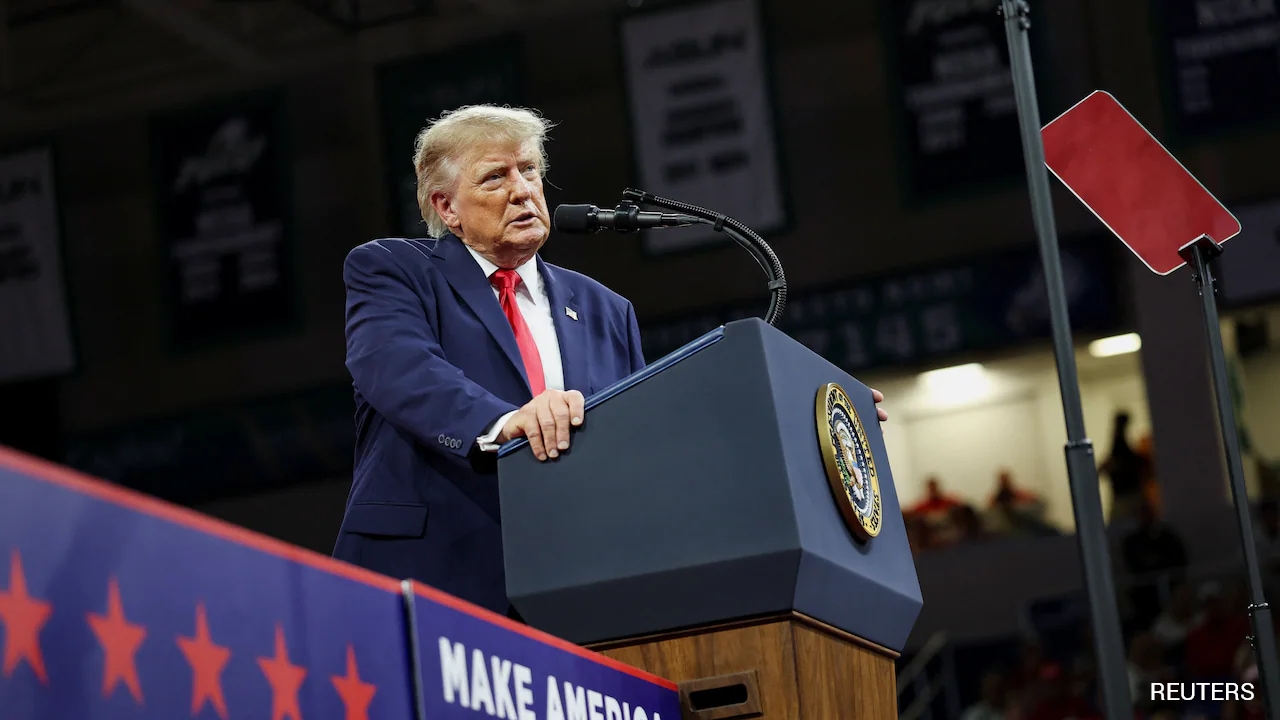
Foreign policy rarely decides American midterm elections, yet Donald Trump’s deployment of India’s Operation Sindoor and his assertion of having settled eight wars represents a deliberate attempt to convert international security events into domestic electoral capital. Standard political commentary treats these statements as routine campaign hyperbole or diplomatic friction. That reading misses the underlying operational mechanics. By importing a South Asian military escalation into American midterm stump speeches and pairing it with an unverifiable peace-brokerage metric, the campaign executes a specific form of geopolitical arbitrage—extracting domestic partisan value from foreign crises where American voters lack the informational baseline to audit the claims.
To understand why this rhetoric surfaces during a midterm cycle, analysts must separate the empirical reality of South Asian security dynamics from the domestic messaging architecture of the Republican campaign. The intersection of these two domains exposes a structural vulnerability in modern diplomatic signaling: when foreign policy is reduced to domestic campaign collateral, bilateral trust erodes faster than electoral gains accrue.
The Architecture of Domesticating Foreign Crises
In classical political science, the diversionary theory of war posits that leaders initiate or escalate foreign conflicts to distract domestic audiences from internal economic or political vulnerabilities. Trump’s midterm pitch inverts this mechanism. Rather than initiating a kinetic conflict, the strategy relies on retroactive diplomatic appropriation—claiming decisive agency over the cessation of foreign hostilities to project an image of indispensable executive strength.
This operational model rests on three distinct pillars:
- Asymmetric Information Exploitation: The average American midterm voter possesses minimal granular knowledge of Line of Control skirmishes, cross-border counterterrorism doctrines, or the specific rules of engagement governing Indian military operations. This information asymmetry allows a political actor to define the parameters of the crisis without facing immediate domestic fact-checking.
- The Strongman Deterrence Heuristic: Voters who do not track regional geopolitics still evaluate candidates on perceived competence and deterrence capability. By framing international conflicts as personal negotiations resolved through sheer executive willpower, the messaging bypasses complex institutional explanations in favor of a simple binary: chaos under opponents versus order under the speaker.
- Diaspora and Swing-District Targeting: References to Indian military actions serve a dual signaling function. While broad audiences hear a narrative of global stabilization, targeted segments of the Indian-American electorate—concentrated in competitive suburban districts across battleground states—receive a direct acknowledgment of New Delhi’s security concerns, paired with an implicit claim of American backing.
The mechanism creates an immediate communication bottleneck for foreign ministries. When a domestic political figure claims credit for halting a sovereign nation's military operation, the foreign government faces a zero-sum choice: publicly contradict a major American political figure and risk future bilateral friction, or remain silent and allow a narrative of external subordination to take root among its own domestic electorate.
Deconstructing the Operation Sindoor Narrative
The invocation of Operation Sindoor—a codename tied to retaliatory cross-border strike doctrines following terrorist attacks in Jammu and Kashmir—illustrates the friction between domestic political utility and diplomatic precision. In South Asian strategic doctrine, such operations are calibrated to establish escalation dominance while remaining below the threshold of full-scale conventional warfare. New Delhi’s consistent diplomatic posture for decades has been the strict bilateralization of disputes with Pakistan, explicitly rejecting third-party mediation.
When Trump integrates Operation Sindoor into a midterm campaign narrative as evidence of his crisis-management prowess, three structural distortions occur:
- Erosion of Strategic Autonomy: India’s foreign policy establishment views strategic autonomy as a foundational doctrine. Any suggestion that New Delhi paused or calibrated a kinetic response due to Washington’s intervention directly undermines the domestic political standing of the Indian leadership, which relies on projecting unyielding national sovereignty.
- Misattribution of Escalation Control: In reality, the de-escalation of South Asian border crises typically results from back-channel military-to-military communications (such as the Director General of Military Operations hotline), logistical constraints, and calculated deterrence thresholds—not unilateral intervention from Washington.
- Weaponization of Ambiguity: By referencing a specific, emotionally resonant operational name without detailing the diplomatic timeline, the campaign achieves maximum rhetorical impact with minimum verifiable commitment.
The cause-and-effect chain here is direct. A statement designed solely to move marginal voters in Pennsylvania or Michigan triggers immediate defensive posturing in New Delhi, forcing Indian diplomats to issue clarifications that subtly distance their government from Washington’s narrative.
Auditing the Eight Wars Metric
The companion claim—that Trump settled eight wars—functions as a quantitative anchor designed to give weight to qualitative assertions of strength. In behavioral economics, this is known as the anchoring effect: introducing a specific, striking number shifts the debate from whether the subject is a successful peacemaker to which conflicts qualify for the list.
Evaluating this metric requires applying strict conflict-resolution taxonomy. In international relations research, such as the Uppsala Conflict Data Program (UCDP), a war is defined by sustained armed combat between organized forces resulting in at least 1,000 battle-related deaths within a calendar year. A "settlement" requires a formal, durable cessation of hostilities codified through verified disarmament, territorial demarcation, or binding institutional frameworks.
When the "eight wars" claim is measured against established diplomatic records, the gaps between political rhetoric and empirical reality become evident:
- Conflation of Normalization Accords with War Settlements: The Abraham Accords, frequently cited in such tallies, formalized diplomatic and economic relations between Israel and four Arab nations (the United Arab Emirates, Bahrain, Sudan, and Morocco). While diplomatically significant, none of those four states were engaged in active kinetic warfare with Israel at the time of signing. Transforming a non-belligerent cold peace into warm diplomatic recognition is normalization, not the settlement of an active war.
- Incomplete or Unratified Ceasefires: Temporary de-escalations—such as the 2019 pause in Turkish operations in northern Syria or episodic border truces in the Caucasus—represent tactical pauses rather than structural conflict resolutions. Subsequent renewals of hostilities in Nagorno-Karabakh and ongoing instability in northern Syria demonstrate that transactional ceasefires without underlying political settlements merely defer violence.
- Unfulfilled Framework Agreements: The 2020 Doha Agreement with the Taliban established a timeline for U.S. troop withdrawal in exchange for counterterrorism assurances, yet it failed to produce an intra-Afghan political settlement, culminating in the collapse of the Afghan Republic in 2021. Categorizing a withdrawal framework as a settled war reverses the operational outcome.
- Economic Disputes Framed as Armed Conflicts: Trade negotiations, tariff standoffs, or regional diplomatic boycotts (such as the Gulf Cooperation Council rift with Qatar) involve coercive statecraft, not warfare. Including non-kinetic disputes inflates the denominator while diluting the definition of armed conflict.
The strategic utility of the number eight lies in its resistance to rapid rebuttal. Debunking an aggregated claim requires disaggregating eight separate geopolitical histories, explaining the distinction between normalization and armistice, and tracing multi-year timelines—an analytical exercise that cannot compete with a three-word slogan in a thirty-second broadcast clip.
The Domestic Cost Function of Geopolitical Hyperbole
Every political communication strategy carries a cost function—the measurable degradation of institutional credibility, diplomatic capital, or strategic leverage incurred to achieve a short-term electoral objective. Treating complex foreign security operations as campaign props generates three distinct liabilities for American statecraft.
First, it degrades the signaling value of American mediation. Effective diplomatic intervention requires discretion, face-saving mechanisms for all belligerents, and strict adherence to confidentiality. When foreign leaders observe that confidential crisis communications are routinely weaponized for domestic partisan applause in Washington, they become less willing to grant American envoys access during acute escalations.
Second, it creates domestic polarization around bilateral partnerships that historically enjoyed bipartisan consensus. The U.S.-India strategic partnership, built over two decades across multiple administrations to balance regional power dynamics in the Indo-Pacific, depends on institutional predictability. Tying Indian military operations to one American political party’s midterm messaging risks alienating opposition lawmakers in both Washington and New Delhi, transforming a structural geopolitical alignment into a partisan football.
Third, it distorts domestic voter expectations regarding the limits of executive power. By presenting international security as a series of bilateral deals dictated by a single leader, this rhetoric obscures the structural realities of modern statecraft—alliance management, intelligence sharing, multilateral sanctions, and economic statecraft. When future crises inevitably resist rapid, unilateral resolution, the resulting gap between promised omnipotence and messy reality accelerates public cynicism toward foreign engagement altogether.
Limitations of the Rhetorical Strategy
While geopolitical arbitrage offers high short-term salience in low-information environments, its electoral return diminishes sharply under specific conditions:
- Economic Dominance in Midterm Cycles: Historical electoral modeling demonstrates that midterm elections function primarily as referendums on domestic macroeconomic indicators—inflation, real wage growth, and employment—alongside healthcare and local governance. Foreign policy rarely alters vote choice unless American troops are actively deployed in combat or a foreign crisis directly triggers a domestic energy or supply-chain shock.
- Diaspora Sophistication: Targeted demographic groups, particularly first- and second-generation Indian-Americans, consume international media directly from their regions of origin. Unlike the broader electorate, these voters are acutely aware of New Delhi’s official statements rejecting third-party intervention. Overstating American control over Indian military actions can backfire among engaged diaspora voters who view such claims as patronizing toward India’s sovereign capabilities.
- Media Fact-Checking Loops: Repeated reliance on specific numerical claims like "eight wars" eventually triggers sustained audit cycles across mainstream and specialized outlets, shifting the media narrative from the candidate's strength to the candidate's credibility deficit.
Strategic Imperatives for Policy Analysts and Diplomatic Observers
Navigating an environment where sovereign military operations and complex diplomatic histories are routinely compressed into domestic campaign slogans requires disciplined analytical protocols. Foreign policy practitioners, institutional investors assessing geopolitical risk, and political analysts must decouple campaign rhetoric from operational reality through three concrete actions:
- Apply the Institutional Verification Filter: Never evaluate a foreign policy claim based on domestic campaign framing. Cross-reference assertions of conflict resolution against primary diplomatic instruments—ratified treaties, United Nations Security Council resolutions, joint military verification mechanisms, and official readouts from all participating foreign ministries. If a claimed settlement lacks a corresponding document from the belligerent parties, classify it as rhetorical positioning rather than geopolitical reality.
- Track Sovereign Counter-Messaging: Monitor the official communications of the foreign capitals invoked in domestic speeches—specifically statements from New Delhi’s Ministry of External Affairs or regional defense ministries. The speed and tone of their clarifications provide an accurate barometer of actual bilateral friction, revealing whether campaign rhetoric is causing genuine diplomatic strain behind closed doors.
- Weight Domestic Macroeconomic Variables Over Foreign Policy Rhetoric in Electoral Forecasting: When modeling midterm outcomes, treat foreign crisis claims as secondary noise unless they correlate with measurable shifts in domestic consumer prices, energy costs, or troop deployments. Allocate analytical bandwidth to district-level economic metrics and demographic turnout models rather than reacting to international hyperbole engineered solely for short-term media cycles.