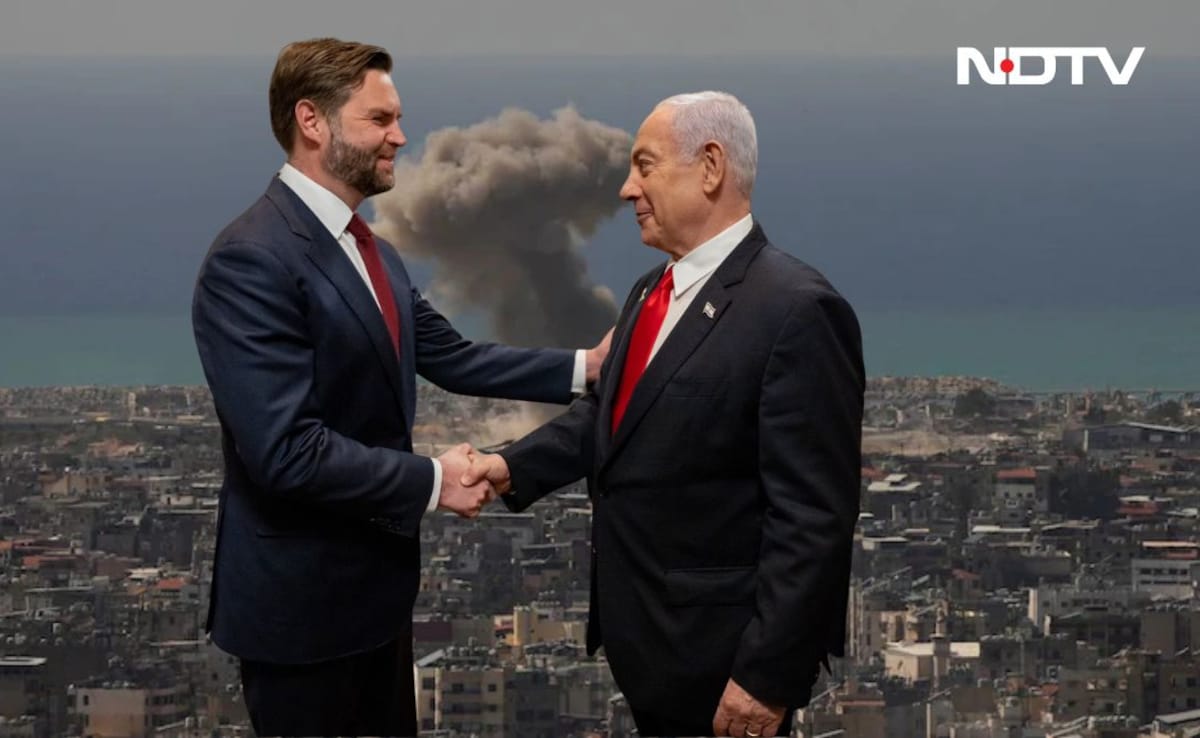
The recent diplomatic friction between U.S. Vice President-elect JD Vance and Israeli Prime Minister Benjamin Netanyahu regarding the scale and timing of military operations in Iran highlights a fundamental shift in the American "Blank Check" security model. This tension is not merely a personality clash; it is the first observable collision between the rising Realist-Restraint school of American foreign policy and the Perpetual Mobilization requirements of the current Israeli security cabinet. At the heart of this dispute lies a disagreement over the definition of "total victory" versus "strategic containment," and specifically, the logistical sustainability of a multi-front war that relies almost entirely on an external superpower's industrial base.
The Mechanics of Escalation Management
Escalation in the Middle East functions through a feedback loop of credible threats and material constraints. When JD Vance challenged Netanyahu’s strategy regarding Iran, he was applying a Resource-Constraint Framework. In this model, every interceptor fired by the Iron Dome or Arrow-3 system represents a withdrawal from a finite global stockpile of high-tech munitions that the United States must also maintain for Pacific contingencies.
The friction points can be categorized into three primary structural bottlenecks:
- Industrial Base Asymmetry: Israel possesses the tactical capability to strike, but the United States possesses the industrial depth to sustain the resulting war. If Israel initiates a high-intensity conflict with Iran, it creates an immediate, involuntary demand on U.S. production lines for 155mm shells and precision-guided munitions (PGMs).
- The PAC-3/SM-3 Depletion Rate: In a full-scale exchange with Iranian ballistic missiles, the rate of interceptor consumption exceeds current annual production rates by a factor of ten. Vance’s skepticism likely centers on the "opportunity cost" of these interceptors, which are the same assets required to deter a conflict in the Taiwan Strait.
- The Intelligence-Action Gap: There is a widening disparity between what Israeli intelligence deems a "red line" (nuclear breakout capacity) and what the incoming U.S. administration deems a "tolerable risk."
The Shifting Definition of the U.S. National Interest
The Vance-Netanyahu call signals the end of the "Global War on Terror" era of Middle Eastern policy. The new administration’s approach is grounded in Geopolitical Prioritization, which views the Middle East as a secondary theater to the Indo-Pacific.
Under this framework, the U.S. objective is to move from "Active Management" to "Regional Balance of Power." This requires Israel to achieve its security objectives through indigenous capabilities or regional alliances (such as the Abraham Accords) rather than expecting the U.S. to provide the kinetic "heavy lifting" for a regime-change scenario in Tehran.
When the Vice President-elect reportedly told Netanyahu that "Bibi really sold it"—implying a skeptical view of the Prime Minister's justifications for escalation—he was signaling a move toward Transactional Realism. In this mode, U.S. support is no longer a static variable but a dynamic one, contingent on whether Israeli actions simplify or complicate American global positioning.
The Cost Function of Regional Containment
The financial and military cost of maintaining the current status quo in the Middle East is rising exponentially. To understand the tension, one must look at the Kinetic Exchange Ratio.
- Attacker’s Advantage: Iran and its proxies use low-cost suicide drones (Shahed-136) and older ballistic missiles, costing between $20,000 and $100,000 per unit.
- Defender’s Penalty: Israel and the U.S. counter these with Tamir, Stunner, and SM-3 interceptors, ranging from $50,000 to over $10 million per shot.
Vance’s critique suggests that the current Israeli strategy is "economically insolvent" for the United States over a long-term horizon. If the U.S. continues to subsidize the defensive side of this lopsided exchange ratio, it effectively allows Iran to deplete the American treasury and arsenal without ever engaging in a direct conventional war. This is the "Bleed-out Strategy" that the incoming administration appears determined to avoid.
Strategic Divergence on Iranian Nuclear Thresholds
A critical point of failure in the U.S.-Israel relationship is the lack of a shared definition of a "Nuclear Iran."
Israel defines a nuclear Iran by Capability: the possession of the knowledge, materials, and machinery to assemble a weapon on short notice. Consequently, Israel advocates for preemptive strikes on enrichment facilities like Natanz and Fordow.
The incoming U.S. administration appears to define a nuclear Iran by Weaponization: the actual assembly and mating of a warhead to a delivery vehicle. This creates a "gray zone" where Iran can remain a threshold state while the U.S. avoids the massive regional destabilization that a strike on Iranian soil would trigger. Vance’s "rebuke" likely focused on preventing Israel from dragging the U.S. into a "preventative war" that does not meet the higher American threshold for direct intervention.
The Logistics of the 'Restrained' Alliance
If the U.S. pivots to a policy of restraint, the operational reality for the Israel Defense Forces (IDF) changes immediately. The shift would manifest in three specific areas:
- Prioritization of Targets: The IDF would have to move away from "Maximum Pressure" targets and toward "High-Value Survival" targets. Without the guarantee of unlimited U.S. resupply, every sortie and every missile becomes a strategic asset that must be hoarded for existential threats only.
- Regional Integration: Israel would be forced to accelerate security cooperation with Sunni Arab states. This creates a "burden-sharing" model where regional partners provide the radar coverage and basing, reducing the logistical footprint of the U.S.
- Indigenous Production: Israel would need to significantly expand its own munitions manufacturing, a process that takes years and massive capital investment, potentially straining its domestic economy.
Assessing the Probability of a Strategic Break
While the rhetoric is tense, a total rupture in the U.S.-Israel alliance is unlikely due to the Intelligence-sharing Interdependency. The U.S. relies on Israeli signals and human intelligence (SIGINT/HUMINT) in the Levant, while Israel relies on U.S. satellite architecture and global logistics.
However, the "Vance Doctrine" suggests that the U.S. will no longer offer "diplomatic air cover" for operations it deems counterproductive to its pivot to Asia. This creates a Strategic Bottleneck for Netanyahu: he can pursue his goal of degrading the Iranian axis, but he must do so within the limits of Israel's current stockpiles, knowing that the next emergency shipment from the U.S. will come with severe political and territorial strings attached.
The tension observed in the call is the sound of a superpower re-calibrating its global commitments. Israel is being transitioned from a "Protected Client" to a "Regional Partner." In the latter role, Israel is expected to manage its own neighborhood threats without triggering a global energy crisis or depleting the U.S. Pacific fleet’s magazines.
The strategic play for the Israeli security cabinet is now to present their operations not as a regional necessity, but as a direct contribution to the U.S. objective of "containing China." If Israel can frame the degradation of the Iran-Russia-China "axis of resistance" as a way to free up U.S. resources elsewhere, it may regain some leverage. Failing that, the IDF must prepare for a future where its operational tempo is dictated by the production schedules of American factories and the political appetite of an administration that views the Middle East as a distraction from the primary theater of the 21st century.