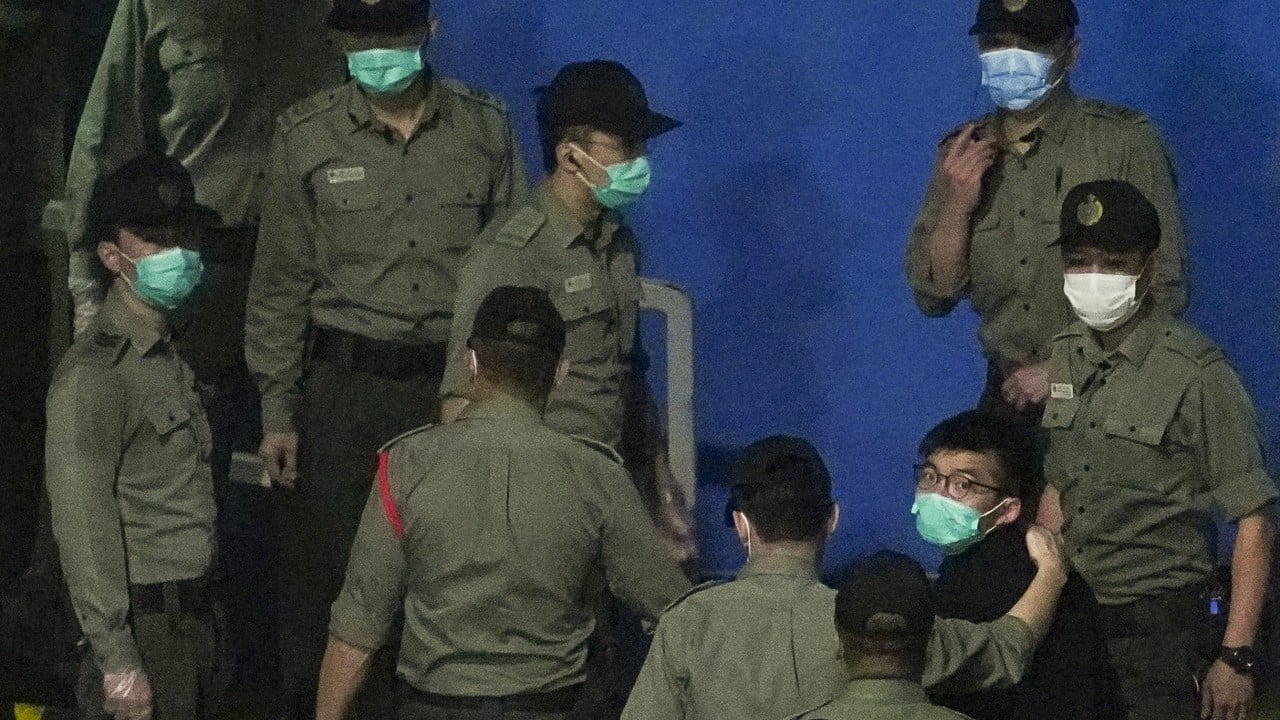
When Western governments condemn the sentencing of Hong Kong pro-democracy activist Joshua Wong, the Hong Kong Special Administrative Region (HKSAR) government does not issue a legal defense; it executes a standardized diplomatic counter-offensive built on the charge of hypocrisy. This rhetorical reflex is neither accidental nor emotional. It represents a calibrated strategic doctrine designed to neutralize foreign moral authority by exposing asymmetries in international legal standards, thereby shifting the analytical frame from domestic civil liberties to sovereign equivalence.
Standard media coverage treats the exchange between Western foreign ministries and Hong Kong authorities as a cyclical war of words. That framing misses the structural mechanics at play. Both sides operate within distinct, irreconcilable legal-political frameworks—liberal internationalism versus Westphalian state security—and the collision of these frameworks produces predictable diplomatic outputs whenever high-profile national security verdicts are handed down.
The Architecture of the Hypocrisy Counter-Argument
To understand why Hong Kong officials immediately deploy accusations of hypocrisy following international criticism of Joshua Wong’s sentences—whether stemming from unauthorized assembly charges or the broader National Security Law (NSL) subversion prosecutions—one must map the three structural pillars of Beijing and HKSAR diplomatic messaging.
1. Jurisdictional Symmetry and Statutory Equivalence
The primary mechanism of the HKSAR rebuttal relies on comparative statutory analysis. When the United States, the United Kingdom, or the European Union characterizes the prosecution of Wong as political repression, Hong Kong authorities point directly to the domestic national security statutes of the criticizing states.
The logic is straightforward:
- United States: The Logan Act, the Espionage Act, and federal seditious conspiracy statutes (18 U.S.C. § 2384) carry severe custodial penalties for attempts to overthrow, put down, or destroy by force the government, or to oppose by force the authority thereof.
- United Kingdom: The National Security Act 2023 expanded state powers regarding foreign interference, preparatory conduct, and sabotage, introducing strict liability and extended detention mechanisms.
- European Union: Member states maintain stringent constitutional protections against anti-constitutional organizations and treasonous conduct, particularly when linked to foreign funding or coordination.
By cataloging these statutes, the HKSAR government constructs an equivalence argument. If a Western democracy criminalizes collusion with foreign powers or coordinated efforts to paralyze state functions, then condemning Hong Kong for enforcing comparable provisions constitutes a double standard. In game-theoretic terms, this is a tu quoque defense elevated to statecraft—it does not prove the innocence of the defendant or the fairness of the local judiciary, but it invalidates the standing of the external prosecutor.
2. The Judicial Independence Firewall
A critical operational distinction exists between how Western observers view Hong Kong’s judiciary and how the HKSAR executive branch frames its role. Critics argue that the introduction of designated national security judges, the curtailment of jury trials in NSL cases, and the high threshold for bail fundamentally compromise judicial independence.
The HKSAR counter-narrative relies on a strict proceduralist definition of judicial independence. Officials emphasize that prosecutions are initiated by the Department of Justice independently of political interference, trials are conducted in open court, judgments are published with detailed legal reasoning, and defendants retain access to appellate mechanisms up to the Court of Final Appeal. Within this framework, foreign criticism of a specific sentence—such as the multi-year prison terms handed to Wong in the "Hong Kong 47" subversion trial or earlier protest-related cases—is categorized not as human rights advocacy, but as an attempt to pervert the course of justice by pressuring sitting judges.
3. The Non-Interference Doctrine as a Sovereign Shield
The third pillar rests on Article 2(7) of the United Nations Charter, which prohibits intervention in matters essentially within the domestic jurisdiction of any state. For Beijing and the HKSAR administration, post-1997 governance falls strictly within China’s internal affairs, governed by the Chinese Constitution and the Basic Law. When foreign governments cite the 1984 Sino-British Joint Declaration to justify diplomatic intervention, Chinese authorities counter that the Joint Declaration was a transitional instrument whose historical mission concluded upon the 1997 handover, leaving no residual supervisory rights for the United Kingdom or third-party states.
Deconstructing the Legal-Political Divergence
The friction surrounding Joshua Wong’s legal fate illustrates a deeper structural divergence in how state security and political dissent are defined. Conventional reporting often blurs the distinction between protest-related public order offenses and national security prosecutions, yet the legal thresholds and geopolitical stakes differ substantially.
In earlier cases involving unauthorized assemblies outside police headquarters or banned vigils, the legal disputes centered on proportionality—specifically, whether the restriction of freedom of assembly under the Public Order Ordinance met the constitutional tests laid out in the Basic Law and the Hong Kong Bill of Rights Ordinance. Courts balanced individual rights against public order, resulting in sentences measured in months.
The transition to prosecutions under the 2020 National Security Law altered the operational variables entirely. In the primary election subversion case involving Wong and 46 other activists, the prosecution's core theory did not rest on violent acts, but on a coordinated political strategy: winning a legislative majority to indiscriminately veto government budgets, thereby forcing the resignation of the Chief Executive and paralyzing the HKSAR government.
Here, the analytical divide becomes absolute:
- The Liberal Democratic Interpretation: Using constitutional mechanisms—such as voting down budgets within a legislature—to force political concessions or executive resignations is a standard, legitimate parliamentary tactic. Criminalizing an electoral strategy transforms political opposition into a crime.
- The National Security Interpretation: Under the constitutional design of the HKSAR, which is an executive-led system rather than a sovereign parliamentary democracy, a premeditated plan to systematically disable the administrative apparatus constitutes subversion of state power under Article 22 of the NSL.
Because the two sides hold mutually exclusive definitions of legitimate political contestation, neither side's legal arguments can persuade the other. Western condemnation treats the verdict as an erasure of political pluralism; HKSAR rebuttals treat the condemnation as an endorsement of constitutional sabotage.
The Cost Function of Diplomatic Confrontation
Every cycle of sentencing, foreign condemnation, and HKSAR pushback imposes measurable operational costs and yields specific strategic dividends for the actors involved. Analyzing this dynamic through a cost-benefit matrix clarifies why the rhetoric continues to escalate despite its lack of immediate impact on judicial outcomes.
For the HKSAR and Central Authorities
The immediate benefit of an aggressive rebuttal strategy is domestic and bureaucratic signaling. HKSAR officials must demonstrate resolute alignment with Beijing’s overarching national security mandate. A passive response to Western criticism would be interpreted within the Chinese political system as ideological weakness or insufficient commitment to safeguarding sovereignty.
The secondary benefit is narrative insulation within the Global South. By framing Western criticism as neo-colonial interference and pointing to selective enforcement of human rights norms by Washington and London, Beijing reinforces its broader geopolitical thesis that Western-led international institutions apply rules arbitrarily to contain rising powers.
However, this strategy carries a distinct economic cost function. Hong Kong’s value proposition as an international financial center relies on global capital markets perceiving its common law system as predictable, rules-based, and insulated from geopolitical volatility. When the HKSAR government engages in high-decibel diplomatic clashes over political prosecutions, it inadvertently amplifies sovereign risk premiums. Institutional investors, multinational corporations, and arbitration clients do not necessarily share the ideological concerns of Western foreign ministries, yet they closely monitor the rule-of-law indicators that underpin contract enforcement and capital mobility. Loud defensive posturing keeps Hong Kong’s legal transformation at the top of international news cycles, complicating efforts to rebrand the city purely as a hub for trade and finance.
For Western Governments
For the United States, the United Kingdom, and the European Union, issuing condemnations of Joshua Wong’s sentences fulfills domestic political imperatives at a low immediate fiscal cost. It signals adherence to democratic norms, satisfies legislative oversight committees, and maintains pressure on Beijing regarding compliance with international commitments.
The strategic limitation of this approach is diminishing coercive utility. Early responses to the National Security Law included tangible policy shifts: the revocation of Hong Kong’s special trade status by the US, the suspension of extradition treaties, targeted sanctions on officials under the Hong Kong Autonomy Act, and the creation of bespoke immigration pathways like the UK’s British National (Overseas) visa scheme. Once those structural levers were pulled, subsequent condemnations became largely declaratory. Without escalating to broader financial sanctions that would disrupt global supply chains and hurt Western financial institutions operating in Asia, diplomatic statements alone cannot alter the trajectory of Hong Kong’s legal system.
Operational Realities and Analytical Blind Spots
Evaluating the longevity and effectiveness of Hong Kong’s defensive diplomacy requires identifying the structural blind spots in both the HKSAR narrative and Western critiques.
First, the HKSAR’s statutory equivalence argument suffers from a critical institutional omission: countervailing checks and balances. While Western democracies possess severe national security laws, those statutes operate within ecosystems characterized by adversarial multiparty elections, an unrestricted investigative press, robust judicial review by courts independent of executive appointment committees, and active civil society watchdogs. Comparing the text of a statute in isolation from the institutional architecture that constrains its enforcement creates a false symmetry. A law that is rarely invoked and subject to rigorous legislative oversight functions differently from a law enforced within a streamlined, executive-led framework.
Second, Western commentary frequently underestimates the degree to which Beijing views Hong Kong’s stabilization as a non-negotiable core interest. Following the 2019 unrest, which paralyzed infrastructure and challenged state authority for months, the central government prioritized absolute political stability over international reputational metrics. Analysts who expect diplomatic pressure or economic friction to induce a softening of national security enforcement misread Beijing’s hierarchy of priorities. Security overrides economic optimization whenever the two variables conflict.
Third, the focus on individual figures like Joshua Wong obscures the broader institutional transformation occurring beneath the surface. Wong’s trajectory—from student leader of Scholarism during the 2012 anti-national education protests, to a central figure in the 2014 Umbrella Movement, to a convicted defendant under the NSL—serves as a biographical timeline of Hong Kong’s political evolution. Yet the structural shift is driven not by the fate of single activists, but by the systematic restructuring of the electoral system, the vetting of public officeholders, the revision of civic education curricula, and the integration of Hong Kong into the Greater Bay Area economic framework.
Strategic Trajectory and Forecast
The pattern of Western condemnation met by HKSAR accusations of hypocrisy has hardened into a permanent feature of the geopolitical environment. As remaining national security trials conclude and appellate processes unfold, the rhetoric will remain adversarial, yet the underlying reality in Hong Kong has already stabilized around a new institutional equilibrium.
For entities operating within or analyzing the region—whether multinational enterprises, institutional investors, or policy analysts—treating these diplomatic exchanges as indicators of imminent policy reversals or sudden escalations is an analytical error. The rhetoric is a lagging indicator of a structural shift that occurred between 2020 and 2021.
Strategic positioning requires separating diplomatic noise from operational reality:
- Discount Declaratory Diplomacy: Statements from Western capitals and counter-statements from the HKSAR Commissioner’s Office of the Chinese Foreign Ministry will continue with high frequency and low material impact. Decision-makers should track actual statutory changes, sanctions lists, and export control regimes rather than press releases.
- Price in Legal Bifurcation: Recognize that Hong Kong’s legal system now operates on two distinct tracks. Commercial, financial, and civil contract law continues to function with high technical competence and international alignment, while public, constitutional, and national security law is fully subordinated to state security imperatives. Risk models must evaluate exposure across these two tracks independently rather than applying a single monolithic risk score to the jurisdiction.
- Monitor Secondary Spillover: The primary risk for international actors is no longer direct political instability on the streets of Hong Kong, which has been effectively eliminated, but compliance friction arising from conflicting legal mandates—specifically where Western sanctions regimes collide with Chinese anti-foreign sanctions laws. Operational resilience depends on ring-fencing data, compliance teams, and financial flows to navigate two incompatible regulatory spheres without triggering statutory violations in either.