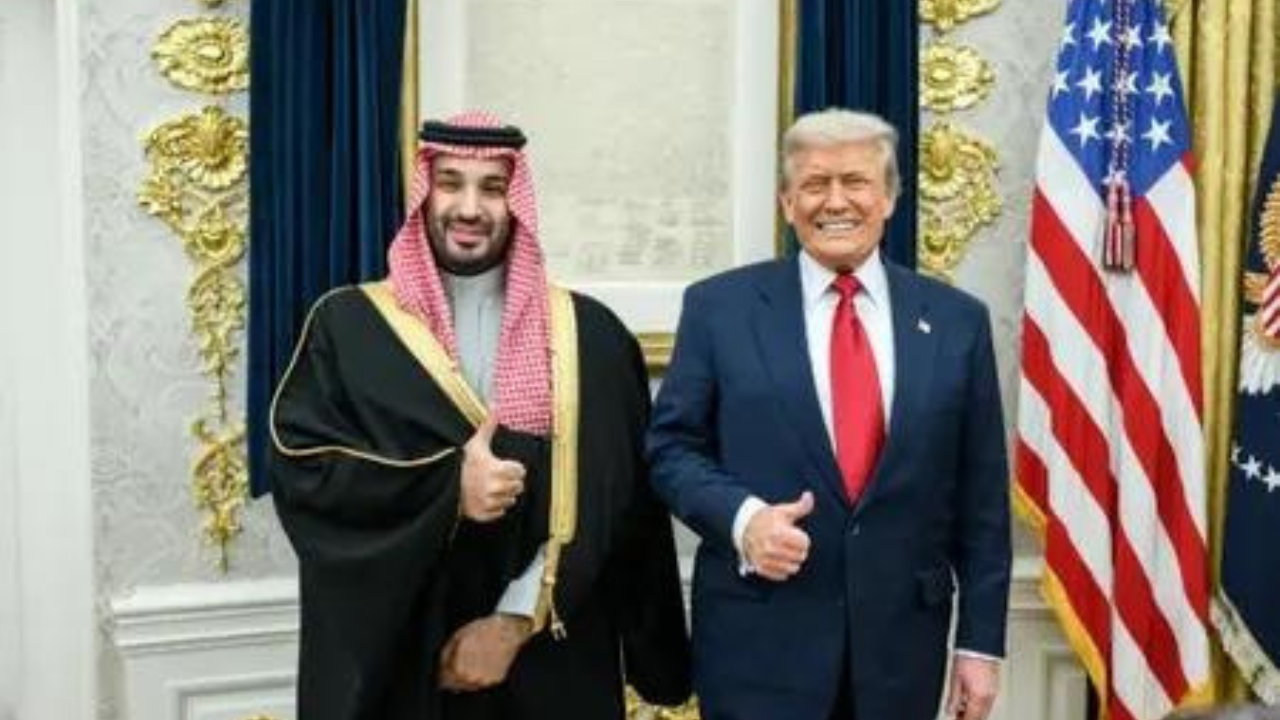
The recent bilateral agreements regarding civil nuclear cooperation between the United States and Saudi Arabia fundamentally alter the strategic equilibrium of the Middle East. Media reporting treats this development as a standard diplomatic transaction. It is not. It represents a multi-variable trade-off involving non-proliferation controls, energy transition economics, regional power projection, and state-sponsored technological transfer.
To evaluate the geopolitical and economic consequences of this deal, one must analyze the operational dependencies across three core dimensions: domestic uranium enrichment protocols, the regional security architecture, and global nuclear supply chain economics.
[Image of nuclear fuel cycle]
The Strategic Trade-Off of Domestic Enrichment
The foundational tension in any bilateral 123 Agreement—governed by Section 123 of the US Atomic Energy Act of 1954—centers on the nuclear fuel cycle. A state seeking civil nuclear power requires access to Low-Enriched Uranium (LEU), which contains between 3% and 5% Uranium-235. The mechanical infrastructure required to produce LEU via gas centrifuge technology is functionally identical to that required to produce Highly Enriched Uranium (HEU) at 90% concentration, the threshold for weapons-grade material.
Standard US policy, historically referred to as the "Gold Standard" (embedded in the 2009 US-UAE 123 Agreement), requires recipient nations to forgo domestic enrichment and reprocessing capabilities entirely. Saudi officials have systematically rejected this constraint, citing vast domestic uranium ore reserves estimated at over 90,000 tonnes across the Arabian Shield.
The architecture of the current deal attempts to reconcile these opposing mandates through a dual-track operational strategy:
- Front-End Containment: The establishment of a US-monitored, joint-venture enrichment facility on Saudi soil, utilizing strict physical and digital perimeter monitoring alongside real-time IAEA (International Atomic Energy Agency) safeguards under an Additional Protocol regime.
- Back-End Lock-In: Mandatory export controls on spent fuel rods, preventing local reprocessing activities that could extract Plutonium-239.
By permitting a controlled, foreign-supervised enrichment mechanism on Saudi territory, the framework bypasses traditional non-proliferation purity to secure long-term industrial integration. The risk profile shifts from absolute prevention to latency management: minimizing the speed at which civil enrichment assets could hypothetically be reconfigured for military breakout.
Supply Chain Realignment and the Rosatom Displacement
Beyond non-proliferation, this agreement serves as an aggressive commercial maneuver to displace Russian and Chinese state-backed nuclear entities from the Middle Eastern energy grid.
Rosatom (Russia) and CNNC (China) have aggressively marketed build-own-operate (BOO) civil nuclear models across the Global South. These models offer fully financed infrastructure packages with lower regulatory barriers. For Saudi Arabia, accepting a pure US framework imposes significant administrative and compliance burdens. However, it delivers three major operational advantages:
- Integration with US Grid Tech: Western reactor designs, specifically Gen III+ Pressurized Water Reactors (PWRs), offer superior operational reliability metrics and longer refueling cycles compared to older regional alternatives.
- Strategic Defense Interlocking: Binding civil nuclear infrastructure to US technology guarantees a multi-decade security umbrella, as long-term maintenance, technical oversight, and fuel assembly supply remain tied to Western supply chains.
- Capital Efficiency: Leveraging domestic uranium reserves lowers long-term operational expenditure (OpEx) for fuel procurement, transforming raw domestic resources into base-load electricity generation.
The economic logic for Saudi Arabia is directly linked to Vision 2030 energy diversification targets. Domestic crude oil consumption for electricity generation currently peaks at over 1 million barrels per day during summer cooling months. Redirecting this volume from domestic power plants to export markets generates high-margin hydrocarbon revenue while base-load demand is absorbed by nuclear capacity.
The Regional Security Calculus and Proliferation Cascade
The structural concessions granted in this framework trigger immediate strategic recalculations across regional capitals. The core strategic variable is non-proliferation symmetry.
If Riyadh secures a path to domestic enrichment—even under joint US oversight—it establishes a precedent across the Gulf Cooperation Council (GCC) and the wider Middle East. Iran’s existing enrichment infrastructure, developed outside traditional bilateral constraints, established the regional baseline. A Saudi capability balances this technical asymmetry.
This creates a tri-polar nuclear stability model in the region:
- Iran: Unsanctioned, indigenous enrichment capacity with low breakout timelines.
- Israel: Undeclared, asymmetric non-civil deterrent capability.
- Saudi Arabia: Heavily monitored, state-backed civil enrichment capacity with embedded Western safeguards.
The vulnerability of this tri-polar model lies in political shifts. While joint oversight provides operational friction against non-civil conversion, the physical presence of enrichment centrifuges on domestic soil lowers the time required to achieve weapons-grade production should international treaties be repudiated.
Implementation Hurdles and Technical Risk Factors
The execution of this framework faces immediate technical and legislative friction. The US Congress retains statutory authority under Section 123 of the Atomic Energy Act to review and potentially block bilateral nuclear agreements via a joint resolution of disapproval.
Legislative resistance focuses primarily on two structural vulnerabilities:
- The Proliferation Precedent: Waiving the prohibition on domestic enrichment weakens the US negotiating position in future non-proliferation agreements globally.
- Tech Transfer Risks: High-grade industrial monitoring systems must operate in environment conditions where physical security control is shared with host-nation personnel, introducing cyber and physical espionage risks.
From an engineering perspective, establishing a nuclear supply chain in hyper-arid environments introduces severe operational constraints. Cooling high-capacity reactors requires massive water throughput. Saudi Arabia’s reliance on coastal desalination plants introduces an additional operational dependency: nuclear units must either be co-located with heavy desalination infrastructure or utilize advanced dry-cooling towers, which reduce thermal efficiency and inflate initial capital expenditure (CapEx) by 12% to 18%.
Strategic Execution Vector
To capitalize on this agreement, stakeholders must abandon traditional diplomatic frameworks and execute a rigorous infrastructure roadmap.
The immediate operational play requires establishing an independent, non-governmental technical audit board composed of US and Saudi engineering leads, operating alongside IAEA inspectors. This board must enforce a hard operational separation between civil power generation facilities and enrichment research centers. Capital allocation must prioritize the rapid construction of coastal reactor sites using proven Gen III+ designs, bypassing experimental small modular reactors (SMRs) until the core base-load grid capacity is stabilized. Concurrently, US policymakers must codify explicit, automated sanctuarization clauses: any unauthorized disruption of IAEA monitoring feeds automatically terminates the delivery of specialized nuclear components, locking the software architecture of the enrichment control systems.