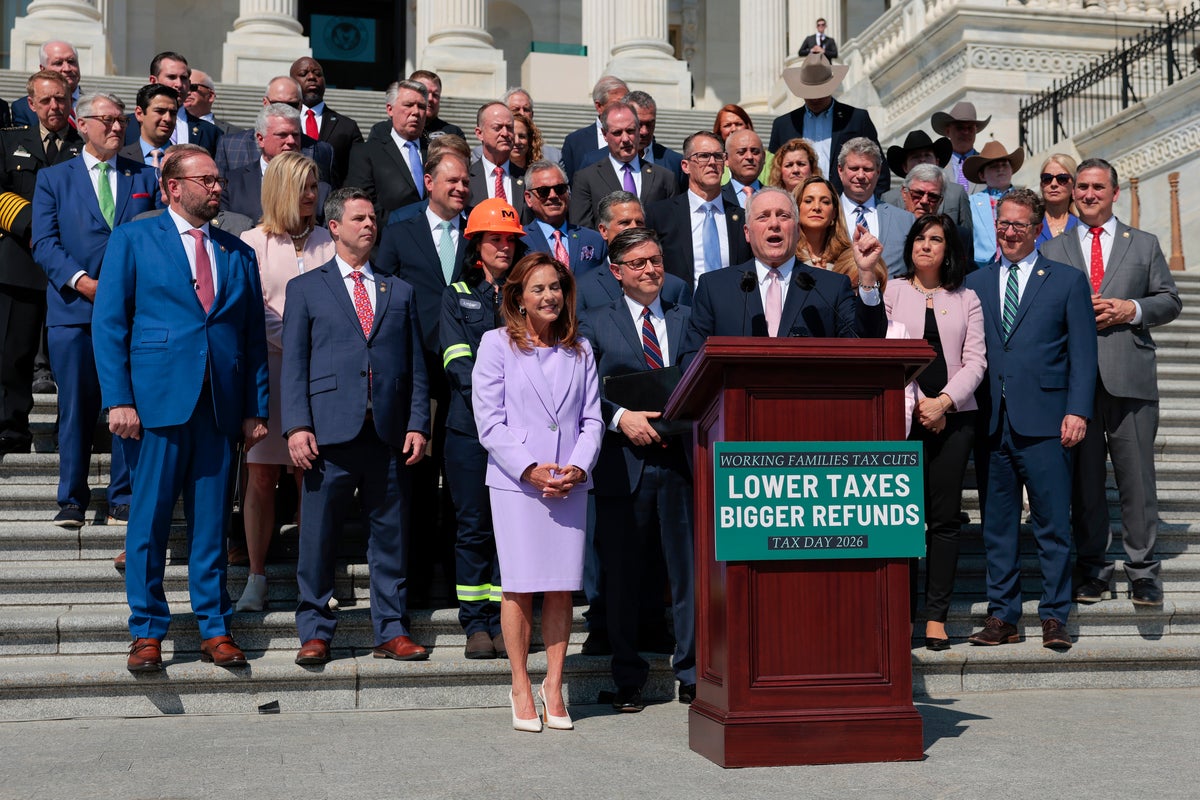
The tension between the Office of the Speaker, the Republican presidential ticket, and the Holy See represents more than a cultural disagreement; it is a fundamental collision of three distinct governance models: Westphalian Sovereignty, Populist Nationalism, and Moral Universalism. When Speaker Mike Johnson aligns with Donald Trump and J.D. Vance against the critiques of Pope Leo, he is not merely defending a partisan platform. He is asserting the primacy of the Nation-State’s internal policy-making logic over external moral oversight. This friction is a direct result of the diverging mandates between a secular legislative body and a global religious authority, creating a feedback loop where political defense mechanisms are triggered by perceived overreaches in spiritual guidance.
The Tri-Axis Power Dynamics
To understand the conflict, one must deconstruct the three competing frameworks currently at play. Each entity operates on a different "incentive structure," which makes friction inevitable rather than accidental.
- The Apostolic Framework (The Pope): Operates on a multi-generational time horizon. Its metrics for success are based on adherence to universal moral doctrine, specifically regarding the dignity of the migrant and the stewardship of the environment. Because the Papacy is not beholden to a four-year election cycle, its rhetoric is often divorced from the logistical constraints of border management or industrial economics.
- The Executive Aspirant Framework (Trump/Vance): Operates on an immediate, four-year tactical window. Success is measured by border security metrics, economic protectionism, and the consolidation of a specific national identity. Their logic is transactional: policies are judged by their direct benefit to the domestic electorate.
- The Legislative Shield (Speaker Johnson): Acts as the bridge and the bodyguard. Johnson’s role is to translate populist sentiment into legislative legitimacy while insulating the party's platform from moral critiques that could alienate religious voters.
The Mechanics of Political Response
Speaker Johnson’s assertion that a "political response" is expected is a calculated recognition of The Reciprocity Principle in public discourse. When a religious leader enters the arena of specific policy critique—moving from the "What" (moral imperatives) to the "How" (border enforcement mechanics)—they effectively forfeit their status as a neutral observer.
The Violation of Domain Specificity
The friction point occurs because the Papacy’s recent critiques have transitioned from broad theological statements to specific denunciations of modern Republican platform pillars, such as mass deportations and restrictive asylum policies. In the view of the Johnson-Trump-Vance triad, this represents a violation of domain specificity.
- The Theological Domain: Issues of grace, salvation, and the inherent worth of the individual.
- The Administrative Domain: Logistics of visa processing, physical barrier construction, and the enforcement of the Rule of Law.
By crossing into the Administrative Domain, the Pope triggers a defensive response from the State. Johnson’s logic suggests that if the Church utilizes political language to critique the State, the State is entitled to use political language to defend its sovereignty. This is a cost-function analysis: the political cost of appearing "anti-religious" is outweighed by the cost of appearing "weak on sovereignty" to the base.
Structural Divergence on Migration and Sovereignty
The core of the disagreement lies in the definition of a "border." To the Vatican, a border is a permeable line where the universal rights of the human person must always take precedence. To the Trump-Vance-Johnson coalition, a border is a functional tool of national survival.
The Security-Morality Bottleneck
This creates a bottleneck in diplomatic relations. The Republican leadership views migration as a matter of National Security and Resource Allocation. They argue that a state which cannot control its entry points ceases to be a state.
- Fact: Domestic law in the United States is codified through the Immigration and Nationality Act.
- Hypothesis: The leadership believes that any softening of this stance, even for moral reasons, would lead to a total collapse of the legal immigration system.
Conversely, the Pope’s critique views these same policies through the lens of Human Rights and Global Solidarity. This is not a misunderstanding of facts; it is a fundamental disagreement on which hierarchy of values should govern a modern republic.
The Vance Factor and the Catholic Intellectual Tradition
J.D. Vance’s presence in this triad adds a layer of intellectual complexity. As a high-profile Catholic convert, Vance represents a specific subset of "Post-Liberal" or "National Conservative" Catholicism that argues for a more muscular, state-focused application of faith. This group often pushes back against the current Vatican administration, suggesting that the Pope’s emphasis on migration and climate change ignores the "Social Teaching" regarding the importance of family, local community, and the protection of national cultures.
Johnson, though an Evangelical, finds a strategic ally in Vance because both agree on the Subsidiarity Principle. In Catholic Social Teaching, subsidiarity suggests that matters should be handled by the smallest, lowest, or least centralized competent authority. Johnson and Vance apply this to the Nation-State: the U.S. government, not a global religious body, is the competent authority to decide U.S. border policy.
The Political Risk Profile
There is a calculated risk in Johnson’s stance. The U.S. Catholic vote is not a monolith; it is a highly fragmented demographic that often serves as the "swing" factor in Midwestern states.
- The Risks of Alienation: Strong rhetoric against the Pope could alienate "Social Justice" Catholics who prioritize the Church’s teachings on the poor and marginalized.
- The Gains of Alignment: Affirming the Trump-Vance position solidifies the "Traditionalist" Catholic and "Law and Order" Evangelical vote, which views the current Vatican direction as overly progressive or "globalist."
The "Political Response" Johnson mentioned serves as a signal to the electorate that the GOP will not allow external moral pressure to override the "America First" policy framework. This is a deliberate move to decouple "Religious Faith" from "Vatican Policy."
Strategic Recommendation for Policy Navigators
Stakeholders must recognize that this is not a temporary spat but a structural realignment of how Western political leaders interact with global moral authorities. The "Johnson Doctrine" in this context is clear: Legislative and Executive action will be dictated by the perceived needs of the domestic constituency, regardless of external ecclesiastical pressure. To navigate this environment, analysts should monitor the following indicators:
- Rhetorical Decoupling: Watch for increased instances of GOP leaders distinguishing between "The Faith" and "The Vatican Bureaucracy."
- Legislative Hardening: Expect the codification of border policies that explicitly prioritize national security over humanitarian exceptions to preempt further moral critiques.
- Coalition Shifting: Observe the strengthening of alliances between traditionalist religious groups and nationalist political figures, creating a parallel authority structure to the official Church hierarchy.
The path forward involves a rigid adherence to the legal definitions of sovereignty. The "Political Response" is the sound of the Nation-State reasserting its boundaries against the tide of 21st-century universalism. The strategic play is to treat the Pope’s statements not as a moral veto, but as a competing geopolitical interest. Leaders should respond by re-centering the conversation on the legal and social contract between a government and its citizens, rather than an abstract global moral standard.