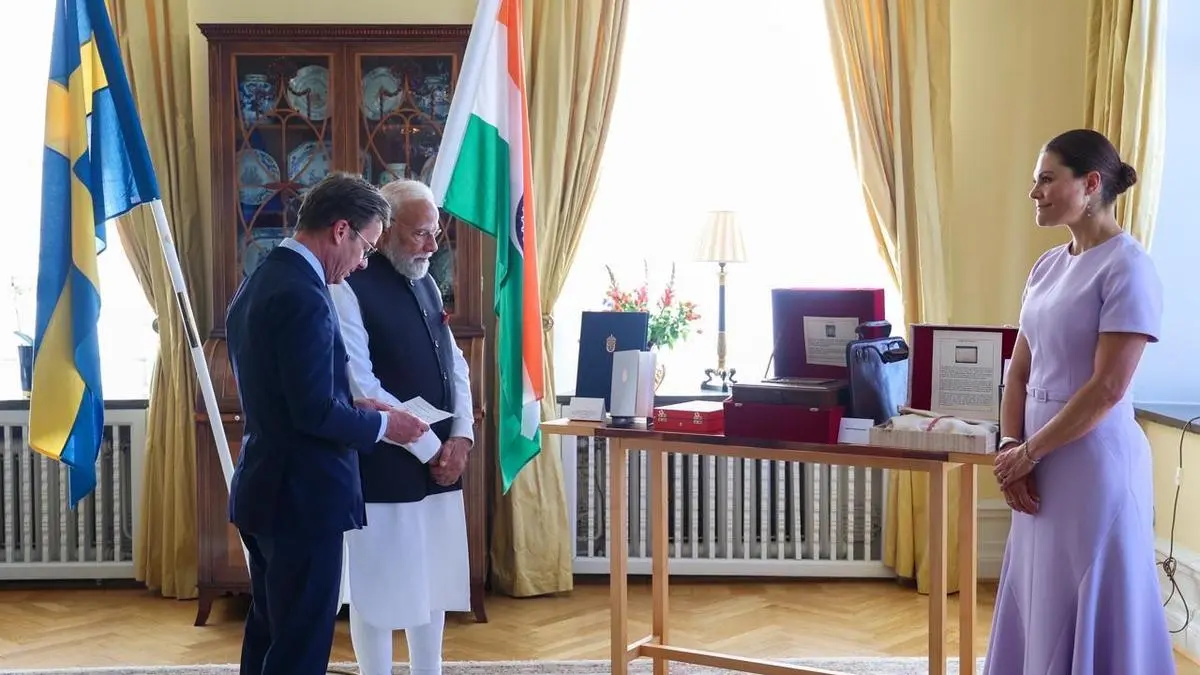
State visits are highly engineered economic and political operations where every symbolic gesture serves as a proxy for structural alignment. The May 2026 meeting between Indian Prime Minister Narendra Modi and Swedish Prime Minister Ulf Kristersson in Gothenburg, which coincided with the formal elevation of bilateral ties to a Strategic Partnership, illustrates how states deploy historical narrative assets to reduce friction in hard-power negotiations. While standard media reporting treats the exchange of Rabindranath Tagore memorabilia as a sentimental footnote, an asset-class analysis of cultural diplomacy reveals it as a calculated deployment of shared intellectual property designed to anchor asymmetric economic agreements.
To evaluate the structural efficiency of this exchange, the diplomatic inputs must be mapped against the broader quantitative objectives of the summit, including a bilateral trade portfolio that reached $7.75 billion in 2025.
The Strategic Asymmetry Matrix: Defining the Diplomatic Input
Cultural diplomacy operates on a mechanism of mutual validation where sovereign entities exchange historical credentials to establish ideological parity before executing transactional contracts. The specific assets exchanged in Gothenburg were selected to optimize historical path dependency, addressing a century-old cultural link to facilitate modern technological and defense integration.
       SWEDEN'S INPUT                          INDIA'S INPUT
┌───────────────────────────┐           ┌───────────────────────────┐
│  Archival Verification    │           │ Industrial Implementation │
│ • 1921/1926 Epigrams      │           │ • Collected Literary Works│
│ • Uppsala Univ. Photo     │           │ • Shantiniketan Artisan   │
│ • State-certified Provenance          │   Leathercraft Asset      │
└─────────────┬─────────────┘           └─────────────┬─────────────┘
              │                                       │
              └───────────────────┬───────────────────┘
                                  ▼
                     STRUCTURAL CONVERGENCE ZONE
              • Asymmetry reduction in trade value
              • Mitigation of intellectual property friction
              • Soft-power baseline for Action Plan 2030
The Swedish Input: Archival Verification
Prime Minister Kristersson presented a cobalt-blue box adorned with gold lettering and a sovereign monogram, containing faithful reproductions of two handwritten epigrams penned by Tagore during his historic visits to Sweden in 1921 and 1926. This asset package included a brief historical commentary and a 1921 photograph from Uppsala University. The specific texts extracted from the Swedish National Archives reveal a deliberate thematic selection:
- Epigram 1 (Bilingual - Bengali and English): "God's smile is revealed in love's light which reveals brother's face." This text serves as a philosophical framework for non-zero-sum cooperation, establishing a baseline of mutual human capital valuation.
- Epigram 2 (English): "History slowly smothers truth but hastily struggles to revive it in a terrible penance of pain." This function serves a dual purpose: it acknowledges historical gaps in Euro-Asian institutional engagement while positioning the current summit as the corrective mechanism.
The strategic value of this input lies in its institutional validation. By pulling these assets from its National Archives, Sweden demonstrated a multi-generational custody of India’s premier intellectual export, signal-boosting its historical respect for Indian sovereignty.
The Indian Input: Industrial Implementation
Prime Minister Modi countered with a structural package consisting of Rabindranath Tagore's collected literary works paired with a handcrafted Shantiniketan leather bag featuring motifs chosen by Tagore. The Indian selection shifts the asset from purely archival to functional and economic:
- The Textual Component: The collected works serve as a comprehensive baseline of India's foundational philosophy on internationalism and institutional balance, signaling intellectual alignment with European democratic frameworks.
- The Material Component: The Shantiniketan bag represents a tangible execution of Tagore’s rural reconstruction and design optimization models. It shifts the perception of Indian manufacturing from low-cost labor to high-value, IP-protected artisanal craftsmanship.
The Economics of Soft-Power Hedging in Bilateral Trade
The deployment of Tagore as the central diplomatic anchor solves an immediate structural challenge in India-Sweden relations: balancing a highly asymmetric trade architecture. Bilateral trade between the two nations reached $7.75 billion in 2025, driven heavily by Swedish exports of high-value capital goods, telecommunications infrastructure, and automotive technology, balanced against Indian software services and textiles.
    SWEDISH HIGH-VALUE CAPITAL ASSETS          INDIAN INTELLECTUAL CAPITAL
     (Volvo, Ericsson, Saab Technology)        (IT, Engineering, Raw Materials)
                     │                                       │
                     ▼                                       ▼
        [High IP / High Margin]                  [High Scale / Emerging IP]
                     │                                       │
                     └───────────────────┬───────────────────┘
                                         ▼
                     Friction Point: Structural Disparity
                                         │
                 Targeted Mitigation via Cultural Equity (Tagore)
                                         │
                                         ▼
                     Equilibrium: Strategic Action Plan 2030
When high-technology sovereign entities negotiate with rapidly scaling emerging markets, trade friction frequently occurs around intellectual property regimes and market-access barriers. The strategic deployment of Tagore—the first non-European Nobel laureate (1913)—establishes a historical precedent of intellectual parity. It reminds European markets that India’s contribution to the bilateral relationship is not merely resource- or labor-scale, but deeply rooted in conceptual innovation.
This structural alignment was immediately leveraged at the European CEO Roundtable hosted by the Volvo Group during the summit. By preceding the industrial talks with the Tagore exchange, both administrations established an equilibrium point. This reduced the psychological distance between European capital asset managers (including representatives from green energy, AI, and defense sectors) and Indian state procurement officials, allowing for smoother negotiations on the India-Sweden Action Plan till 2030.
Path Dependency and the Centenary Compression Mechanism
The timing of this exchange is governed by the principles of path dependency. The 2026 summit directly coincides with the centenary of Tagore’s last historic visit to Sweden in 1926. In diplomatic statecraft, an uncelebrated centenary represents an underutilized asset; by actively mining the 1926 archive, both leaders executed a compression mechanism that links past validation to current policy imperatives.
The historical bottleneck dates back to 1913. Although Tagore was awarded the Nobel Prize in Literature in that year, global geopolitical volatility and systemic healthcare constraints prevented him from traveling to Stockholm to receive the award. He was eventually received by King Gustav V in 1921.
By referencing this specific timeline, the Kristersson administration achieved a critical diplomatic objective: validating the historical continuity of Sweden's institutional independence. By reminding India that Swedish institutions recognized Asian intellectual dominance long before modern multilateral forums did, Sweden differentiates itself from other European powers burdened by colonial histories. This historical neutrality converts directly into a competitive advantage for Swedish firms seeking access to Indian public sector defense and infrastructure tenders.
The Strategic Play: Translating Symbolic Capital into Action Plan 2030
The utility of cultural equity is maximized when it is immediately converted into hard-power policy executions. The Tagore exchange did not occur in a vacuum; it served as the psychological baseline for elevating the relationship to a comprehensive Strategic Partnership.
To capitalize on the momentum generated by this framework, international strategy teams and state corporations must execute a specific multi-tiered operational play designed to translate this symbolic alignment into measurable economic outcomes.
Phase 1: Institutional IP Co-Development
The acknowledgement of mutual intellectual heritage must be formalized through institutional R&D pipelines. Entities operating in the Artificial Intelligence, space tech, and green transition sectors should leverage the joint state statements to bypass early-stage regulatory friction.
- Establish dedicated India-Sweden innovation clusters focused on localized sustainability frameworks.
- Use the historical precedent of Shantiniketan's functional art to secure sovereign grants for sustainable industrial design, utilizing Indian scale and Swedish circular economy frameworks.
Phase 2: Supply Chain Resilience Integration
With bilateral trade at $7.75 billion and growing, the immediate operational bottleneck is supply chain vulnerability. The strategic recommendation is to leverage the newly minted Strategic Partnership to establish dedicated logistics corridors.
- Companies specializing in critical minerals, semiconductors, and defense components must utilize the Action Plan 2030 frameworks to secure preferential tariff treatments and streamlined customs clearance protocols in Gothenburg and Indian maritime hubs.
Phase 3: Geopolitical Expansion via the India-Nordic Framework
The Gothenburg summit served as the operational prelude to the 3rd India-Nordic Summit in Oslo, marking a significant strategic pivot toward Northern Europe.
- Indian enterprises must view Sweden not merely as a isolated market, but as the institutional gateway to the broader Nordic bloc.
- The thematic alignments established regarding human dignity, knowledge, and technology sharing should be systematically deployed in subsequent negotiations with Norway, Denmark, Finland, and Iceland to establish a standardized regulatory and investment environment across the entire region.