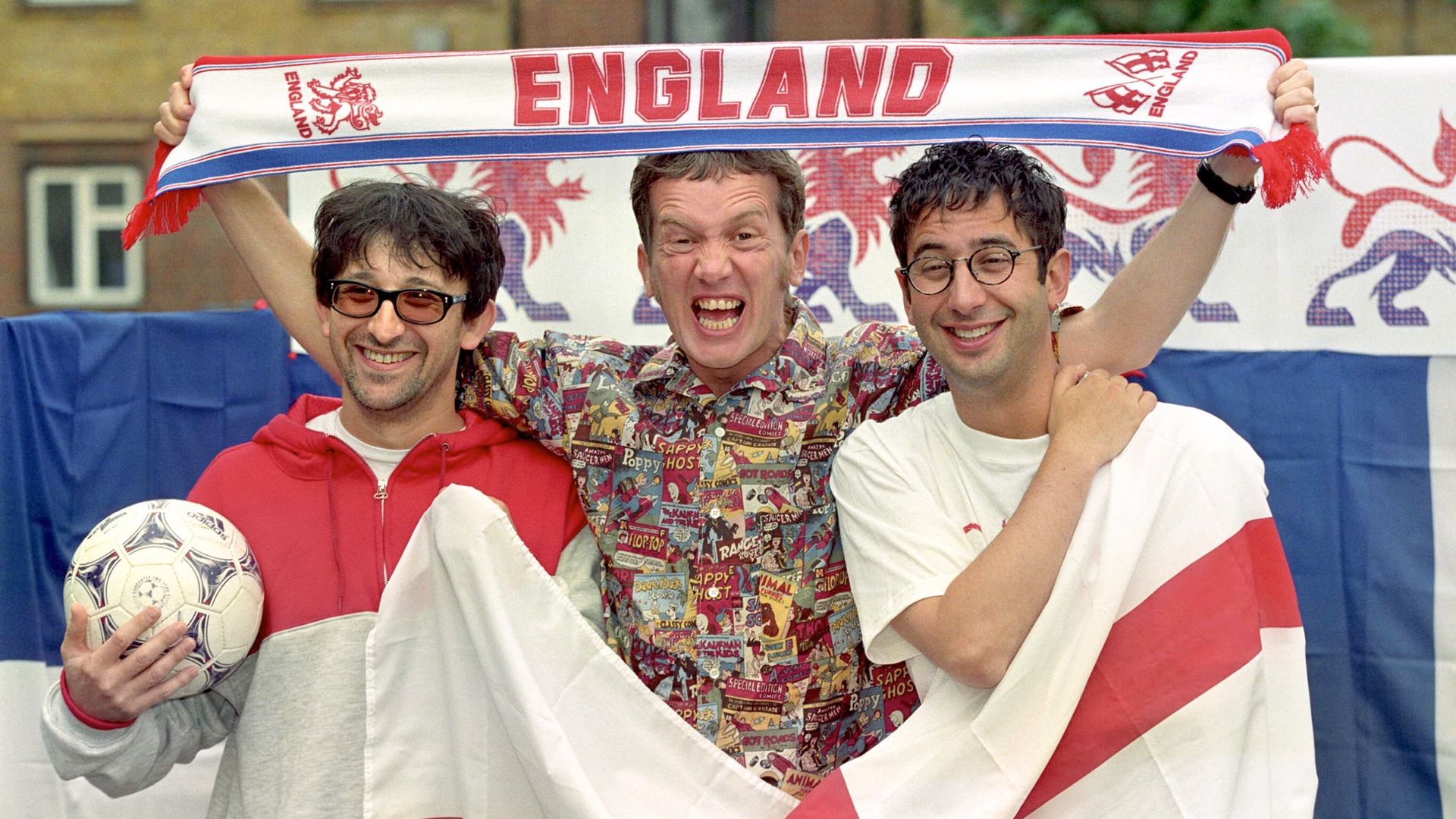
The friction between English football culture and international perception is not a matter of superficial sporting rivalry; it is a structural clash of psychological frameworks. When prominent continental football figures criticize the English anthem Three Lions ("It's Coming Home") as arrogant, they are not merely reacting to a catchy refrain. They are identifying a strategic miscalculation in cultural diplomacy. The song, originally written in 1996 by Baddiel, Skinner, and the Lightning Seeds, operates on a dual track: it is experienced internally as a self-deprecating chronicle of hope and historical failure, but it is projected externally as an assertion of historical entitlement.
This asymmetry in communication creates a significant deficit in competitive psychology. In elite sports, cultural narratives function as external stimuli that influence opponent motivation and media framing. By failing to manage the external perception of its central cultural artifact, English football consistently concedes a psychological advantage to its opponents, transforming a localized mechanism of coping into an international instrument of provocation.
The Dual-Narrative Framework Internal Vs External Perception
To understand why a track rooted in misery and near-misses is universally interpreted abroad as a hubristic demand, the narrative must be deconstructed into its component vectors. The song operates under two entirely distinct semiotic systems depending on the audience.
The Internal Vector (The Self-Deprecating Loop)
For the domestic English audience, the core utility of the anthem is vulnerability management. The lyrics explicitly catalog historical trauma:
- The failures of previous tournaments ("Three Lions on a shirt / Jules Rimet still gleaming / Thirty years of hurt / Never stopped me dreaming").
- The critique of tactical obsolescence ("Everyone seems to know the score / They've seen it all before / They know they're so assured / That England's gonna throw it away / Gonna blow it away").
- The reliance on collective memory over present utility ("I know that was then, but it could be again").
The domestic framework relies on an irony loop. By vocalizing the certainty of failure, the fan base insulates itself from the emotional shock of elimination while simultaneously validating their continued loyalty. It is a psychological defense mechanism disguised as a celebration.
The External Vector (The Entitlement Signal)
For the international observer—lacking the hyper-local context of English media self-deprecation—the anthem is parsed through a linear historical framework. The external audience filters the song through three structural markers:
[Intentionality of "Home"] -> Implies football inherently belongs to England.
          |
[The Chorus Intercept]    -> Repeating "It's coming home" acts as a definitive forecast.
          |
[Historical Asymmetry]    -> Ignores the competitive merits of rival footballing nations.
The phrase "It's coming home" ceases to be a hopeful prayer and becomes an assertion of geographic ownership. International squads do not interpret the song through the verses of Baddiel and Skinner; they interpret it through the repetitive, monolithic chorus. This structural asymmetry converts an act of domestic vulnerability into an act of external aggression.
The Cost Function of Cultural Friction in Elite Sports
In high-performance environments, any variable that increases an opponent's baseline motivation without providing a corresponding functional benefit to one's own team represents a net strategic loss. The external projection of Three Lions acts as an involuntary tax on English performance.
Opponent Motivation Multiplication
Elite athletes optimize performance through various intrinsic and extrinsic motivators. External disrespect—whether real or perceived—is the most readily weaponized extrinsic motivator in professional sports. When an opposing team listens to the English media or fan base chant "It's coming home," it simplifies their tactical briefing. The narrative shifts from a standard sporting contest to a defensive action against cultural chauvinism.
The psychological cost can be modeled as a function of opponent intensity:
$$I_{opponent} = f(M_{intrinsic} + M_{extrinsic}(N_{provocation}))$$
Where $N_{provocation}$ represents the perceived arrogance of the cultural narrative. As $N_{provocation}$ increases, the opponent's psychological willingness to sustain high-intensity defensive blocks or execute high-press systems under physical fatigue escalates. The song systematically lowers the threshold required for opponents to reach peak emotional investment.
Media Echo Chambers and Regulatory Pressure
The international press corps uses the anthem as a highly effective framing device. During tournament knockout stages, continental European and South American media outlets routinely present the song as evidence of English exceptionalism. This media framing creates a hostile atmospheric environment for the English squad. It increases the scrutiny on officiating, intensifies the hostility of neutral crowds, and places an asymmetric psychological burden on English players, who must carry the weight of an perceived historical debt they did not personally incur.
Historical Precedents and Comparative Cultural Artifacts
The tactical error of England's musical branding becomes stark when compared to how other footballing nations manage their historical legacies. Successful sporting cultures typically decouple their historical achievements from their current operational objectives to avoid generating counter-motivation in adversaries.
Italy: Il Canto degli Italiani and Tactical Solemnity
The Italian footballing identity leverages national pride through solemnity and martial imagery rather than footballing specificity. The anthem and associated cultural output emphasize duty, sacrifice, and collective resistance (L'Italia chiamò). Because the narrative is inward-looking and existential, it offers no foothold for opponents to claim they are being patronized. It builds a defensive psychological wall without throwing a cultural stone.
Brazil: Samba and the Illusion of Joy
Brazil possesses a historical pedigree that vastly outstrips England's modern record, yet their cultural footballing artifacts emphasize aesthetic joy (joga bonito) and community celebration rather than structural ownership of the sport. The underlying message is one of organic superiority through grace, not bureaucratic entitlement through origin. Opponents may fear Brazilian talent, but they are rarely motivated by a sense of cultural grievance.
Germany: Bureaucratic Pragmatism
German football tradition systematically avoids the creation of highly emotional tournament anthems that predict outcomes. Their cultural positioning is grounded in operational efficiency (Die Mannschaft). When Germany wins, it is framed as the logical output of a well-designed machine, not the fulfillment of a destiny. This lack of narrative vulnerability prevents opponents from generating ideological fury prior to kick-off.
The Mechanics of National Trauma and Narrative Traps
The persistent reliance on Three Lions highlights a deeper systemic vulnerability within the English football apparatus: the inability to separate the origin of the modern ruleset from the evolution of the global game.
The structural trap operates across three generational bottlenecks:
- The Origin Fallacy: The assumption that because the Football Association codified the game in 1863, the international trophy ecosystem remains a closed loop that must eventually return to its point of origin.
- The Media Metric Distortion: English sports media requires high-engagement narratives to maximize commercial returns during a tournament cycle. The simplified, binary nature of "It's Coming Home" serves commercial engagement metrics perfectly, despite running counter to the sporting squad's need for low-variance, low-pressure environments.
- The Nostalgia Bottleneck: By continuously anchoring the fan experience to 1966 (and subsequently 1996), the culture enforces a backward-looking evaluation metric. Current players are not judged against their tactical instructions or contemporary opponents; they are judged against the ghosts of a monochromatic past.
This structural loop prevents the development of a modern, clinical sporting identity. The squad is forced to operate within a circus of historical reenactment every two years.
Operational Recommendations for Narrative Realignment
To neutralize this self-inflicted psychological tax, the English football hierarchy must execute a deliberate, top-down decoupling from legacy cultural artifacts that damage international diplomatic leverage. This does not require the suppression of fan passion, but rather the strategic management of official cultural output.
1. Phasing Out Official Institutional Endorsement
The Football Association must cease the utilization of Three Lions in official promotional material, stadium playlists controlled by the governing body, and player-facing media content. The song must be relegated entirely to organic fan spaces. By removing institutional backing, the FA deprives international media of the ability to claim that the arrogance is a policy directed by the squad or management.
2. Introduction of an Inward-Looking Narrative Pivot
Future cultural commissions must mimic the successful frameworks of continental Europe. The narrative must shift from entitlement (where the trophy belongs) to endurance (the labor required to achieve it). Content should focus on the diverse, contemporary reality of the modern squad rather than a continuous loop of historical archives featuring the Jules Rimet trophy.
3. Media Training and Linguistic De-escalation
Players and coaching staff must be strictly insulated from the narrative loop. When asked about the anthem by international journalists, the operational response must be standardized, clinical, and analytical.
The communication protocol should follow a precise structure:
- Acknowledge the song purely as a domestic pop-culture artifact.
- Explicitly disavow the literal interpretation of the lyrics.
- Redirect the conversation to the tactical merits and respect owed to the upcoming opponent.
By systematically starving the international press of quotes that validate the "arrogant English" archetype, the squad can actively lower the emotional temperature of their tournament fixtures.
The Strategic Play
The English national team has made undeniable structural progress in youth development, tactical modernization, and physical preparation over the past decade. However, these marginal gains are continually compromised by an archaic cultural infrastructure that alienates potential allies and energizes adversaries on the global stage.
The definitive play for English football is not to win a tournament despite the weight of its cultural baggage, but to dismantle the baggage so that winning becomes a functional probability. Until the sport in England chooses to live in the contemporary reality of global parity rather than the mythos of its founding fatherhood, it will continue to find that the home it speaks of is a place foreign nations are highly motivated to keep it from reaching.