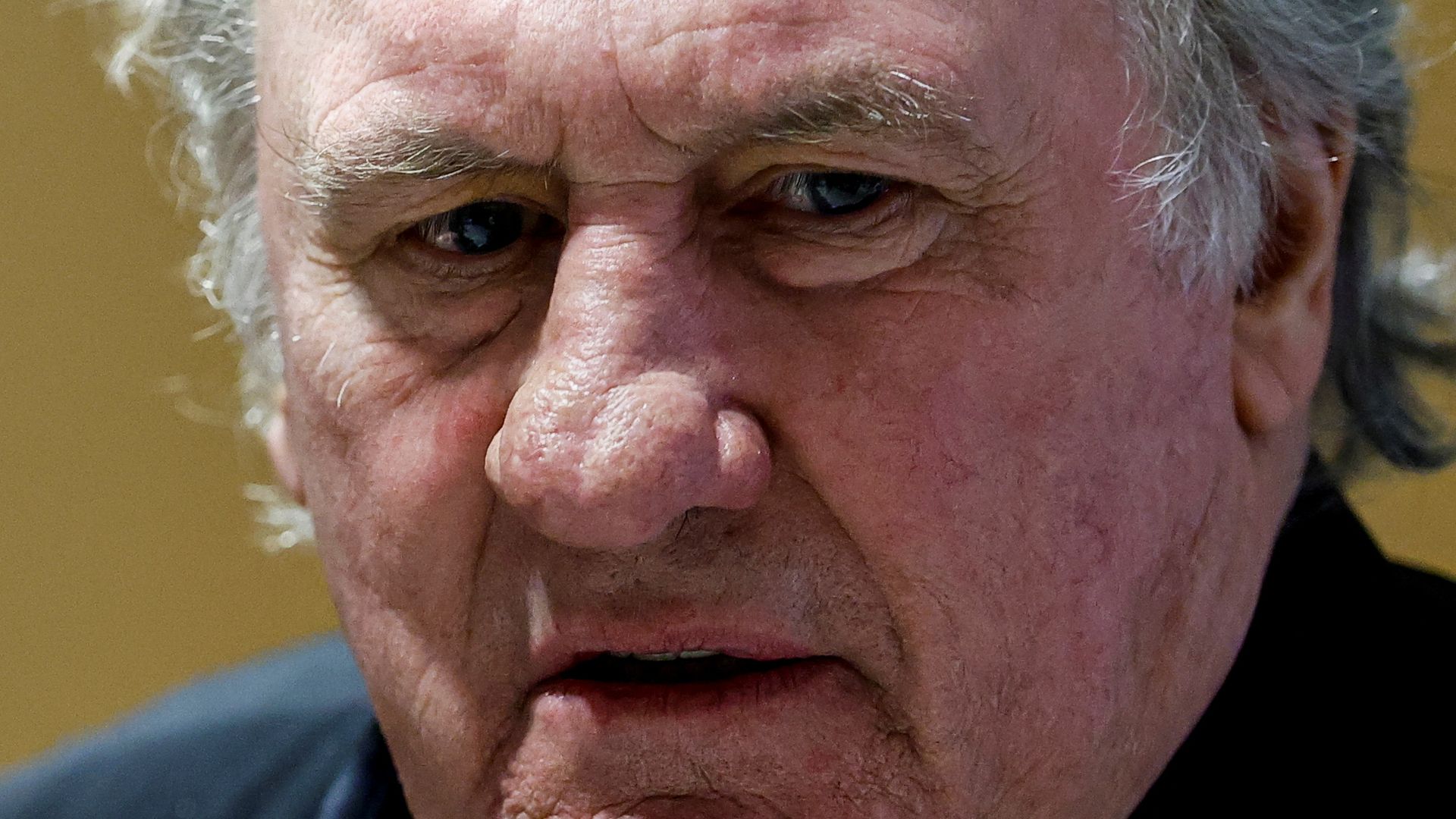
Gerard Depardieu has formally dropped his appeal against his sexual assault conviction and issued a public apology, bringing an abrupt end to a legal battle that has fractured the French film industry for years. By withdrawing the challenge, the 77-year-old actor accepts the guilty verdict handed down by a Paris court regarding misconduct on the set of the 2021 film Les Volets Verts (The Green Shutters). The decision marks a rare moment of accountability for a figure long treated as untouchable by France's cultural establishment, signaling a decisive shift in how power and impunity operate behind the cameras.
For decades, the standard operating procedure in Paris when a major star faced allegations was simple. Deny everything. Hire the most aggressive defense attorneys available. Wait for the media cycle to move on, counting on an unspoken pact of silence among producers, directors, and state funding bodies to keep the work flowing. Depardieu followed that exact playbook until the legal and financial walls closed in too tightly to ignore.
The Anatomy of a Legal Retreat
Dropping an appeal in the French judicial system is rarely an act of pure moral awakening. Usually, it is cold, hard risk management.
Under French criminal procedure, an appeal is not merely a review of potential legal errors made during the initial trial. It is a complete retrial of the facts—a de novo hearing before the Court of Appeal. When a defendant appeals a misdemeanor conviction, the appellate judges have the full authority to examine the evidence all over again, hear new testimony, and, crucially, impose a harsher sentence than the original court handed down.
In May 2025, a Paris criminal court found Depardieu guilty of sexually assaulting two women—a set dresser and an assistant director—during the 2021 shoot of Les Volets Verts. The court handed him an 18-month suspended prison sentence, ordered him to pay financial compensation to the victims, and mandated his inclusion on France's national sex offender registry. At the time, his legal team immediately announced plans to appeal, calling the verdict an injustice driven by media pressure rather than hard evidence.
Yet proceeding to the Court of Appeal carried severe strategic hazards. A second trial would have meant another multi-day media spectacle, dragging every detail of his behavior on set back onto the front pages of Le Monde and Libération. Worse still, prosecutors in appellate hearings frequently cross-appeal, asking the higher court to convert suspended sentences into firm prison time or increase financial penalties if the defendant shows a lack of remorse.
Consider how appellate risk works in a hypothetical scenario involving any high-profile defendant. If a first-instance court hands down a suspended sentence alongside mandatory registration, the defendant retains their physical freedom while carrying a permanent legal stain. Pushing for a retrial gambles that freedom on the hope that a second panel of judges will view witness credibility differently. When the underlying testimony is corroborated by multiple crew members, the odds of a full acquittal drop sharply, leaving the appellant exposed to stricter punishment with very little upside.
By withdrawing the appeal and offering an apology, Depardieu locked in the suspended sentence, avoided another grueling courtroom cross-examination, and attempted to salvage whatever sliver of public goodwill remained.
The Collapse of the Sacred Monster Doctrine
To understand why this case reverberated so violently across Europe, you have to understand the French concept of the monstre sacré—the sacred monster.
In American entertainment, scandal tends to trigger immediate corporate risk aversion. Studios cut ties, agents drop clients, and insurers refuse to underwrite productions because shareholders demand predictable returns. France operates on a fundamentally different cultural and financial model. French cinema is heavily subsidized by the state through the Centre National du Cinéma et de l'Image Animée (CNC), and the industry has historically viewed artists not as corporate employees, but as erratic geniuses whose personal excesses are inseparable from their creative output.
Depardieu was the ultimate embodiment of this archetype. From Cyrano de Bergerac to Jean de Florette, his physical presence and raw talent defined modern French film. For years, crudeness on set was dismissed by executives and co-stars alike as harmless folklore—just Gerard being Gerard.
That protective shield began cracking long before the Les Volets Verts verdict. Investigative reporting by Mediapart brought forward accounts from more than a dozen women describing inappropriate touching and explicit remarks spanning two decades. In late 2023, a documentary broadcast on France 2 showed footage of Depardieu making vulgar, sexualized comments during a 2018 trip to North Korea, even directing remarks toward a young girl riding a horse.
The footage sparked outrage, yet the establishment's initial reflex was still to circle the wagons. President Emmanuel Macron famously went on national television to defend Depardieu, decrying what he termed a "manhunt" against an actor who "makes France proud." Shortly after, dozens of prominent French actors and directors published an open letter in Le Figaro condemning the "lynching" of a giant of cinema.
The backlash to that defense proved to be the turning point. Younger actors, technicians, and feminist groups pointed out the glaring disconnect between the elite's nostalgia for a bygone era and the daily reality of women working minimum-wage crew jobs on film sets. Several signatories of the Le Figaro letter quickly distanced themselves from it once the public reaction turned toxic. For the first time, defending the sacred monster carried a higher social and professional cost than criticizing him.
What the Apology Actually Changes
Public apologies from disgraced celebrities usually land with a dull thud, scrutinized more for what they omit than what they admit. Depardieu's statement is no exception, yet in the context of French law and industry politics, its existence matters.
Throughout the initial investigation and trial, his defense relied heavily on cultural relativism. His lawyers argued that boisterous, tactile behavior and ribald humor were part of his generation's theatrical tradition, claiming that modern sensibilities were retroactively criminalizing harmless banter. They portrayed the complainants as oversensitive or opportunistic.
An apology, however carefully worded by crisis communications specialists, punctures that narrative. You do not apologize for behavior that never happened, nor do you express regret if your actions were entirely benign. Even if the statement stops short of a sweeping confession to every allegation ever leveled against him, it validates the core reality established by the Paris court: that boundaries were crossed and harm was done.
For the two women at the center of the Les Volets Verts case, the withdrawal of the appeal brings tangible relief. Legal proceedings in France move at a glacial pace. Waiting two or three years for an appellate docket keeps victims trapped in a state of suspended animation, forced to repeatedly relive traumatic events while facing intense online harassment. Finalizing the conviction allows the civil damages to be disbursed and closes a chapter that has dominated their lives since 2021.
The Structural Reckoning on French Film Sets
The real story here extends far beyond one actor's tarnished legacy. The Depardieu conviction and subsequent retreat have forced concrete structural changes across an industry that long resisted reform.
When the Les Volets Verts case went to trial, one of the most damning aspects of the testimony was not just what Depardieu did, but how people around him reacted. Witness accounts painted a familiar picture of bystander paralysis. Producers worried about losing their lead actor and triggering catastrophic insurance claims. Directors focused on making their daily shot lists. Crew members feared that speaking up would get them blacklisted from future productions in a tight-knit, freelance economy.
Since the scandal broke, the pressure on institutions has yielded measurable policy shifts:
- CNC Funding Conditionality: The national film board has implemented strict rules tying public production subsidies to mandatory anti-harassment training for producers and key crew members. Productions that fail to establish clear reporting mechanisms risk losing state financial backing.
- Intimacy Coordinators and Set Monitors: Once mocked in Paris as an unnecessary American import, intimacy coordinators and independent on-set compliance officers are becoming standard requirements on major French shoots, particularly when financing involves international streaming platforms like Netflix or Canal+.
- Insurance and Completion Bonds: Film insurers are increasingly treating behavioral misconduct as a material financial risk. If a lead actor's behavior halts production, the resulting delays cost hundreds of thousands of euros per day. Underwriters now scrutinize cast histories and demand strict behavioral riders in contracts.
These changes do not magically erase decades of ingrained hierarchy. A below-the-line technician still holds vastly less leverage than a bankable star or an acclaimed auteur. Yet the legal precedent set by the Paris court removes the primary excuse producers used for years—the claim that nothing could be done because no crime had been proven.
Unresolved Cases and the Limits of Closure
Dropping the appeal closes the book on Les Volets Verts, but Depardieu's legal troubles are far from over. The actor still faces separate, ongoing proceedings stemming from allegations made by actress Charlotte Arnould, who accused him of rape and sexual assault at his Paris home in 2018.
The Arnould case is legally distinct and far more severe. Unlike the Les Volets Verts incidents, which were prosecuted as misdemeanors (délits) in a correctional court, rape is classified as a felony (crime) under French law, carrying potential penalties of up to 15 to 20 years in prison before a criminal assize court. Investigating magistrates have spent years gathering evidence, conducting psychiatric evaluations, and interviewing witnesses in that file.
Furthermore, other complaints filed by women alleging assaults in earlier decades have run into France's statute of limitations, leaving complainants without a path to criminal prosecution even when prosecutors acknowledged the credibility of their accounts. This legal bottleneck highlights an ongoing tension in French jurisprudence: the gap between what society now recognizes as unacceptable abuse of power and what the criminal code can actually punish decades after the fact.
By stepping down from his appeal in the 2021 set assault case, Depardieu has effectively cleared his immediate legal deck to focus on the far greater threat posed by the Arnould indictment, while attempting to lower the temperature in the court of public opinion.
The era in which artistic stature automatically granted immunity from basic workplace standards is dead. For fifty years, French cinema operated on the unspoken assumption that genius excused cruelty, and that the spectacle on screen justified whatever collateral damage occurred behind the lens. A 77-year-old icon quietly signing away his right to appeal proves that the bill has finally come due.