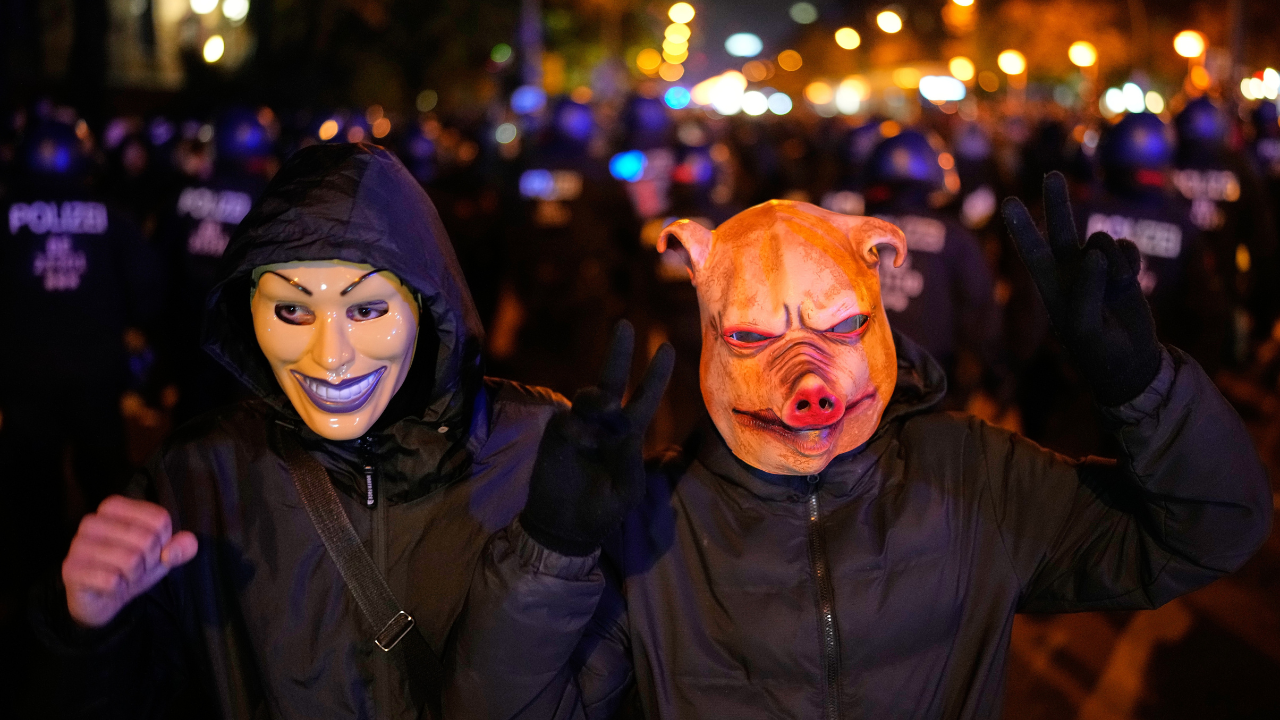
Look at the photos coming out of Berlin, Hamburg, and Munich. Thousands of twenty-somethings marching through the streets in cheap zombie makeup and inflatable dinosaur suits, holding cardboard signs that read GenZ regelt!—"Gen Z handles it."
Mainstream outlets are eating this up. They call it a fresh wave of youth activism. They celebrate the irony, the internet-native humor, and the sheer novelty of young Germans turning political dissent into a Halloween street party. It makes for great B-roll. It generates easy clicks. And it completely misses the point.
If you actually understand how political power works in the Federal Republic of Germany, you do not look at a crowd of costumed protestors and see a rising movement. You see a generation that has mistaken aesthetic performance for structural leverage. You see people trying to defeat an entrenched bureaucratic machine with memes.
I have spent over a decade watching grassroots movements across Europe either seize legislative ground or evaporate into pure noise. The ones that win—from the early anti-nuclear blockades in Gorleben to the disciplined labor strikes of IG Metall—share one defining trait: they impose a direct, unavoidable cost on the status quo. The ones that lose rely on spectacle. They optimize for Instagram algorithms instead of committee votes.
Right now, Germany’s youth movement is choosing the dopamine hit of a viral hashtag over the brutal, unglamorous work of institutional power.
The Seductive Lie of Aesthetic Activism
The lazy consensus among commentators is that Gen Z is "reinventing protest" by stripping away the grim, rigid dogmatism of older generations. According to this narrative, dressing up as a vampire to protest pension reform or climate inaction is a brilliant subversion of traditional politics. It lowers the barrier to entry. It makes civic engagement fun.
That is precisely why it fails.
When you turn a political demand into a costume party, you give the political establishment the exact gift it wants: permission not to take you seriously.
Consider the mechanics of attention in modern media. When 10,000 people march in Halloween costumes, the cameras show up. Journalists write glowing profiles about the cleverness of the cardboard signs. Politicians in the Bundestag issue polite, patronizing statements praising "youth engagement" and "creative expression." And then, on Monday morning, those same politicians pass the exact budget, pension hike, or fossil fuel subsidy they were always going to pass.
Sociologist Zeynep Tufekci nailed this dynamic in her landmark work Twitter and Tear Gas. She demonstrated how digital-era protests scale rapidly because they bypass the slow, grueling process of building organizational infrastructure. A clever slogan spreads in hours. Thousands show up for a single afternoon.
Yet that speed is a trap. Because the movement never had to build real coalitions, negotiate internal compromises, or develop tactical discipline, it possesses zero staying power. It cannot pivot when politicians ignore it. It cannot sustain a strike. It cannot primary a vulnerable incumbent. It is a flash flood—loud, dramatic, and gone by Tuesday.
What GenZ regelt Actually Means in Practice
Let us define our terms clearly. When protestors chant GenZ regelt, they are claiming ownership over the future. They are asserting that where older generations—specifically the Baby Boomers who dominate German demographics—have failed on housing, pensions, digitalization, and climate policy, young people will step in and fix the mess.
It is a great slogan. It is also mathematically impossible under current participation rates.
Look at the demographic reality of Germany. According to the Federal Statistical Office (Destatis), voters aged 60 and older make up nearly 40 percent of the electorate, while voters under 30 account for less than 15 percent. In a representative democracy, politicians respond to one metric above all others: reliable turnout at the ballot box and sustained pressure within party structures.
Imagine a scenario where a Member of the Bundestag (MdB) in a contested district has to choose between two policies. Policy A protects the triple-lock pension system that benefits 25,000 reliable older voters in their constituency. Policy B redirects billions toward youth housing subsidies and green infrastructure, backed by 3,000 students who showed up to a Halloween march in Berlin-Mitte but rarely vote in local municipal elections.
Which way does that politician vote? Every single time, without hesitation, they vote for Policy A.
The costume protest does not alter that calculus by a single millimeter. In fact, it reinforces the stereotype that young voters are transient, unserious, and easily distracted. You cannot meme your way past a demographic wall.
Dismantling the Myths Around Youth Protest
Whenever someone criticizes the tactics of modern youth movements, the same predictable defenses emerge. Let us dismantle them directly.
Does viral visibility force politicians to act?
No. Visibility is not leverage. In the 20th century, visibility was scarce; getting on the evening news meant you had achieved a level of disruption the state could not ignore. Today, visibility is infinite and cheap. Every niche interest group trends on social media every week. Politicians have developed complete immunity to viral outrage because they know the internet's attention span resets every 48 hours. Unless visibility is tied to a credible threat—a boycott, a general strike, a coordinated voter registration drive in swing districts—it is just free entertainment.
Isn't humor and irony the best way to reach apathetic young people?
Humor gets people to show up once. It does not keep them in the room when the work gets boring. Real political change happens in smoky municipal council meetings, party youth wings, labor union committees, and neighborhood tenant associations. Nobody wears an inflatable T-Rex costume to a four-hour zoning board hearing in Frankfurt. If you recruit people using the promise of a party, they will leave the moment the music stops.
Aren't these protests raising awareness about generational injustice?
Everyone in Germany is already painfully aware of generational injustice. Every young worker knows their pension contributions are funding a system that will barely exist when they retire. Every student in Munich or Cologne knows rent eats half their income. Raising awareness for a problem everyone already experiences is redundant. The missing ingredient is not awareness; it is power.
The Uncomfortable Downsides of the Hard Path
Let me be completely honest about the alternative I am proposing, because it is neither glamorous nor easy.
If young Germans actually want to regeln—to take control and fix the structural decay of their country—they have to abandon the street spectacle and enter the trenches of institutional politics. And that path comes with massive, frustrating downsides.
First, it is excruciatingly slow. Joining a political party—whether the Greens, the SPD, the FDP, or the CDU—means spending years dealing with petty internal rivalries, rigid hierarchies, and glacial bureaucracy before you ever get near a legislative lever. You will lose most of your early votes. You will be patronized by party elders who have held the same local chairmanship since 1998.
Second, it requires ideological compromise. A Halloween march lets everyone hold their own personalized sign with their own pure, uncompromising demand. Building a winning political coalition requires sitting down with people you dislike—unionized factory workers worried about energy costs, rural voters who need cars, small business owners choking on regulation—and hammering out deals that leave nobody 100 percent satisfied.
Third, you lose the cultural cool factor. Nobody gets 50,000 likes on TikTok for posting a spreadsheet of municipal housing permits or a summary of an amendment to the federal pension formula. You trade social media clout for actual influence. Most people are unwilling to make that trade.
How to Actually Break the Status Quo
If I were advising the organizers behind these marches—and I have worked with enough advocacy groups to know which ones actually move legislation—I would tell them to pack up the costumes immediately and execute four ruthless, unsexy moves.
1. Hijack Local Party Associations
German political parties are starving for active ground-level members. In hundreds of local chapters (Ortsvereine), a coordinated group of 30 disciplined twenty-somethings can literally show up to an annual general meeting, outvote the existing board, and take control of the local nomination process. Instead of marching outside the Reichstag, take over the machinery that decides who gets to sit inside it.
2. Weaponize Single-Issue Swing Voting
Stop allowing political parties to take your vote for granted or write you off entirely. Form a strict, non-partisan youth voting bloc focused on three concrete metrics: housing construction deregulation, pension reform, and infrastructure modernization. Publish a brutal scorecard before every state and federal election. Make it clear that you will ruthlessly punish any party—regardless of its climate rhetoric—that fails on those three numbers.
3. Shift From Marches to Economic Disruption
A weekend march in a costume costs the state nothing. In fact, local cafes and transit systems make money off the foot traffic. Look at how German train drivers (GDL) or farmers extract concessions from Berlin: they shut down critical arteries on weekday mornings. If students, apprentices, and young service workers organized coordinated weekday walkouts that halted university operations, logistics hubs, and retail centers, the tone in the Chancellery would change overnight.
4. Master the Boring Mechanics of Policy
Stop chanting slogans and start drafting model legislation. The most effective advocacy groups in Berlin—from industry lobbies to seasoned environmental NGOs—succeed because they hand overworked lawmakers ready-to-use legal text, backed by airtight fiscal math. When you bring a politician a fully costed proposal to reform real estate transfer taxes for first-time buyers, you stop being a protestor and start being a stakeholder.
The Choice Between Clout and Power
History is littered with youth movements that mistook cultural dominance for political victory. In the late 1960s, millions of young people across Europe owned the music, the fashion, the universities, and the streets. Yet when the smoke cleared, the conservative institutions they mocked simply absorbed their aesthetics, repackaged their rebellion into consumer products, and kept right on governing.
Germany does not need another clever protest. It does not need better cardboard signs, funnier costumes, or more viral recaps on social media. The country is facing a historic convergence of demographic collapse, industrial stagnation, and crumbling infrastructure. Those problems do not care about your irony.
Either young Germans put away the masks and start the slow, brutal work of seizing institutional power, or they will spend the next forty years paying the bills written by the people who actually showed up to govern.