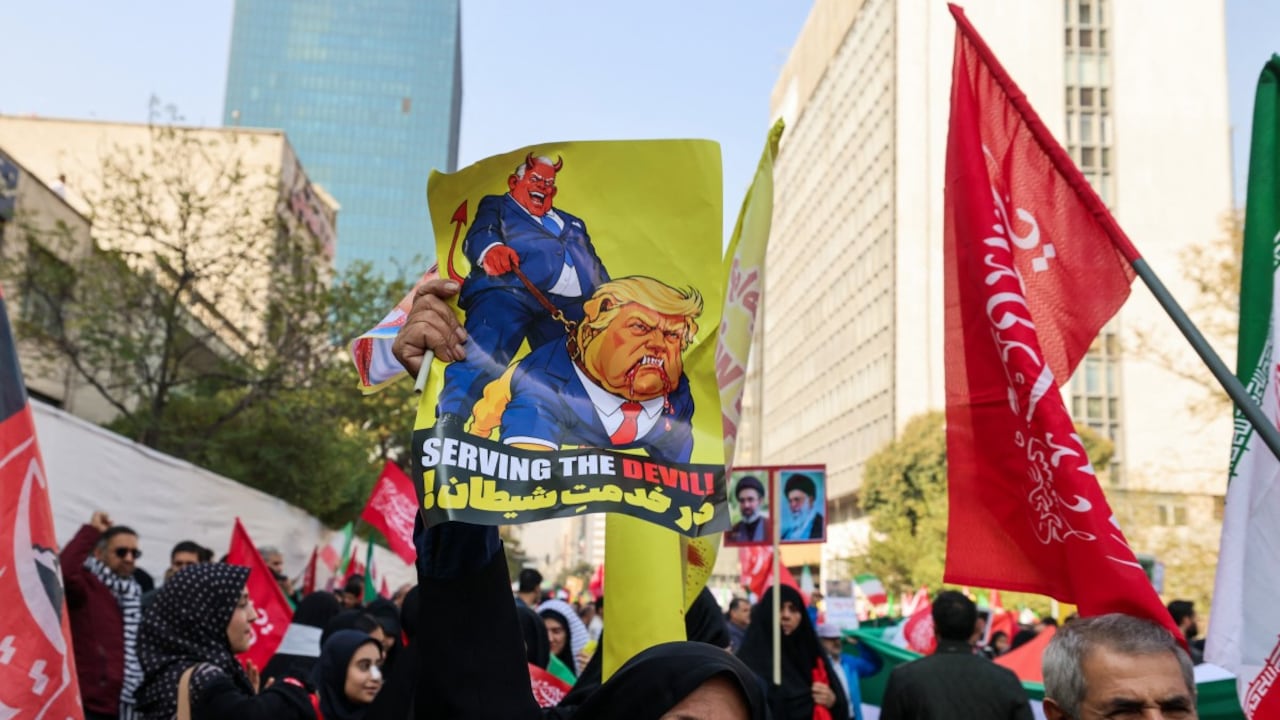
The coffee in a third-floor walk-up in northern Tehran tastes different when the television is muted. You can still see the red banners scrolling across the bottom of the screen, the grainy footage of American precincts closing, the sharp-suited anchors gesturing at maps turning blue.
Silence.
For Darius, a hypothetical composite of the millions of mid-level Iranian engineers watching their savings evaporate over the last two years, that silence isn't peaceful. It is the sound of holding your breath while two giants wrestle over your roof. When Iranian state media declared that Tehran had handed Donald Trump a "political defeat" in Washington following the American midterm rout, Darius didn't cheer. He checked the black-market exchange rate for the rial on his phone.
To understand why a ballot cast in Ohio or Pennsylvania makes a teacup rattle in Isfahan, you have to strip away the podium rhetoric. Standard news reports treat geopolitics like a scoreboard. One side loses the House of Representatives; the other side claims a tactical victory from seven thousand miles away. That framing misses the blood and bone of the story. When Iranian officials—from the Foreign Ministry to the hardline press—stepped forward to claim credit for surviving Washington's "maximum pressure" campaign and watching the American electorate rebuke the White House, they weren't just gloating. They were executing a psychological maneuver aimed at two very different audiences at the exact same time.
The Architecture of Patience
Think of modern economic warfare not as a sword fight, but as a winter siege. One army builds a wall of sanctions, cutting off oil tankers, freezing central bank assets, and strangling trade routes. The besieging general expects the city gates to open within months, driven by hunger and panic.
The defenders, however, have a different clock. They don't need to defeat the army outside the walls; they only need to outlast the general's political term back home.
This is the exact thesis Iranian officials laid out in the wake of the midterm results. In the dry language of diplomatic cables, Tehran argued that Washington's unilateral withdrawal from the 2015 nuclear accord and the subsequent reimposition of crushing sanctions failed to achieve their core objective—forcing Iran back to the table on American terms or triggering internal collapse. Instead, by the time American voters went to the polls, the Democratic Party had reclaimed control of the House of Representatives, fracturing the unified Republican front that had backed the administration's aggressive posture.
Wait. Did Iranian diplomats actually walk into voting booths in suburban America? Of course not. Even Tehran's most brazen commentators don't claim to have hacked the electorate. The "political defeat" Iran speaks of is structural, rooted in the sheer exhaustion of unilateralism.
I remember sitting in a cramped briefing room in Vienna years ago during the marathon nuclear talks, watching diplomats age in real time under fluorescent lights. Even then, the seasoned negotiators understood a fundamental truth about American foreign policy: its greatest vulnerability isn't a lack of power, but a lack of continuity. Every two years, the tectonic plates shift. Every four years, the entire map can be redrawn. Iranian leadership has built its entire survival strategy around that calendar. When the midterm results rolled in, stripping the White House of a rubber-stamp legislature, Tehran saw confirmation that its strategy of "heroic flexibility" mixed with stubborn endurance had survived the first major storm.
What Happens Inside the Walls
It is easy to analyze grand strategy from a leather armchair in Washington or a studio in London. It is much harder when you are trying to buy imported insulin in a pharmacy off Valiasr Street.
Let's be honest about the numbers, because numbers don't care about political spin. In the months leading up to the American midterms, the Iranian economy contracted sharply. Inflation surged past thirty percent. The national currency lost more than half its value against the dollar, turning middle-class retirements into pocket change overnight. The International Monetary Fund projected deepening recession as European companies—terrified of secondary American sanctions—packed their bags and abandoned billions of dollars in planned investments.
When Foreign Minister Mohammad Javad Zarif or President Hassan Rouhani addressed the public, framing the American midterm outcome as a blow to Washington's isolation of Iran, they were speaking directly to the anxiety inside their own borders.
Imagine running a household where the roof is leaking, the pantry is half-empty, and the neighbors are whispering that the house is about to be condemned. As the head of that household, you walk into the kitchen holding a newspaper showing that the landlord who raised your rent just lost his seat on the town council. Does that fix the leak today? No. Does it put bread on the table tonight? Not immediately. Yet it changes the atmosphere in the room from terminal despair to stubborn hope.
Tehran needed its domestic population—and its skeptical trading partners in Europe, Russia, and China—to believe that the American pressure campaign had hit its ceiling. By labeling the midterms a defeat for Trump, Iranian officials were telling the world: The storm has peaked. Do not panic. The man driving the sanctions bus just lost his steering wheel.
The Myth of the Monolith
Here is where the story gets uncomfortable, and where both Western hawks and Iranian hardliners tend to oversimplify reality.
If you listen solely to Washington's narrative, sanctions are a surgical tool designed to punish a regime while sparing the people. That is a comforting fiction, and anyone who has watched sanctions play out on the ground knows it is false. Sanctions act like a thick blanket thrown over an entire society; the people with the best connections and the deepest pockets always find a way to breathe near the edges, while ordinary citizens suffocate in the middle.
Conversely, if you listen solely to Tehran's triumphalism after the midterms, you would think the American political shift solved Iran's problems. That, too, is an illusion.
Consider what actually happens when power splits in Washington. A Democratic House of Representatives certainly creates friction for a Republican White House. It brings oversight hearings, subpoena power, and fierce resistance to any march toward direct military confrontation in the Persian Gulf. For Tehran, that reduction in the immediate threat of war is massive. A divided Washington is far less likely to greenlight a kinetic strike.
Yet on the economic front, a divided Washington rarely means sanctions relief. In American politics, voting to lift penalties on Tehran is radioactive, regardless of which party holds the gavel. Even lawmakers who fiercely opposed the withdrawal from the nuclear deal found themselves hesitant to spend precious political capital defending trade with Iran when domestic battles over healthcare, judges, and investigations consumed all the oxygen on Capitol Hill.
So why did Tehran celebrate so loudly?
Because in international politics, perception is half the currency. When European leaders saw the American electorate push back against the White House, it emboldened Brussels to continue building alternative payment mechanisms—special financial channels designed to keep legitimate trade flowing with Iran without touching the U.S. dollar. Even if those mechanisms moved at a glacial pace, their mere existence proved that Washington's diplomatic isolation was incomplete. Tehran didn't need the U.S. Congress to repeal a single sanction to claim a win; it only needed the rest of the world to doubt Washington's permanence.
The Invisible Chessboard
There is a dangerous trap in reading headlines about "defeats" and "victories" in the U.S.-Iran standoff. It tricks us into thinking this is a game with a final whistle.
It isn't. It is an endless series of adjustments, feints, and endurance tests.
When Iranian officials pointed to the midterms as proof that Washington's policies were failing, they were also fighting an internal battle at home. Inside Iran, pragmatic politicians who had staked their careers on diplomacy with the West were bleeding credibility. Hardline factions—those who had argued all along that America could never be trusted—were circling like sharks. For the pragmatists in Tehran, the American midterm results were an oxygen tank. They could point to the shifting American electorate and argue that patience, rather than nuclear escalation, would eventually yield results.
Look closely at the timing. Had Iran immediately restarted its high-level uranium enrichment or expelled international inspectors in a fit of rage, it would have handed the White House the exact crisis needed to rally the world back into an anti-Iran coalition. Instead, Tehran waited. It absorbed the economic blows, let the calendar turn to November, and watched American domestic politics do the work of restraining the executive branch.
That is the cold, unsentimental brilliance of asymmetric statecraft. When you cannot match your opponent's aircraft carriers or financial dominance, you turn their own democratic volatility into your shield. You make time your ally.
The Weight of the Unfinished
Back in that third-floor apartment in northern Tehran, Darius eventually turns the volume back up on the television. The American pundits are still arguing over suburban voting margins and turnout models in states he has never visited.
He closes his banking app. The rial hasn't magically recovered overnight. The price of meat at the corner butcher shop hasn't dropped by a single toman. His sister, a pharmacist in Shiraz, still has to call three different distributors every morning just to secure basic blood pressure medication for her elderly neighbors.
Across the ocean, in a quiet town in Pennsylvania, a voter who cast a ballot out of frustration over local healthcare costs or the tone of national politics goes to sleep without giving a single thought to the Persian Gulf. They have no idea that their local frustration was just harvested, packaged, and broadcast across state television in Tehran as proof that an empire is stumbling.
This is the strange, unsettling intimacy of our connected world. A domestic tremor in one hemisphere becomes a geopolitical lifeline in another. Leaders in Tehran can stand behind microphones and declare a political defeat in Washington, and in the narrowest, sharpest sense of diplomatic survival, they have a point—they outlasted the maximum pressure blitz without folding.
Yet standing in the kitchen as the water boils for tea, watching the steam fog the window against the cool November night, you realize that survival and victory look very different depending on which side of the wall you live on. The banners on the screen keep scrolling, declaring winners and losers in bold red letters, while down on the street, the lights of the city flicker on one by one, waiting to see who blinks first in the dark.