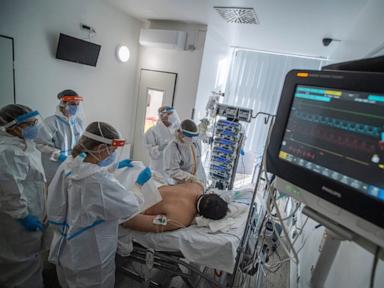
Paper trails do not bleed. They do not smell like antiseptic or fear. They do not carry the heavy, stagnant weight of an intensive care ward at three in the morning, when the monitors hum their flat, terrifying songs and families wait in the dark for a phone call that might shatter their universe.
Instead, official documents are clean. They are stamped in blue ink. They feature neat rows of figures, neat little decimals, and clean zeros that stretch out across the page until the mind stops registering the true magnitude of what those numbers represent.
Nearly one billion dollars.
Say it out loud. Let the syllables settle. It sounds like an abstraction. It sounds like a line item in an institutional ledger owned by people who measure success in quarterly yields and sovereign risk assessments. But behind that sum sits a specific kind of wound. That money was not born in a vault. It was pulled from public coffers during a global catastrophe, sliced out of tax receipts paid by bakers, mechanics, teachers, and nurses who were currently being told to lock their doors and wait out the plague.
Money meant for breath. Money meant for defense.
When a government files a criminal complaint over a staggering nine-hundred-and-sixty-five-million-dollar COVID-19 procurement deal, citing the ominous legal architecture of possible fraud, the media will treat it like politics. They will talk about shifting alliances, legal maneuvers, and the slow grind of prosecutors reviewing files in gray offices. They will miss the human tragedy entirely.
Let us fix that lens.
The Architecture Of Panic
Imagine the spring of twenty-twenty.
The air outside feels different. It feels thin, suspicious. Cities that used to pulse with the chaotic rhythm of millions of footsteps have emptied out into ghost towns overnight. Sirens wail down empty boulevards. Inside government ministries across Europe, the panic is absolute. Phones are ringing off the hook. Fax machines spit out desperate pleas from hospital directors who are watching their storage rooms empty down to the last cardboard box of latex gloves.
There are no masks. There are no ventilators. There is only a terrifying, invisible wave rolling across borders, and every nation on earth is suddenly trapped in a global knife fight for medical supplies.
In that room of sweating bureaucrats and frantic ministers, time loses its shape. Normal oversight protocols, the boring, agonizing checks and balances designed to keep public money safe from thieves, start to look like obstacles. Bureaucracy kills, people whisper. We need agility. We need speed. We need to wire the money now, or people die tonight.
That is the exact moment the predators smile.
Fraud thrives in the fog of war. And a pandemic is a war where the enemy is microscopic and the battlefield is everywhere. When the urgency reaches a fever pitch, due diligence becomes the first casualty. Contracts are signed with intermediaries whose offices turn out to be mail drops. Prices are multiplied by ten, twenty, fifty.
Think about what a billion dollars looks like when it moves through shell companies. It does not look like bags of cash dropped off in alleys. It looks like wire transfers executed with the click of a mouse. It looks like invoices for millions of items that never quite arrive, or arrive late, or turn out to be substandard junk bought off the discount shelf of a global warehouse.
The Anatomy Of The Deal
Let us look closely at how these things happen, not through dry legal briefs, but through the mechanics of human deception.
When a state apparatus panics, it loses its memory. It forgets that middlemen exist precisely to skim margins while adding zero value to the physical reality of a product. Imagine a hypothetical broker named Thomas. Thomas has never sold a medical ventilator in his life. Last month, Thomas was brokering commercial real estate or luxury cars. But today, Thomas has an email address, a newly incorporated offshore entity registered in a tax haven with lax disclosure laws, and a friend of a friend who claims to know a manufacturer somewhere in East Asia.
Thomas does not manufacture anything. Thomas does not test anything. Thomas simply sits in the middle of the communication chain, marking up the price of a life-saving machine by three hundred percent, and demands payment upfront. Escrow? Unnecessary, Thomas says. The market is moving too fast. If you don't wire the funds in the next two hours, another buyer will take them.
The official, terrified of being blamed for a shortage in the morgues, signs off.
The money moves.
And then, the silence begins. Weeks pass. The delivery date arrives and goes. The phones at Thomas’s shell company ring out to an automated voicemail. The address listed on the incorporation documents is a shared desk in a nondescript office building where the receptionist has never heard of Thomas or medical procurement.
Multiply that single, stomach-churning realization by nearly a billion dollars.
That is what Budapest authorities are digging through now. They are tracing the digital ghosts of transactions executed during humanity's darkest hour, trying to claw back public wealth that was siphoned away while doctors were taping garbage bags around their arms for lack of proper personal protective equipment.
The Cost Of Institutional Amnesia
We are terrible at remembering how terrifying those early months felt. We want to close the book on the pandemic era, to shove it into the attic of history and pretend we emerged from it wiser and stronger.
We did not. We emerged from it exhausted, cynical, and deeply exposed.
When massive procurement corruption is uncovered years after the fact, the public response is usually a tired shrug. Corruption is old news. Politicians steal, bureaucrats look the other way, and the system absorbs the shock while ordinary taxpayers foot the bill through higher levies and slashed public services.
That cynicism is dangerous. It is corrosive. Every time a nearly billion-dollar fraud case surfaces, it deposits another layer of poison into the well of public trust. How can you ask a citizen to sacrifice, to obey public health guidelines, to pay their taxes honestly, when they suspect that the very people sworn to protect them were treating a global plague as a golden opportunity for private enrichment?
It creates a profound moral injury.
Physical injuries heal with stitches and time. Moral injuries rot from the inside out. They make people cynical about democracy. They make them vulnerable to demagogues who promise to burn down the entire administrative apparatus because the current one looks like a feeding trough for the connected and the corrupt.
The Long Tail Of Accountability
Investigations like the one unfolding in Hungary are agonizingly slow. They require forensic accountants to spend years chasing digital breadcrumbs across international jurisdictions, untangling layers of shell corporations designed specifically to frustrate law enforcement.
Skeptics will ask why it took this long. They will point fingers and score cheap political points. But the truth is that untangling financial fraud of this scale is like performing surgery in the dark. Every document must be authenticated. Every bank account must be subpoenaed across multiple international borders where cooperation is often sluggish or hostile.
Yet, the filing of this criminal complaint matters. It matters profoundly.
It sends a message, however belated, that the statute of limitations on disaster profiteering does not expire just because the emergency has faded from the front pages. It tells the predators who thought they could hide behind the chaos of a dying world that their paper trails are still visible, glowing faintly in the dark like dying embers.
We need more than audits. We need consequences that match the scale of the betrayal. Because when you steal from a hospital during a plague, you are not just committing a white-collar property crime. You are stealing air. You are stealing time. You are stealing the fragile thread of human survival itself.
The prosecutors in their quiet offices have a massive job ahead of them. The ledgers are long, the defenses will be litigious and fierce, and the road to actual recovery will be littered with legal roadblocks. But every step they take toward dragging those hidden transactions into the sunlight brings us closer to a reckoning.
The pandemic is over. But the invoice has finally arrived.


