Seventy-two winters have come and gone since the sky over the Korean Peninsula swallowed a machine and turned thirty-five men into ghosts.
Ice freezes the marrow in a matter of minutes out there on the dark, unforgiving waters of the Yellow Sea. You learn that quickly if you spend enough time listening to the old-timers who still map the coordinates of missing echoes on salt-stained charts. They do not talk about geopolitical strategy when they gather in damp coastal rooms. They talk about the wind. They talk about the fog that rolls off the Manchurian mountains like breath on a cold windowpane. And they talk about the silence.
For more than seven decades, that silence has been absolute.
Consider what happens next: a sonar ping slices through pitch-black currents two hundred feet beneath the surface, bouncing off something metallic and unnatural. It is not a rock. It is not a reef. It is a fuselage, bent and broken, wearing seventy years of marine growth like a shroud.
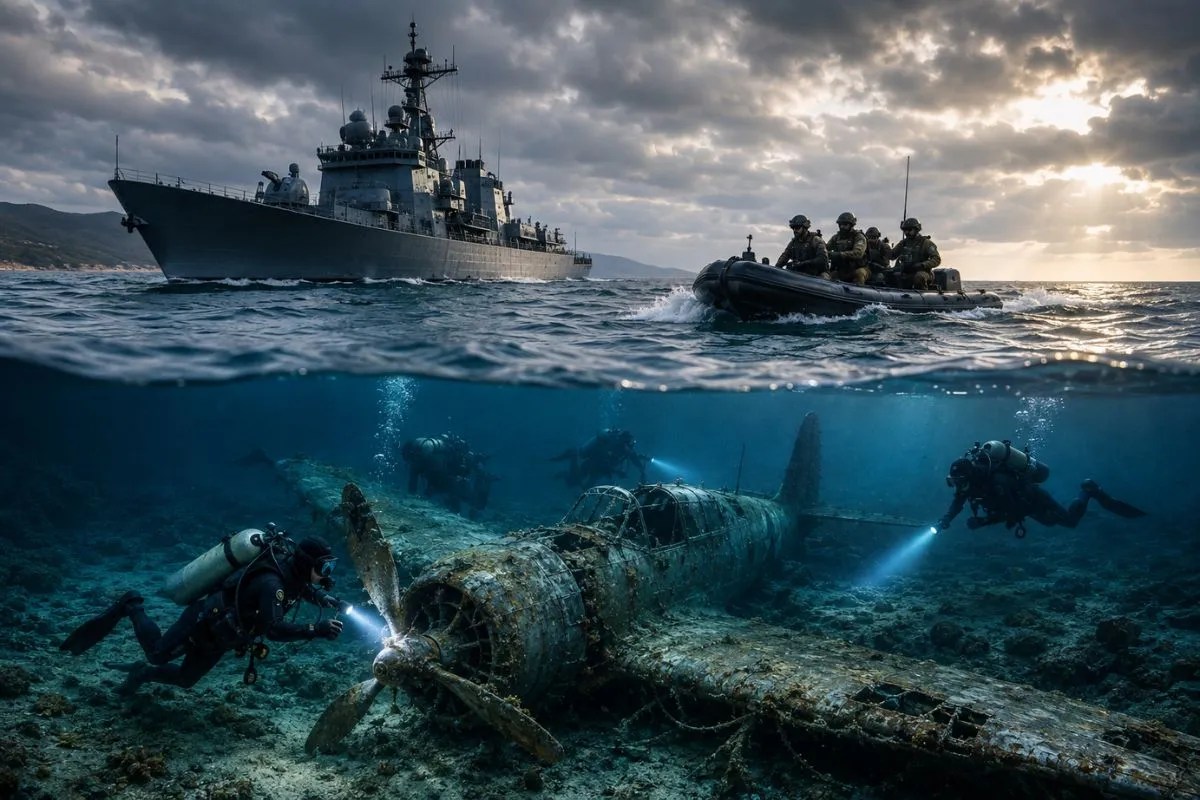
This is the reality of the joint underwater search operation launched by the United States and South Korea. It is an extraordinary convergence of high-tech marine archaeology and raw, stubborn human grief. To understand why nations are spending millions of dollars to dredge the ocean floor for a wreckage so old that most of the families who wept for it have turned to dust, you have to look past the military communiques. You have to look at the empty chairs.
War has a way of finishing its bloody work on the battlefield, but its administrative cruelty lingers in filing cabinets for generations. We treat missing-in-action designations like bureaucratic ledger entries, neatly categorized rows of personnel numbers and date-of-loss stamps. But every single one of those numbers represents a pair of boots left unpolished, a letter half-written on a wooden bunk, a photograph tucked safely inside a leather wallet that dissolved in the brine decades ago.
Imagine a young pilot in the winter of 1952. Let us call him Thomas, though his real name lives on a bronze plaque in a quiet municipal park somewhere in the Midwest. He was twenty-two years old, old enough to fly a heavy transport aircraft through freezing squalls, young enough to still believe that the world made a coherent kind of sense. On a standard supply mission, his aircraft vanished. No distress call. No fiery trail across the morning sky. Just an abrupt, terrifying cessation of existence. One second, he was a living, breathing human being worrying about a letter from home; the next, he was a meteorological footnote.
When planes drop out of the sky over land, search parties can comb the tree lines, turning over leaves and soil until they find closure. When they fall into the sea, the ocean swallows the evidence with cold indifference. The currents tear the aluminum apart. The tides drag the pieces miles away from their initial point of impact. Silt buries the remains until the ocean floor looks like any other desolate, rolling desert of mud.
That is why the current underwater search operation is nothing short of a miracle of stubbornness.
Modern marine technology has evolved past the days of dragging clumsy hooks behind diesel-chugging cutters. Today, autonomous underwater vehicles glide silently through the deep, scanning the seabed with side-scan sonar and high-definition optical cameras. They map the topography of the abyss in microscopic detail, looking for the telltale geometric angles of a man-made wing or the jagged tear of a propeller blade.
Yet, technology only gets you to the threshold. The rest is pure, grinding human endurance.
Divers and researchers work in conditions that defy comfort. Down there, visibility is often measured in inches. The water is dense, freezing, and heavy with the weight of an entire sea pressing down from above. Every square inch of silt brought to the surface is carefully sifted through fine mesh screens, looking for fragments of bone, a wedding band, a uniform button, anything that can tether an anonymous statistic back to a human name.
Critics occasionally ask why we bother. They point to the staggering financial cost. They point to the immense span of years, arguing that the dead are beyond caring and the living have long since aged and passed away. They suggest that memory alone should be monument enough.
They miss the point entirely.
Nations are measured not merely by their economic output or their tactical dominance, but by the promises they make to the people they send into the fire. A military oath is not a transactional agreement that expires when the engine fails or the treaty is signed. It is an eternal contract. It carries an unspoken clause: if you fall, we will not leave you to the dark. We will look for you until we find you. We will bring you home.
When a government abandons its lost, it breaks that contract. It signals that human lives are disposable commodities, useful only until the utility runs out. By continuing to search for a missing aircraft seventy-two years after it plummeted into the icy depths, the United States and South Korea are making a profound statement. They are declaring that time has no jurisdiction over loyalty. They are proving that an individual human life matters just as much today, in an era of supersonic jets and digital surveillance, as it did in the smoky, brutal winters of the Korean conflict.
Consider the descendants walking along the rocky shores of Busan today. Many of them never met the uncles, grandfathers, or great-uncles whose names echo down their family trees. They grew up in houses haunted by a photograph on the mantelpiece, a man frozen forever in his twenties, smiling blindly into a camera lens while the world burned around him. They carry an inherited ache, a hollow space where a family member should have been.
When a recovery team finally matches a DNA sample from a recovered fragment to a living relative, something shifts in the universe. The ghost is finally allowed to rest. The family receives not just remains, but narrative closure. The story of a life interrupted is finally permitted a proper ending.
The ocean remains deep, dark, and indifferent. It guards its secrets fiercely, hiding the rusted bones of history beneath miles of heavy water and shifting sand. But every sonar sweep, every recovered rivet, and every identified fragment is a direct act of defiance against that indifference.
Out there on the cold sea, the searchlights cut through the murk. Down in the blackness, the past refuses to stay buried.