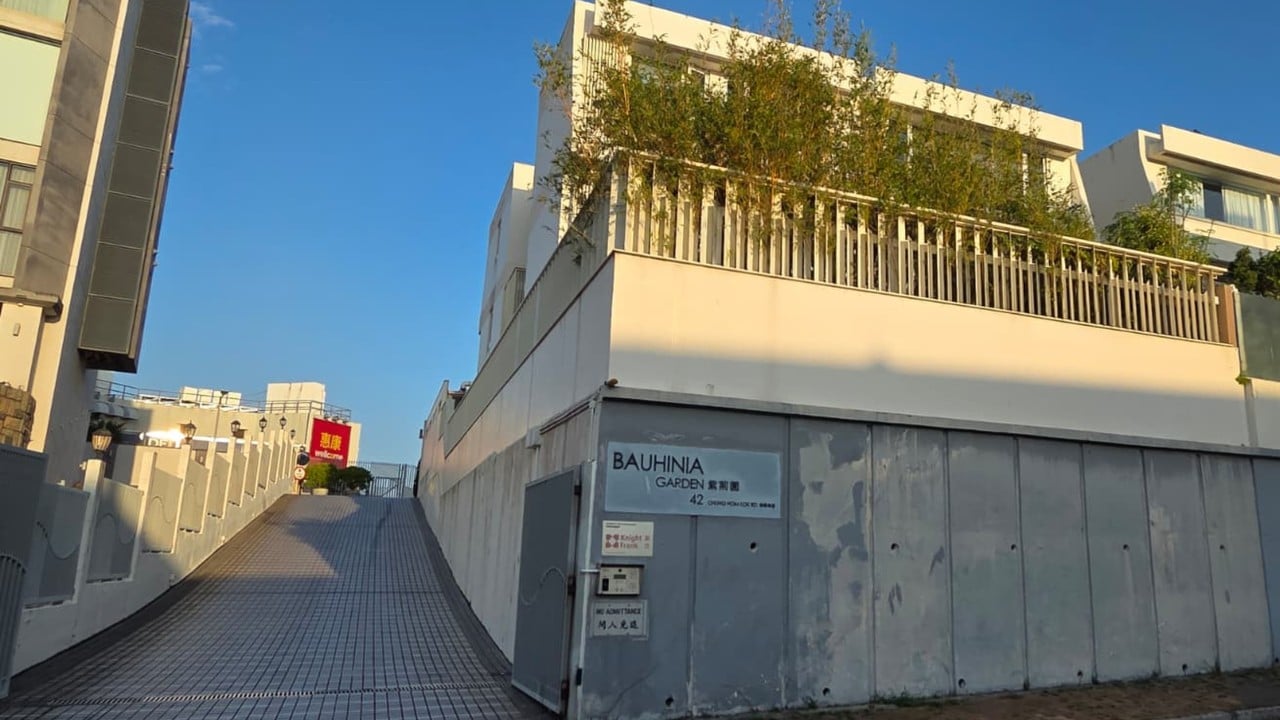
Silence in the Southern District of Hong Kong does not sound like empty space. It sounds like money. It is the low, steady hum of concealed climate-control vents behind teak cabinetry, the soft click of a custom-milled brass latch, and the distant, muffled sigh of the South China Sea rolling against the rocks below Repulse Bay. People buy homes in this pocket of Hong Kong Island—tucked along winding coastal roads where tropical banyan trees hang over limestone walls—specifically to purchase that silence. They pay tens of millions of dollars for the privilege of believing the outside world cannot reach them.
Then someone pries open a window. Meanwhile, you can explore related stories here: Stop Blaming Lazy Bureaucrats When City Departments Pass the Ball on Safety Complaints.
When reports broke that the Hong Kong police were investigating a staggering HK$40 million jewellery theft from a residential flat in the Southern District, the standard news dispatches treated it like a tidy ledger entry. Forty million Hong Kong dollars—roughly US$5.1 million—vanished from a private residence. Detectives from the regional crime unit arrived. Forensic teams dusted for prints. An investigation was underway.
Read the dry facts, and your brain registers a big number, feels a brief flicker of curiosity, and moves on to the weather or the Hang Seng Index. To explore the full picture, we recommend the detailed report by Al Jazeera.
That reaction misses everything. To understand what actually happens when a fortune in gems disappears from a quiet hillside flat, you have to step past the police tape and look at the invisible architecture of trust, memory, and vulnerability that shatters the moment a lock gives way.
The Architecture of an Illusion
Consider a hypothetical resident of this exact neighborhood—let’s call her Elena, a composite drawn from the real families who call the Southern District home. Elena is not a movie-villain billionaire lounging on a yacht. She is a second-generation textile executive who spent thirty years waking up at five in the morning to negotiate shipping manifests and factory leases across the Pearl River Delta.
When Elena opens her safe, she does not see a spreadsheet of appraised market values. She sees the jadeite bangle her grandmother smuggled out of Shanghai in a lining of winter wool in 1949. She sees the three-carat Burmese ruby ring her late husband bought with his first real bonus in 1988, its setting slightly worn down on one side from thirty-five years of resting against her steering wheel. She sees the heavy gold dragon-and-phoenix bangles gifted at her daughter’s wedding, stored in red silk boxes that still smell faintly of sandalwood incense.
On a police report, those items become cold nouns and cold numbers. One jadeite bangle. One ruby ring. Assorted gold ornaments. Total estimated loss: HK$40 million.
In reality, a burglary of this scale is an amputation of personal history. You can insure a diamond for its replacement cost at Sotheby’s, and an underwriter in Central will eventually wire funds to cover the carat weight and clarity grade. Nobody can underwrite the specific microscopic scratch on the underside of a watch case caused by a child’s baby tooth, or the exact weight of a pendant that rested against a mother’s collarbone through decades of grief and celebration.
I know the cold nausea of coming home to an violated threshold. Years ago, my own apartment was broken into while I was away for a weekend. My losses were trivial compared to a Southern District fortune—a secondhand laptop, a jar of foreign coins, a silver cufflink my father gave me before I left for college. Yet for six months afterward, every time I put my key into the deadbolt, my heart hammered against my ribs like a trapped bird. I checked the closets before taking off my shoes. I stared at the scuff mark on the doorframe where the crowbar had bitten into the wood, realizing that a stranger had stood in my bedroom, breathing my air, rifling through my underwear drawer with unwashed hands.
Multiply that violation by forty million dollars, and place it inside a sanctuary built specifically to feel impregnable. That is the real story unfolding behind the gates of Hong Kong’s most affluent southern coastline.
How a Fortress Fails
To understand how thieves walk away with HK$40 million in one of the world’s most heavily policed cities, you have to understand the unique geography of the Southern District.
Unlike the dense, vertical canyons of Kowloon or the neon-lit grid of Wan Chai—where thousands of eyes and street-level cameras watch every sidewalk—the Southern District is defined by topography and foliage. Roads like Deep Water Bay Road, Island Road, and the winding spurs above Stanley curve sharply around steep, jungle-covered hills. Luxury low-rises and townhouses sit terraced into the slopes, separated from one another by dense thickets of bamboo, drainage channels, and steep retaining walls.
In security terms, privacy is a double-edged sword. The exact features that keep paparazzi, delivery vans, and curious pedestrians away also give a patient intruder cover.
Think of a high-end residential flat not as a bank vault, but as a medieval castle that forgot to watch its orchard. Front entrances in these complexes are heavily fortified. There are uniformed guards at the main gate, keycard-operated elevators, intercoms, and closed-circuit cameras covering the lobbies and underground carparks. If you walk through the front door without authorization, you are caught on high-definition video within three seconds.
Seasoned burglary syndicates rarely use the front door.
Instead, they study the back slope. In Hong Kong, professional housebreaking crews—often operating with terrifying athleticism—use the hillside catchwaters, overgrown trees, and exterior drainage pipes as vertical highways. They wait for the specific window of vulnerability that every wealthy household creates without realizing it: the evening dinner hour, a weekend trip to Tokyo, or a public holiday when domestic staff are off duty and the flat sits empty between seven and eleven at night.
Once an intruder reaches a second- or third-floor balcony, the fortress often turns out to have glass walls. Homeowners who spend hundreds of thousands of dollars on interior marble and Italian lighting frequently leave sliding balcony doors unlocked because they assume no human being could possibly scale a thirty-foot sheer wall hidden behind a retaining embankment. Or they rely on standard aluminum window frames that yield in less than ten seconds to a twelve-inch pry bar.
Inside, the thieves have a strict clock. Professional crews operating in Hong Kong’s upscale districts rarely linger for more than fifteen or twenty minutes. They bypass bulky electronics, paintings, and silverware—items that are heavy to carry down a steep hillside and impossible to fence without paper trails. They go straight for the master bedroom walk-in closet.
And there, almost always, they find the safe.
The Myth of the Heavy Box
Here is a secret that locksmiths and insurance investigators will tell you over coffee, though brochures never mention it: most residential safes are psychological pacifiers.
When a homeowner buys a safe, they look at the thickness of the steel door and the weight of the unit. A three-hundred-pound box feels immovable. It feels permanent.
What the homeowner rarely considers is how that box is anchored, or what happens when a crew brings portable, battery-powered angle grinders or heavy-duty crowbars found inside the home’s own utility room. Even worse, many luxury flats feature safes tucked inside custom timber wardrobes. If the safe is bolted only into a wooden shelf rather than deep into the structural reinforced concrete slab of the building, two determined men can wrench the entire unit free, wrap it in a bedsheet to muffle the noise, and carry it straight out through the hillside brush.
Sometimes, they do not even need tools.
Human memory is notoriously fragile under daily routine. People write down safe combinations in the notes app of an old tablet left in a bedside drawer. They hide backup keys inside a velvet jewelry tray three feet away from the safe itself. They leave the safe on "day-lock" mode—where the bolts are thrown, but the combination dial is only turned a few digits off the final number—because spinning the full sequence every morning feels tedious when you are rushing to make a nine o'clock meeting in Exchange Square.
Consider what happens next when a thief discovers a HK$40 million cache sitting in a single master suite.
In the underworld of illicit luxury goods, high-end jewellery is the ultimate currency. Unlike a stolen Ferrari or a rare oil painting, gems and gold have no serial numbers stamped into their molecular structure. A master diamond cutter in an unmarked workshop across a border can re-cut a four-carat pear-shaped stone into a slightly smaller oval, erasing its unique inclusion map and rendering it invisible to international registries. Gold bracelets can be melted down into anonymous bullion bars in a backyard crucible within forty-eight hours, losing twenty percent of their artistic value while retaining nearly one hundred percent of their melt value.
Even the most recognizable pieces—signed vintage watches or rare jadeite—find quiet buyers in private, cash-only markets far from Hong Kong’s jurisdiction, moving through layers of middlemen who never ask where a piece came from as long as the price is forty cents on the dollar.
The Echoes Inside the Precinct
When detectives from the Hong Kong Police Force arrive at a Southern District crime scene like this one, they are fighting against time and terrain from the first minute.
Their work is methodical, unglamorous, and intensely pressure-filled. Forensic officers must comb through the dense vegetation along the hillside perimeter, looking for a single crushed fern, a discarded cotton glove, or a faint muddy footprint on a concrete storm drain that reveals the entry and exit route. Detectives canvass neighboring flats, pulling hours of private CCTV footage from perimeter walls and parked cars, looking for a white van idling too long on a quiet cul-de-sac or a lone figure walking along a coastal footpath at an odd hour with a heavy backpack.
They cross-reference the haul against known syndicate signatures. Did the intruders cut the phone lines or use a portable signal jammer to block wireless alarm sensors? Did they target only the master suite while leaving watches on a hallway console untouched, suggesting inside knowledge of the family’s habits—or perhaps a former contractor, air-conditioning technician, or cleaner who once saw the inside of that closet?
That last question is the poison that lingers longest after the police pack up their fingerprint powder.
In a high-value domestic theft, suspicion acts like acid. Suddenly, the homeowner looks differently at the delivery driver who came up the service lift last Tuesday. They wonder about the renovation crew that replastered the ceiling six months ago. They question the loyalty of household staff who have worked for the family for a decade, creating an atmosphere of silent, suffocating paranoia inside the home. Trust, once fractured by a crowbar, does not heal on the same schedule as a splintered doorframe.
Beyond the Locked Door
We tend to read headlines about HK$40 million thefts with a subtle sense of detachment, as if extreme wealth operates as a force field against real suffering. It is easy to think, Well, if you have forty million dollars in jewellery sitting in a drawer, you can afford to lose it.
That misses the human truth of what security actually means.
Every single one of us builds a version of that Southern District flat. Yours might be a suburban house with a Ring doorbell, a third-floor walk-up with a brass chain on the door, or a dorm room with a combination padlock on a metal trunk. Whatever its market value, you place the things that prove who you are—your grandmother’s ring, your child’s first hospital bracelet, the watch you bought with your first real paycheck—inside a small dark space and make a quiet wager with the universe that tomorrow morning, they will still be there.
High-net-worth families in Hong Kong are discovering, as many already have, that passive walls and polite security guards are no longer enough against crews that treat hillsides like ladders and glass doors like paper. True protection requires friction—layered sensors that detect vibration on glass before it breaks, safes anchored with chemical bolts into structural concrete, off-site bank vaults for pieces worn only twice a year, and the humility to accept that convenience is always the enemy of safety.
Yet even the best engineering cannot solve the deeper vulnerability.
Tonight, in a flat overlooking the dark water of the Southern District, a window frame has been repaired. The broken glass has been swept up, the fingerprints dusted away, and the police report filed into an active case folder. The air conditioning still hums softly behind the teak panels, maintaining the exact temperature of quiet luxury.
Inside the master bedroom, however, the closet door stands open to an empty velvet shelf—and the silence in the room no longer sounds like money at all.


