The heat in the Hellshire Hills does not just sit on your skin. It presses against your chest, thick with the scent of salt, crushed limestone, and dry scrub that looks like gray bone under a bleached Jamaican sky.
If you walk out there at midday, nothing moves. Not a leaf. Not a bird. You start to believe the silence is permanent, a geological certainty carved into the southern coast of the island just outside Kingston. For nearly half a century, scientists believed the same thing about the creature that once ruled this jagged limestone forest.
They wrote its obituary in 1948.
The Jamaican rock iguana, Cyclura collei, was gone. Eaten out of existence by invasive predators, squeezed into nothingness by charcoal burners and coastal sprawl, erased before anyone thought to mourn it properly. Taxonomy books closed the chapter. Conservationists moved on to species that still had a pulse.
Then, in June 1990, a pig hunter named Edwin Duffus walked into the bush with his dogs, and history broke its own rules.
The Dog That Caught a Dinosaur
Picture a man tracking wild boars through razor-sharp karst rock, miles from any paved road. Duffus was not looking for biological miracles. He was looking for meat. When his dogs cornered something heavy and thrashing in the undergrowth, he expected a hog or a stray mongrel.
Instead, he pulled a five-foot, prehistoric reptile from the jaws of his hounds.
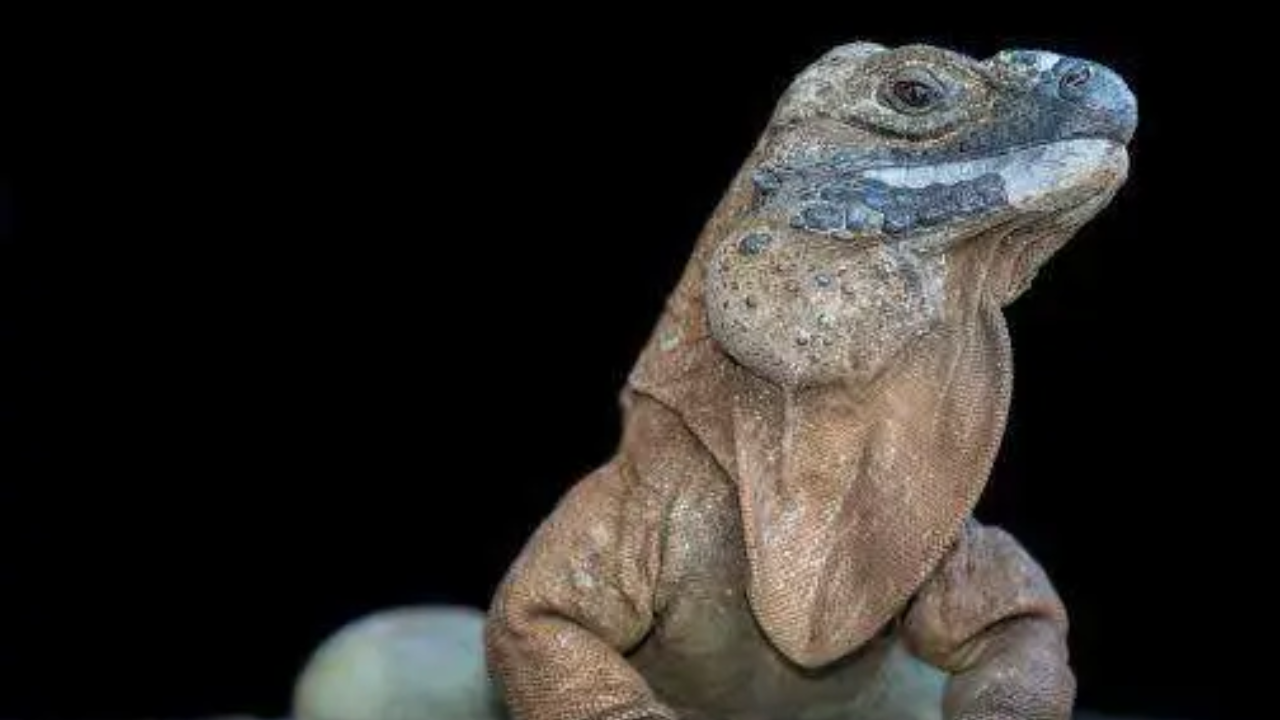
It looked like something stitched together from charcoal and old leather, with a row of thick dorsal spines running down its back like ragged teeth and a heavy, bulbous jowl that made it look perpetually offended. It was battered, bleeding, and impossibly alive. Duffus did not leave it to die in the scrub. He carried it out of the hills and brought it to the Hope Zoo in Kingston.
That single animal—injured, stressed, and entirely unaware of its own celebrity—shattered forty-two years of scientific certainty. Somewhere in the brutal, waterless limestone maze of the Hellshire Hills, a remnant population had held on. Not thriving. Barely breathing. A handful of aging adults hiding in rock crevices while an invisible army hunted their young to zero.
To understand why those iguanas were vanishing, you have to understand what happened to Jamaica in 1872. That year, sugar planters imported nine small Indian mongooses from Calcutta to kill the rats destroying their cane fields. It seemed like simple arithmetic. Predator eats pest; harvest survives.
Except rats are nocturnal, and mongooses hunt by day.
The mongooses ignored the rats and turned their teeth on everything that slept in the sun or nested in the dirt. Ground-nesting birds disappeared. Native snakes vanished. And every spring, when female Jamaican iguanas buried their clutches of eggs in the warm red soil of the Hellshire Hills, the mongooses dug them up and ate them all. For decades, not a single hatchling survived to adulthood. The species was not dying of old age. It was suffering from complete reproductive suffocation—a slow-motion extinction where the elders lingered like ghosts while the future was eaten before it could crack its shell.
Thirty Years of Stubbornness
When biologists hiked back into the Hellshire Hills after Duffus’s discovery, what they found was grim enough to make grown researchers sit on the limestone and stare at their boots. Fewer than a hundred adults remained. Maybe as few as fifty. The entire genetic library of a species found nowhere else on Earth was trapped inside a shrinking pocket of dry forest, surrounded by feral cats, wild pigs, stray dogs, and thousands of mongooses.
Saving them required more than good intentions. It required a thirty-year war of attrition fought in ninety-five-degree heat with hatchling pens, radio transmitters, and sheer human obstinacy.
Consider what that actually looks like on the ground. It is not glamorous documentary filmmaking. It is sweating through your shirt by seven in the morning while hauling buckets of water up jagged limestone ridges. It is sitting motionless in blinding sun for six hours just to watch a female iguana pack dirt over a nest so you can mark the spot before a mongoose smells it.
In 1991, a coalition of researchers from the University of the West Indies, the Hope Zoo, and international partners—including the Fort Worth Zoo and the San Diego Zoo—started doing something desperate. They began collecting newly hatched iguanas straight from the wild nests before the predators could reach them.
They brought those tiny, bright-green hatchlings—no longer than a human hand—back to a dedicated head-start facility at the Hope Zoo.
Think of the head-start program as an ecological witness protection scheme. In the wild, a baby iguana is a bite-sized snack for everything with claws or fangs. At the zoo, behind mesh wire and under the watchful eyes of keepers who know individual lizards by the scars on their scales, those hatchlings grow. They eat native greens and fruit. They bask under the Caribbean sun without looking over their shoulders. They grow for four, five, sometimes six years until they reach roughly two feet in length and carry enough muscle, tail-whip force, and attitude to make a mongoose think twice.
Only then do they go home.
The Weight of Number One Thousand
Three decades later, that quiet, grueling assembly line of survival is approaching a number nobody in 1990 dared to say out loud: the one-thousandth release.
Stop and let that number sit in your mouth for a second. One thousand.
In a world where wildlife news usually reads like an obituary column—another amphibian gone in Panama, another reef bleached in the Pacific, another rhino subspecies reduced to two individuals behind armed guards—one thousand living, breathing, wild-released Jamaican iguanas is an act of defiance.
I remember standing near an enclosure of head-started iguanas years ago, watching a keeper open a transport crate on the edge of the release zone. You expect a triumphant cinematic moment. Music swelling. A noble creature bounding toward freedom.
That is not what happens.
What happens is pure, stubborn reptile suspicion. The iguana freezes at the mouth of the crate. Its nostrils flare, tasting the dry air of a forest it has never seen outside a cage. Its heavy eyelids blink slowly. For two full minutes, nothing moves except the rhythmic pulse of its throat. Then, with a sudden, gravelly scrape of claws against limestone, it bolts ten feet into a tangle of scrub, turns sideways to make itself look twice as wide, and stares back at the humans as if daring them to follow.
No gratitude. No backward glance. Just immediate, fierce ownership of the rock beneath its belly.
That is the real victory. Conservationists do not spend thirty years getting bitten, sunburned, and scratched by limestone thorns so animals will love them. They do it so the animal can forget humans exist.
What a Lizard Actually Holds Together
At this point, a skeptical reader might ask a fair, blunt question. Why spend millions of dollars and thirty years of human lives on a grumpy, herbivorous lizard that most Jamaicans will never see in the wild? The island has pressing human needs—roads, schools, storm resilience, jobs. Why does Cyclura collei matter?
Because an island ecosystem is not a museum display where you can remove one statue and leave the room intact. It is an engine, and the Jamaican iguana is one of its primary pistons.
In the tropical dry forest of the Hellshire Hills—one of the rarest and most threatened forest types on the planet—large herbivores are scarce. Deer do not roam there. Monkeys do not swing through the canopy. For millions of years, the Jamaican iguana was the largest native land vertebrate on the island, the heavy-duty gardener of the limestone scrub.
When an iguana eats the fruit of native trees and shrubs, those seeds pass through its digestive tract, stripped of their outer pulp and scarified by stomach acid, before being deposited miles away in fertile little packets of fertilizer. Studies on Caribbean rock iguanas have shown that seeds passed through an iguana’s gut germinate faster and at higher rates than seeds that simply drop to the forest floor.
Without the iguana, the forest stops replanting itself properly. Certain native trees lose their primary courier. As those trees thin out, the shade shifts, the soil dries faster, the insects that depend on those leaves decline, and the migratory birds that stop in Hellshire to fatten up on insects before crossing the Caribbean Sea find an empty pantry.
Pull the iguana out of the Hellshire Hills, and you do not just lose a lizard. You slowly unravel the entire coastal forest—the very buffer that absorbs storm surge, anchors thin limestone soil against hurricane rains, and keeps the southern coastline from turning into eroded dust.
The Invisible War That Never Stops
Here is the part where a conventional success story would roll the credits, declare victory, and move on.
That would be a lie.
Approaching the thousandth release is a staggering milestone, especially when you consider that the wild population has rebounded more than sixfold since the dark days of the 1990s, with wild females once again nesting in the red dirt on their own. Researchers now find wild-born juveniles—the grandchildren of those early head-start releases—basking on rocks without a single radio tag or pit-chip anywhere near them.
Yet the Hellshire Hills remain a knife-edge paradise.
The mongooses have not left. Feral cats still slip through the brush at dusk. Every single week, conservation teams walk miles of trap lines, rebaiting and clearing invasive predators just to keep the pressure low enough for young iguanas to survive. The moment that trap line stops, the clock starts ticking backward again.
Worse still is the threat coming from outside the fence lines. Kingston is growing, hungry for land, housing, and infrastructure. Illegal charcoal burning still eats away at the edges of the dry forest, turning centuries-old hardwood trees into sacks of cooking fuel sold along the roadside for a few dollars. Plans for coastal development, port expansions, and access roads constantly circle the perimeter of the protected area like sharks testing a reef.
You can raise a thousand iguanas in captivity. You can teach them to forage, watch them mate, and celebrate every clutch of eggs that hatches under the red soil. None of it means a damn thing if the forest itself gets bulldozed for a highway or burned down for charcoal.
A Different Kind of Inheritance
I think often about Edwin Duffus walking out of those hills in 1990 with a bleeding lizard in his arms. He had no grant funding. No doctorate. No five-year strategic recovery plan. He simply saw something rare in the jaws of his dogs and decided it deserved a chance to live.
Most environmental stories drown us in grief until we go numb. We hear about tipping points and parts per million and collapsing fisheries until despair feels like the only rational response. Despair is easy. Despair lets you off the hook because if everything is doomed anyway, you do not have to haul water up a limestone hill in ninety-five-degree heat.
The Jamaican iguana offers no room for that kind of comfortable surrender.
Its survival is proof that extinction is not always a one-way door—provided enough stubborn human beings refuse to walk away from the threshold. For thirty years, Jamaican field technicians, zoo keepers, university students, and international biologists have chosen the hard, unglamorous work of keeping a promise to a creature that hisses when they approach.
Somewhere in the Hellshire Hills right now, the thousandth iguana is probably sitting inside a mesh enclosure at the Hope Zoo, tearing into a pile of hibiscus leaves and wild greens, growing thicker by the week. It knows nothing about 1948. It knows nothing about Edwin Duffus, or predator trap lines, or zoning battles in Kingston.
All it knows is the sun on its spines, the strength building in its tail, and the quiet, ancient pull toward the limestone rocks waiting just beyond the city edge.


