The morning of December 7, 1941, did not smell like glory. It smelled like thick, black bunker oil, scorched paint, and the sharp, coppery tang of panic.
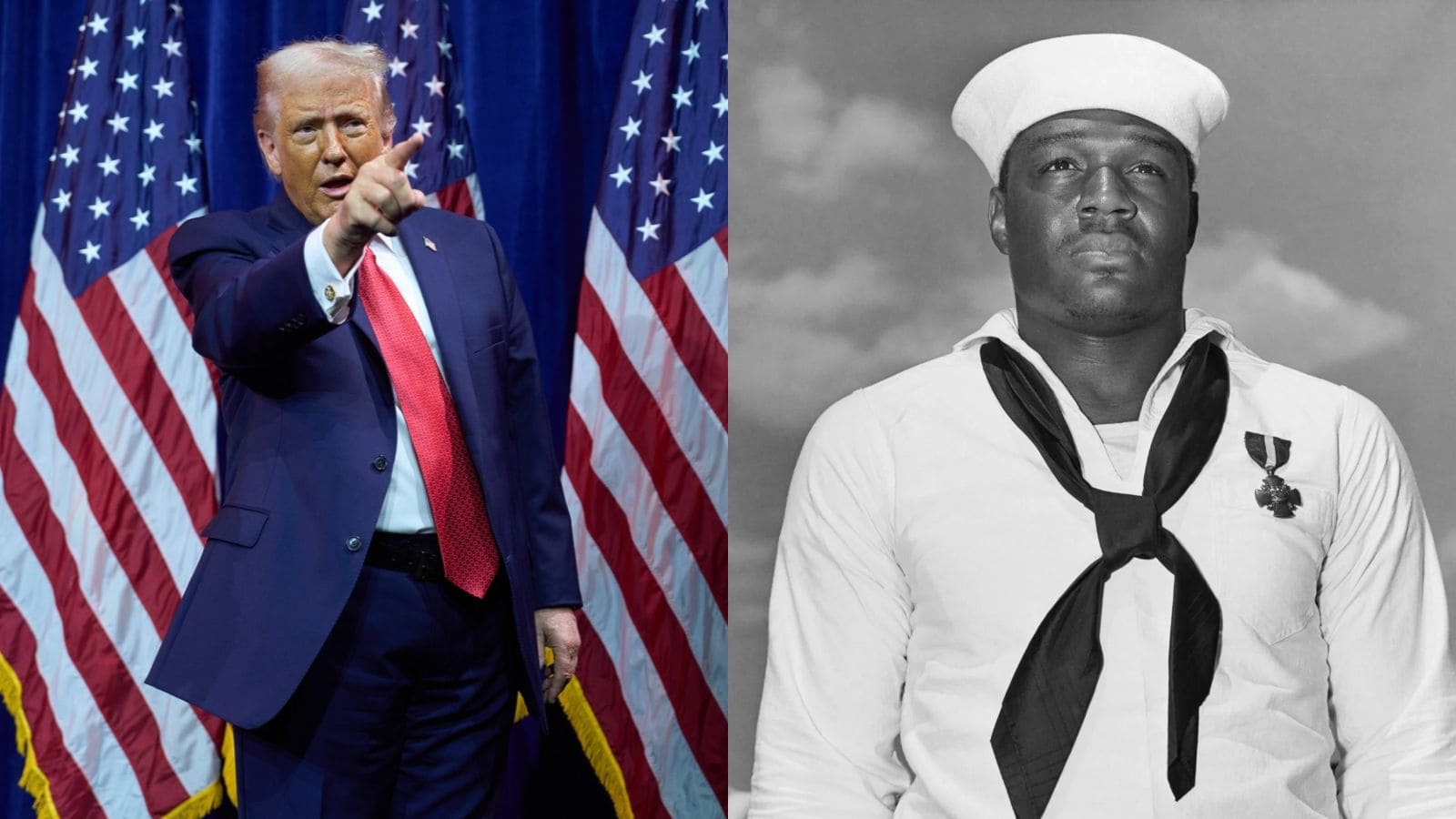
Down in the laundry room of the USS West Virginia, a young mess attendant named Doris Miller was just starting his day. He was a sharecropper’s son from Waco, Texas, a giant of a man with broad shoulders who boxed in his spare time. But in the segregated Navy of that era, his official job title meant he was restricted to hauling linen, shining shoes, and serving meals to men who would not sit beside him in peacetime.
Then came the roar of falling bombs.
Within minutes, the West Virginia was taking a fatal pounding from Japanese torpedoes. Assigned battle stations were obliterated. Miller did not hesitate. He rushed topside, navigating a splintered labyrinth of fire and smoke to find his mortally wounded captain, Mervyn Bennion, bleeding out on the bridge. Miller hauled him out of the line of immediate danger. When the air grew thick with strafing Zeros, Miller did something extraordinary. He sat down behind a Browning .50-caliber anti-aircraft machine gun.
He had never touched one before. The Navy had not trained Black sailors to fire weapons.
It did not matter. He gripped the handles, aimed at the sky, and fired until the ammunition trays ran dry. For his raw, desperate valor, he became the first African American to be awarded the Navy Cross, earning a permanent place in the pantheon of American resilience.
Decades later, the United States Navy made a promise. In a rare break from honoring politicians and admirals, naval leadership announced that a massive, nuclear-powered Ford-class aircraft carrier—hull number CVN-81—would bear his name. For the first time, an enlisted sailor, a Black hero from the bowels of a sinking battleship, would grace the prow of the fleet's most powerful floating fortress. Families of shipbuilders and descendants of Miller gathered to sign their names onto the initial steel plate. The steel remembered.
Until recently.
Reports surfaced that the Navy has quietly stopped using the name USS Doris Miller in internal communications, referring to the vessel strictly by its sterile hull number, CVN-81. Behind closed doors, discussions have turned to scrubbing the sailor's name entirely to christen the ship after a living politician: Donald Trump.
Consider what happens next.
If finalized, it would shatter a foundational American military tradition. No aircraft carrier in the history of the United States has ever been named after a sitting president. Presidents have their libraries, their highways, and their foundations. Warships, by long-standing custom, belong to the nation's historical memory—to the ideals fought for by ordinary people who found themselves caught in extraordinary nightmares.
The shift is not merely alphabetical. It is gravitational.
To trade the name of Doris Miller for the name of a modern political figure is to rewrite the physical manifestation of sacrifice. It sends a chilling message to the sailors currently standing watch in the rusting corners of the fleet: that history can be rewritten, that the quiet grit of an unranked cook can be brushed aside for the loud branding of contemporary power.
There is an irony written into the steel, too. While debates swirl over the ship's name, structural changes ordered by the administration have pushed to retrofit the modern carrier with older, steam-powered catapult systems, a move naval analysts warn will cost billions of dollars, delay the ship's arrival into the late 2030s, and strain an already exhausted naval force.
A ship delayed. A name erased. A legacy shuffled off to a lesser vessel as a consolation prize.
Down in Waco, the family of Doris Miller waits. They spent decades petitioning to have his Navy Cross upgraded to a Medal of Honor—an upgrade the Navy is now reportedly recommending alongside plans to find another minor ship to bear his name. But a smaller hull is not a Ford-class carrier. A footnote is not a centerpiece.
Names matter because they tell us who we think we are. They are anchors we throw into the future so we do not forget where the storm hit us.
When the steel is finally cut and the ship takes its eventual shape, it will carry something heavier than aviation fuel or titanium armor. It will carry the weight of our choices. The hull will either slice through the dark bearing the name of a man who looked into the burning sky at Pearl Harbor and fired back into the unknown, or it will bear the fleeting signature of the present.
The ocean is deep. The water remembers everything.